On Martin Luther King day I got to take a new ride out for a spin.This ‘ride’ was not like many you find in the lower 48! It had 16 legs and accelerated like a drag racer; when the dogs at Black Spruce Dog Sledding take off they do so with gusto! Check out the video below for an excerpt of an afternoon of mushing!
This actually wasn’t my first dog-sledding rodeo, but it was 11 years ago that I was on a on a dog sled. Some things I remembered well. For instance, I remembered the excitement! As you stand on the rear of the sled and the dogs are baying and pulling against the gangline the feeling of thrill builds! When the quick release (a rope and pin tied to a non-moving object) is pulled the team takes off like a race car. Rule #1 is to hold on! From the kennels we headed out with our tag-sled team for a 13 mile loop. The dogs settled into a rhythm of about 7 mph on the uphills and ~10 mph on the flats. That is the pace that Jeff tries for when racing his dogs for mid-distance (300 mile) and longer races (1000 mile Yukon Quest or 2000 mile Iditarod). The constant pace of the run is essential for the dogs, they perform the best by establishing that pace.
On this particular trail it’s not long before the beginner’s baptism-by-fire comes into a view. A 90 degree turn after a road crossing was looming and my senses were keen as I considered how to navigate the obstacle. Jeff coached me by telling me to lean into the turn and try to stand on one ski while peddling one foot on the outside of the turn. He deftly performed the lesson he gave to me and I deftly tipped the sled into the snow bank! “I’m Down!” was all I had to call before Jeff had put on the break and I righted myself. Rule #2 – hold on during a fall! Fortunately, it was the only time I dumped the sled on our tag-sled tour. However, that doesn’t mean other section did not feel harrowing! On steeper down hills it was critical to keep plenty of weight on the drag to slow the sled and the team down. Zipping between black spruce trees we hurtled over snow drifts, wound through tight corridors, and leaned around turns. It’s amazing to me how mentally active you have to be when riding with a dog team in those conditions! Anticipating the turn or terrain ahead was essential to placing my weight correctly in the sled. Being centered, on the left ski, or the right ski changed how well I coped with the turns and the terrain.
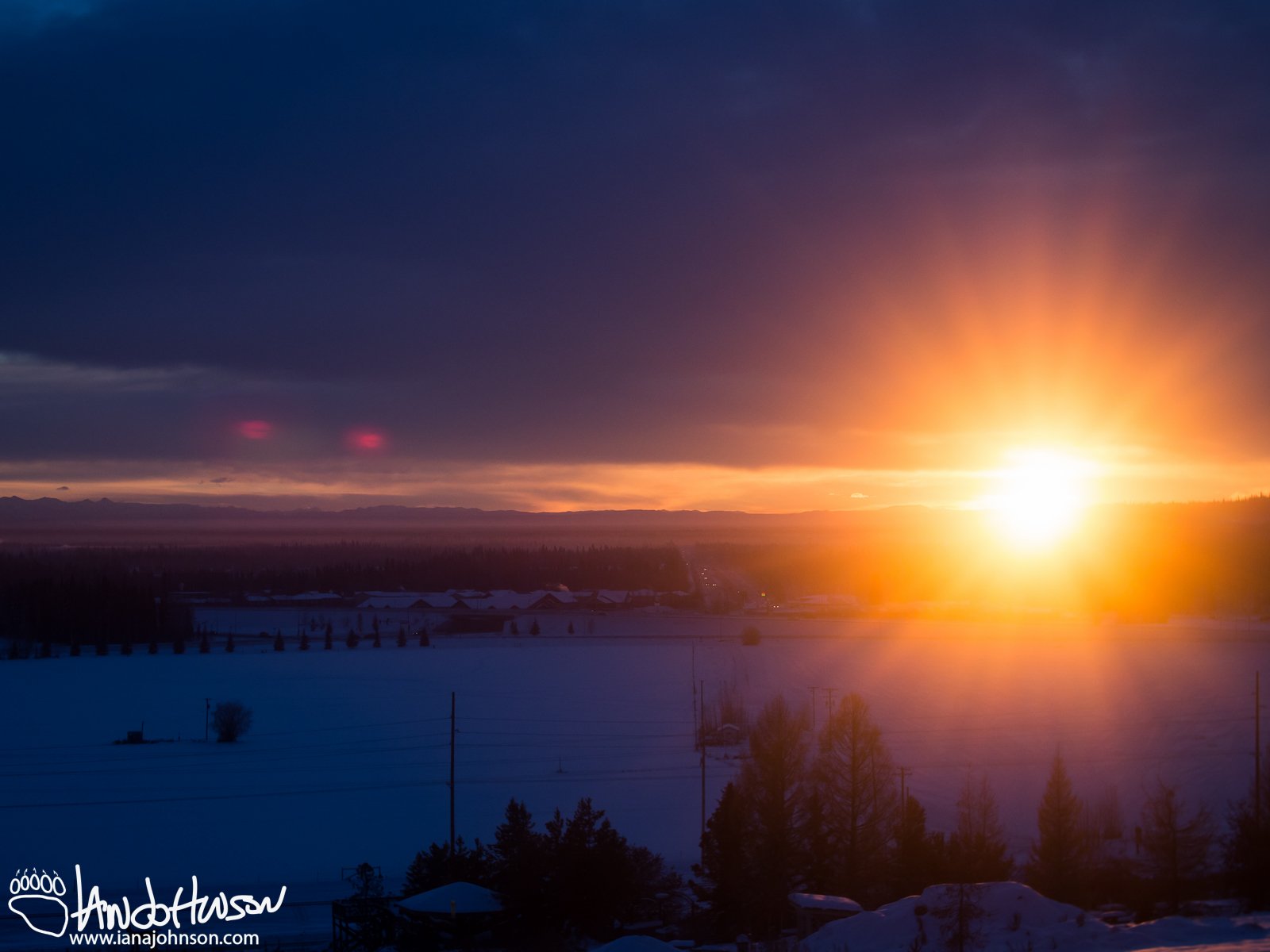
I think it took me about five miles to start to feel comfortable in the sled. I no longer felt that I was going to tip at each turn and I began to feel my body relax. The smile which had not left my face since take off was still glued on. The joy of running with the dogs is infectious and the beauty of the scenery was unforgettable. During the night and morning a heavy ice fog had built up scales of hoar frost on the trees. The encapsulated trees glinted in the sun that burned through the fog bank. We concluded our 13 mile tag sled run (2 sleds pulled by a larger team), and then I took my own 4 dog team out for a short, local loop. It was great to test my skills with my own (albeit smaller, but more manageable) team! By the time I left that day the sun, now low in the sky, ricocheted through the gem-encrusted limbs in an orange light ending a truly great day!
At the kennels the Gray Jay is a food thief. All food containers have to stay closed to keep these marauders out!We stopped to tell some jokes along the trail – I guess Inferno thought they were pretty doggone funny! 🙂 In reality though, each time we stopped the dogs LOVE to dive through the powder that their ganglines allow. Here, the dog “Inferno” is enjoying a roll in the snow.Take a break – but ready to run!My team of 4 is taking a quick breather – but they’re ready to keep running!The sun breaks on the hillside behind black spruce encrusted in hoar frost.The hoar frost built an intricate lattice of ice on each needle of this black spruce. Quite pretty!Hoar Frost builds up up on a black spruce limb. Look at the size of those crystals!A shrub with a heavy layer of hoar frost was illuminated by the setting sun.A frosty beard after the 13mile tag-sled run!
When I was home for Christmas break one of the questions I got asked fairly regularly was “what’s it like to live in Alaska in the winter?”. I always grin, which seems to be what people expect because they grin back, but I think I disappoint them by explaining that a lot of times the winter conditions are not as desperate as you think. Yes, 40 below is cold, but in Fairbanks the wind rarely blows making the cold very tolerable. 20-25% humidity ensures that it is a ‘dry cold’ (think of someone from Arizona explaining the dry heat). In the eyes of many, the hardest thing to adapt to is the short days in the winter. Although we are gaining length now, the dark days at bottom of winter make getting out of bed hard and sleeping easy. In Alaskan winters I celebrate and cherish the sun because I miss it! The darkness lately has been compounded by cloudy skies, so when the sun was out this morning I knew I wanted to be outside for it as much as possible! I gathered together my gear for setting burbot lines (more on that soon!!) and headed to the Tanana river. But, my trip to the river certainly was not linear, all along the way I found things to swing my camera lens at in that beautiful sunshine. So, today I give you a snap shot of January 17th in Alaska, a beautiful day! Photos are time-stamped and in order of occurrence. Hopefully you’ll see that not all winter days are so bad in Alaska!
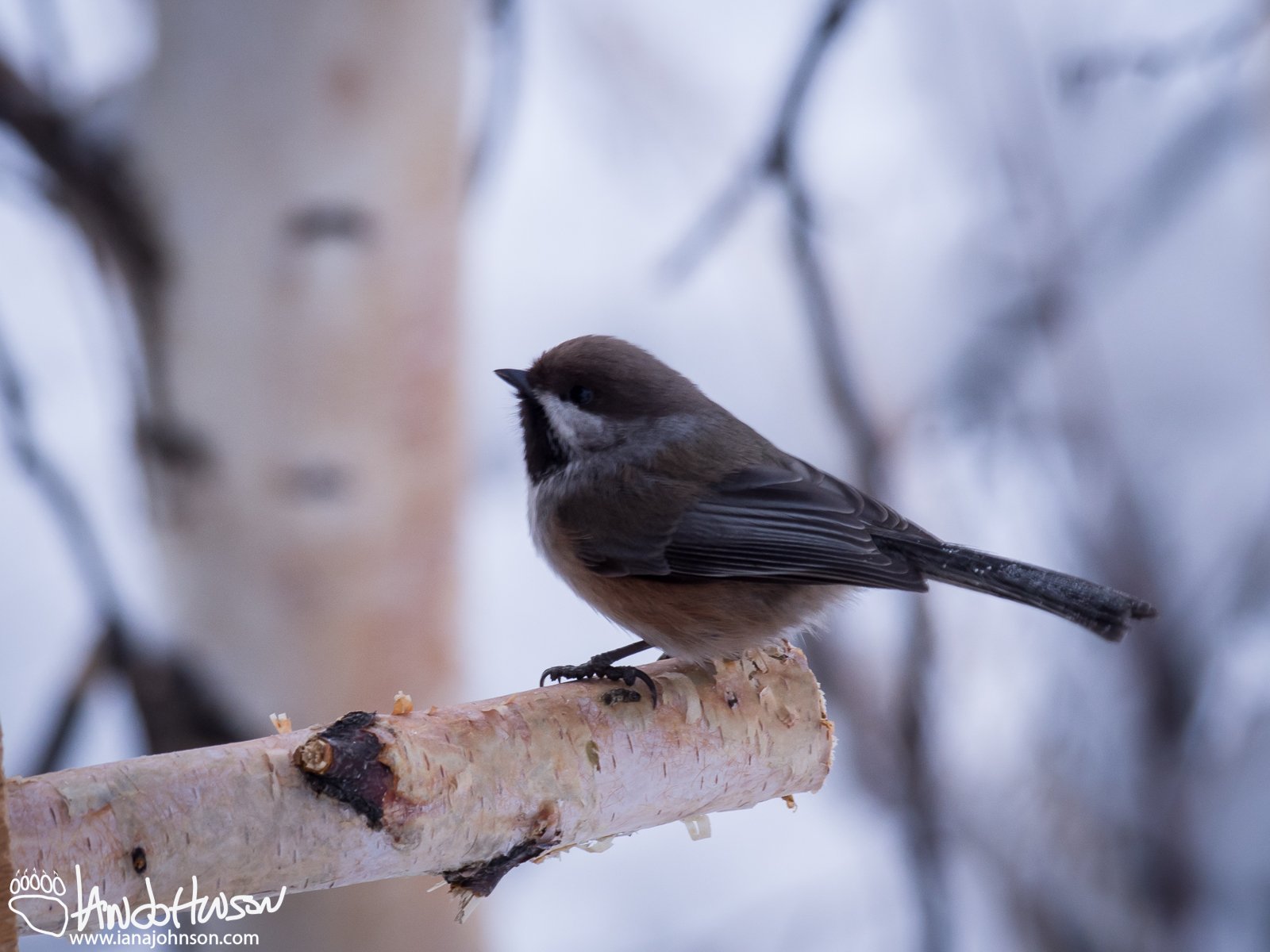
11:37 AM : A boreal chickadee poses for a cute picture just outside of my house11:37 AM : A boreal chickadee looks before it leaps and is eyeing up some suet.11:39 AM : Red-backed voles are a common Alaskan rodent. I have counted up to eight at a time under my feeders scavenging what they can find. Red-backed voles have actually been demonstrated to spend a large portion of their days in black spruces which is a recently documented behavior!11:43 AM : A sharp tailed grouse sits under the spruces. This seems to be a pretty normal winter behavior – move as little as possible to conserve energy.12:06 PM : The sharp-tailed grouse is actually a pretty small bird. Tucked up high in the spruces it is safe from almost any predator present in the Alaskan winter. Most raptors have migrated for the season, although a lingering great-horned owl could get bold and try for this big meal!12:06 PM : Sharp-tailed grouse moved to the birches to pick at the catkins2:18 PM : I spent the afternoon drilling through the Tanana River to set burbot lines. The ice was thick! About 36 inches. However, early in the season the river broke up and formed “jumbled ice”. The shadows of small snow-dunes indicate a rough texture underneath!4:29 PM : As I got back into town the Alaska Range (South of Fairbanks) was lit up by the low sun. The mountain range is always beautiful, but on nights like this you cannot stop watching! The pinks and purples of this sunset were amazing! This is easily my favorite panorama to date because it is a view I get to enjoy everyday, and this picture captures it well!4:32 PM : The sun is almost ready to disappear. We’ve gained an amazing amount of time back since December 21st when the day length was 3.5 hours. Today’s day length is just over 5 hours!
This recycled bird feeder is made from palates and window-screen for the base. The post is a 4×4 found along the highway, and the joists for the roof are from a wooden futon frame found at the dump. The roof is the remainder of the palate. It’s wonderful – and the birds love it!
It seems I have inherited a family legacy. Why? Well, outside of my window as I type this a red squirrel, whose fat rolls are bulged to the size of small golf balls under its elbows, is eating my birdseed and I am choosing to do nothing about it. Many chipmunks and squirrels were spared from my arrows and bullets because they were decreed ‘off-limits’ by my dad although they were destroyers of gardens and wasters of seeds. Bird feeder construction attests to the cumulative frustration of birders everywhere watching their money being vacuumed up by greedy rodents. Undoubtedly, if I were to figure out how many pounds of bird seed the family of squirrels living in my brush pile were responsible for chomping down at my buffet line, I would find that my 40 pound bags would last indefinitely longer. In the back of my mind, I know the squirrels are any easy target for my stew pot, but I never seriously consider harvesting them around the house because the feeder is a sacred place. Besides, it hardly seems sporting to shoot a happy squirrel on top of his seed supply.
A winged candidate for dinner has also taken up residence under the feeder and watches me from the surrounding birches or from the hoops of my fallow garden each day that I walk by. Like the mind of the Wiley Coyote, that sharp-tailed grouse has transformed into drumstick in front of my eyes several times. But, seeing as I have not even thrown a rock at it, it has become fairly accepting of pedestrian traffic. I think anyone that has a bird feeder can give nod to the benefit of these wildlife for watching far outweigh their worth in their pan.
My feeder has been a great source of entertainment, and has also given me insight into natural bird foraging behavior. The birds interact with the Alaskan Birch and my feeder. During the last couple of days I have come to appreciate the importance of the catkins of the Alaska Birch as a food source. Both the pine grosbeaks and black-capped chickadees have been taking mouthfuls of them. Seems like pretty meager forage to me!
A pine grosbeak takes a mouthful of of Alaskan Birch catkins. It seems to be a very important forage for them.A pine grosbeak male shows off his beauty in the birches.The rusty-orange of the female pine grosbeak makes them very easy to discern from the males. A very beautiful bird!A pine grosbeak perches among it dinner – Alaska Birch catkins.One of the best-known feeder birds there is rarely less than 12 chickadees cracking seeds in the birches around the feeder. They are a constant source of entertainment. However, the black-caps also take large mouthfuls of catkin seeds for forage.
Spending time watching wildlife in your backyard is rewarding! Observing this sharp-tailed grouse nearly every day for the last two weeks has been a privilege, and I’ve learned a lot. For instance, they do not move far, and this one roosts in the same trees near the house every night. During the day it spends most of the time on the ground and does not move farther than about 30 yards. Although sharp-tailed grouse are not traditionally common in the Fairbanks region, they seem well adapted to the cold and can puff their bodies up to large sizes much like chickadees, jays, and other boreal species.
This sharp-tailed grouse was photographed the day before Thanksgiving bursting from its resting spot near the Sustainable Village at the University of Alaska Fairbanks.A BIIIIIGGGG stretch in the morning for this sharp-tailed grouse.This ‘sharpie’ is making sure it stays warm by puffing up in the cold temps.
I will leave you with a ‘feeder first’ which occurred just two days ago. A northern shrike came and perched outside of my window. It was near dark, but the chickadees started squawking and kept their distance from the carnivorous bird. I must say, I was rooting for this bird to whack a chickadee, just to see it first-hand! Shrikes are actually songbirds, and are known as “butcher birds” because they cache food by impaling it on sticks or anything sharp. They eat rodents, small birds, and insects (in the summer). Ordinarily they are found in habitats with tall trees where they perch and survey the area. It was very rare to see one in a closed spruce and birch habitat, and especially at this time of year in Fairbanks! Due to the time of day (we are down to 5 hours of light), I wasn’t able capture to an incredible shot of the bird, but here’s what I have. It shows very clearly the curved beak for tearing meat, a feature you would normally attribute to being a raptor.
A northern shrike came in to pester my birds the other just yesterday! I must admit, I was rooting for him to take down a chickadee! This was the first time for this species at my feeder. Nicknamed “butcher birds” northern shrikes are actually carnivorous song birds!
What does it mean to have a “long day” of fly fishing? The old adage says : a bad day of fishing is better than a good day in the office. Agreed. However, by the end of our sunny, late April day at the Magalloway River of northern Maine, my friend Kevin Shea and I were doubting that any of the trophy 22″ brook trout we were seeking could ever be caught in a river renowned for them. The brookies were not intrigued by our fly fishing techniques of finessing nymphs or stripping streamers, and drift after drift our lines stayed slack. After hours of the torturous work of standing in the water to fish (sensing the irony?), I turned my eyes to a soft spot on the bank and took a seat. The sun shown overhead, and in my memory not a cloud could be seen in the sky. At least that explained the poor fishing – they never bite on the nice days! The Magalloway River flowed in front of me, and several fisherman were down the bank from me about 25 yards still dredging the rocky bottom with their #18 beadheads.
It was the movement that caught my eye. A bird had flown near my left shoulder and disappeared. Turning my full attention to the area I watched a black-capped chickadee emerge from the end of a rotten alder log and fly off with a face full of sawdust. As it flew off, another of the gregarious birds quickly flew in to take the first’s place in the hollowed log, and seconds later reappeared with a mouthful of sawdust. The bird flew to the nearest branch and pulled apart the sawdust, apparently looking for some type insect or larvae. In its place a train of birds flew into the hollow log and then back out creating a constant stream of entertainment for a curious human.
The fearlessness of chickadees makes them a favorite bird of children and adults alike and is part of the reason chickadees are one of the best-known birds of North American feeders. [As a side note, these tiny birds are able to survive brutal winter (e.g. -40 F in Fairbanks, AK) temperatures by dropping their body temperature as much as 12-15 degrees below their average body temp every night, conserving as much as 25% or their body energy!] However, even though I had seen their antics many times at a bird feeder, this was the first time I had seen them so voraciously ripping apart wild fodder. It was addicting to watch the organized flow of black-caps eagerly looking towards their next meal!
Their consistent pattern of entering the log, and emerging a few seconds later gave me enough time to snag my camera and take some shots. The shots I captured sealed the moment in time and memory of these great birds for me, which is what I offer you today!
This successful black-capped chickadee is headed to shred some sawdust in hopes of a quick meal.A black-capped chickadee shows off an impressive mouthful of sawdust and food! (?)A black-capped chickadee waits it turn as a fellow member of the species root for some grub in the hollow alder log.Full spread! A black-capped chickadee takes flight after digging out some pay-dirt from the log.
So, the old adage is right. However, arguably based on my day, a bad day of fishing is worse than a good bout of bird watching! The images, antics, and thoughts of these birds have stuck with me for the last 18 months. There’s always something to watch in nature, even if the fishing isn’t good!
Kevin works on slinging a cast to the far bank of a pool. A beautiful day to catch no fish!Posing for a picture Circa April 28, 2013 while fishing the Magalloway
For those of you who haven’t read through one of my ‘photographic reflections’ before they are entries from pictures I took before the blog started, but have a story. This one took place in 2013, I hope you enjoyed! I will leave you with this short clip of the Chickadees using the alder-log bonanza
When the sandhill cranes arrive in the fall in Fairbanks, Alaska it is a marker of the passing of a season. It means fall is beginning, and the birds that have nested on the tundra for the summer are shipping out to warmer latitudes. If you have ever head the raucous call of the sandhill, you’ll know their presence is trumpeted for miles, and that it is unmistakable for any other sound!
Sandhill cranes are a beautiful, elegant, and striking bird. Look at that red crest and orange eye!
Of the 15 crane species in the world, sandhill cranes are the only ones which are not endangered or threatened in some way (Creamers Field Billboard). Across their global range, cranes were threatened by habitat loss and market hunting. In the early 20th century market hunters nearly exterminated whooping cranes. Their numbers dropped as low as 23 individuals in the 1940s, but thanks to the International Crane Foundation and the work of many other agencies, numbers hover around 600 currently.
Low sunlight put this crane in a mosaic of shadows.
Sandhill cranes are actually omnivores and spend their days eating grains, seeds, insects and small rodents. In fact, in larger concentrations of cranes I believe they can temporarily clear a field of pesky, small rodents. Of course that’s just me being an optimist. Sandhills can have long migrations and breed on the tundra of Canada and Alaska, but can also be found in breeding populations in the western United States (All About Birds.org)
A sandhill crane caught in the golden glow of low sunlight at Creamer’s Field, Fairbanks, AlaskaWhen flying the legs of the crane stick straight out behind them, pretty impressive if you think about it!It seems that the pastures are always greener for the sandhill somewhere. It was very normal for them to transfer feeding locations or swap groups.
Each fall hundreds of cranes pass through Creamers Field National Waterfowl Refuge . The fields and water sources there bring in many ducks, geese (snow, white-fronted, canada, cackling) and of course the Sandhill Cranes. In fact, it’s such an event that each year the Sandhill Crane Festival brings in hundreds of visitors. The cranes are fascinating to watch and the power of any large migration event such of this can be overwhelming!
A sandhill settles in among the group.
When observing the cranes there’s a lot of things to notice, and a lot of questions to answer. The cranes with chicks still maintain their family groups, and chicks may stay with the parents for up to 10 months! Also, the cranes seem to be very territorial and are always squabbling with each other. They may point their beaks straight into the area and verbally duel each other, or hop towards each other beating their wings either to intimidate or strike. I don’t know why, in an area with such plentifiul food, they are so territorial! I guess they’re a cantankerous species. If you are lucky enough to see a courting crane pair they may ‘dance’ with each other trying to win a mate.
The young-of-the-year are a noticeable shade of orange which separates them from the parents.Even though the migration is ‘on’ the young of the year still hang in family groups and learn (I presume) from their parents.
This fall I spent a lot of evenings enjoying the cranes. There is always new behavior to watch, and the roads which bisect and border the fields at Creamer’s Field offer first class seats to watch and listen. Here’s a montage of some crane behavior including the magnitude of their call, the family groups, grooming, feeding, and defending territories. The cranes departed in Mid-September along with most of their avian comrades, but I certainly will look forward to their return!
This post is a celebration of the beauty and invigoration fresh snow, and early winter days when a cold nose is not a drudgery. Instead, a rosy tip is acknowledged as punctuation to an exciting time as the season changes. During the early days of winter, fall has not quite relinquished its beauty. Animals and humans alike are fat-and-happy.
Setting the poetry and light thesis statement aside, to all who read this, beware! Winter is here in Alaska, and for my friends in the lower 48, it seems it will descend upon you in short order! On Thursday a friend and I left for the North Slope for some caribou hunting (Note : I can’t leave that story open ended. I was archery hunting, and was a mere 3 seconds from success on two occasions but did not have the chance to deliver the coup de gras on some keen caribou.) The trip over the Brooks Range was marred by sloppy roads and rain. My truck was caked in thick mud which was slippery to walk on, not to mention drive on. Fast forward 60 hours, and the trip south revealed 8 inches of snow 80 miles north of Fairbanks which had fallen in our absence. What a change, and so quickly! It is likely that winter is here to stay, temperatures are staying around freezing during the day and dipping to the lower teens at night.
The snow did bring some incredible beauty as only a first snow can. Rivers were still flowing, and the bending branches of snow-laden spruce leaned into river channels along the Dalton. On Wickersham Dome ghost-trees already heavy with their first layer of hoar frost for the year kept silent sentry.
This black-and-white photo captures the flowing stream and the contrast of fresh snow to the water.The river just south of Chandlar Shelf was open and flowing, but probably not for long. Ice shelves covered a lot the river.A slowly flowing streams meanders past snow-covered banks. So beautiful!Some lingering dwarf birch leaves are ringed in hoar frost on Wickersham Dome.Snow-covered spruces on Wickersham Dome
I did observe a very novel phenomenon – I would love to hear if anyone has witnessed this before! Behold, the snowbow. On our drive home we were met by gray skies and the hills were wreathed in falling snow. However, at the end of the Dalton Highway the sun broke and the landscape was lit as far as the eye could see. A snow cloud hanging low to the north of us caught the rays and formed a snowbow. I have seen many sundogs, but had never seen a rainbow caused by snow crystals.
Here’s a new phenomenon – the snowbow! Although the colors were not as vibrant as a rainbow it was still beautiful. Has anyone else had the chance to see this before??A full snowbow! The sun broke through at just the right time to create this stunning landscape. Pretty cool!
I will leave you with this northern hawk owl which was a great bird to see along the way. These birds are known for their boreal habits. They spend the days on spruces watching for rodents and can be hard to spot. This was my first time seeing this bird, although they do occur in Minnesota in the winters during owl irruptions (i.e. owls heading further south than their ‘normal’ range due to environmental or food conditions). The clip below is a short one of a hawk owl behavior, cleaning.
This northern hawk owl was a real treat as we headed south. They are boreal forest feeders which migrate south in the winters. They are known for hunting during the day by perching on the tops of spruces looking for rodents. This black-and-white photo captures the snowy landscape of a hunting hawk owl.
First off, Thanks to all who contributed to the new watermark. Your input and voting helped a lot, and I was overwhelmed by the response. It was really great!
If this post had a theme, and I guess it does since I’m suggesting it, the theme would be that there’s always a “silver lining” or “blessings in disguise”.
When Aaron and I began our bike tour on the Denali Park Road our eagerness was tangible. Even the first big hill after Savage River could not dampen it. However, the next few long climbs put out some of our internal fires. While we are talking about hills, if you do go to Denali National Park remember, it is known for it’s mountains and one of them, who’s name literally means “The Great One”, is the tallest in North America. Gradients are often 5-9% and can extend for 2 or 3 miles. Getting over or around these stone giants is the name of the game.
The video here does a great job of capturing the incredible wildlife (bears, sheep, ptarmigan, wolves) as well as the joy of riding down a big hill and some of the scenery. For context on the video make sure to read the rest of the post 😉
The first night we peddled into the Sanctuary River Campground which was is located at mile twenty-three. We got a a late start, so when we arrived at camp around 8:30 PM it was time for bed. The next morning’s sky looked promising. Blue sky overhead was allowing the rising sun to illuminate the fall colors. Autumn in Denali NP was in full bloom. White-barked aspens were fluorescent yellow and stubby, dwarf shrubs were dark red. Willows along the banks were a mellow yellow and the bowl of mountains provided a stark, snow-covered backdrop.
Fallen colors in a small creek near Igloo Campground
A shot of yellow.
Mountain and fall splendor!
The flourescent colors of these aspen and red of the aging fireweed were stunning!
An incredible patchwork of reds and yellow in Denali National Park!
A willow ptarmigan surrounded by saturated fall colors.
As we pushed our gear up the road to Igloo Campground the curtains were pulled and the sky when flat gray. It stayed that way for the grueling climb over Sable Pass where we encountered a few inches of snow on the ground, but a clear road. The sky remained gray for our joyride down the back of Sable Pass. By the time we had reached the Polychrome Mountain Overlook rain seemed imminent. The Polychrome Mountains are known for their red-streaked banding which resulted from old volcanic activity. However, on Saturday we could barely make them out, and shifty fog was hanging in the valley and around the toes of the mountains.
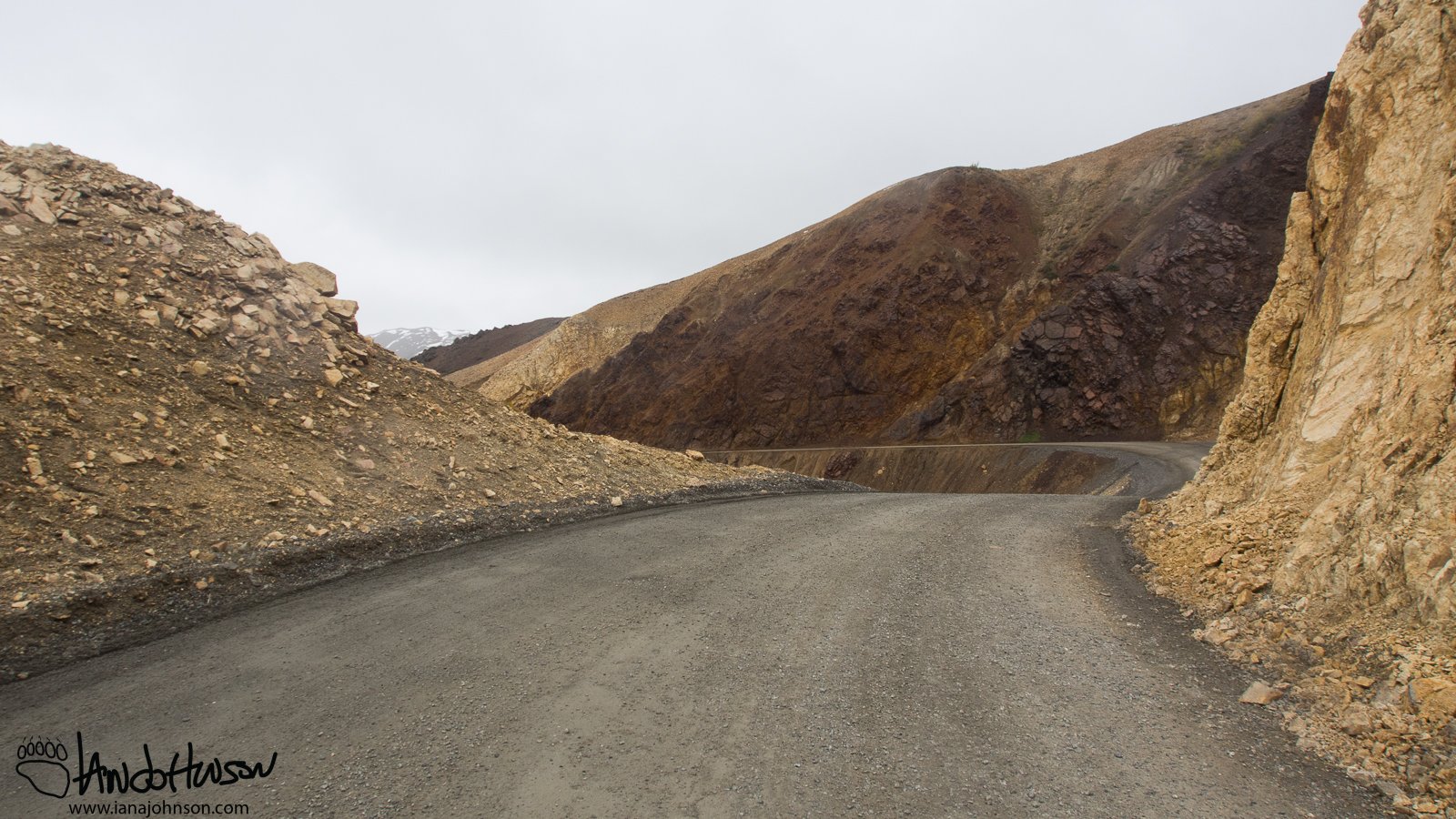
The Denali Park Road as it heads up Polychrome Pass. The reds in the rock are a result of volcanic activity and were sculpted by glaciers.
At the bottom of Polychrome pass, approximately 43 miles into the park disaster hit. The bike that Aaron was using broke down when the spokes in the rear wheel loosened up. We knew we could grab a bus at anytime, but before hanging our hat on that fate pushed our bikes the 2 miles to the top of Sable Pass. We reached the top and a few minutes later a bus trundled up. The bus driver opened up the door and told us the great news – there were two wolves headed up the pass and would be there in just 90 seconds!! I grabbed my gear, set up, and just a few seconds later encountered my first wolves of Alaska when they popped up 50 yards away. One was a collared animal which I assume is female and was traveling with one of her offspring. Both of the wolves seemed a bit thin. Lately wolf numbers in the park have been way down for unknown reasons, so since approximately 25% of visitors see wolves I was ecstatic to be so close! The encounter lasted for less than 45 seconds before they moved on and were never seen again. It is amazing to think that if Aaron’s bike had not broken down and if we chose to take the bus right away that we never would have had this incredible encounter. What an experience! That’s my silver lining story!
A collared Denali Wolf at the top of Sable Pass. What a treat!!This juvenile wolf was traveling with the collared wolf. Who knows how many were still in the brush. This wolf seems a bit thin, hopefully he bulks up before winter for his sake!
After the wolf Aaron caught a bus back to Igloo campground and I biked through the snow and rain to the bottom. As night fell the sun broke through the clouds and lit the mountains up in coral pink. We were optimistic for great weather on Sunday!
Just as the sun set it lit the sky up in an ever-intensifying pink. The snow capped mountains and sky all the incredible shade of color.
The next morning Aaron got an adrenaline rush right-off-the-bat when he encountered a mature brown bear at the food lockers. The bear did not hang around long, but since Aaron was carrying food to the locker when he came up to it, the experience was pretty electrifying! Without bikes we decided to hike up one of the snow clear summit of Igloo Mountain. We climbed from about 1200 feet and were greeted by sheep, snow covered peaks, a piping arctic ground squirrel and blue skies. Our journey was almost done as we pushed our bikes to Teklanika River where a bear came to the rivers edge to strip berries and flip rocks for insects. We exited the rest of the park on motorized wheels. Trip accomplished with a final count of three grizzly bears, two wolves, loads of sheep, and buckets of memories!
I guess this is Bear Ass picture. This big brown bear appeared in camp on Sunday morning. After very briefly checking the food lockers he forded Igloo Creek and headed to the bridge and down the road.This grizzly came out and stripped berries and flipped rocks along the river.
This post follows Kassie and my pelagic bird trip to Seward. For our trip back to Fairbanks, we decided to bird the Denali Highway which extends 135 miles to connect Cantwell to Paxson. The unpaved road curves south of the Denali Range surrounding it with incredible mountains. The shrubby, tundra habitat is prime real estate for several arctic bird species rare to most other areas of the state.
During our 12 hours on the Denali Highway we observed behavior of many exciting birds. We also saw a few moose and heard from one other traveler of a wolf only a couple miles down the road. The road is a transect through one of the very remote areas of interior Alaska. The end of our drive was punctuated by full rainbows arching over the mountains. As the sun and the rain played across the landscape we observed lasting rainbows which waxed and waned. The birding for the day was incredible; each stop was filled with singing birds. The cutest moment of the day was a spruce grouse poult which jumped up along the road, and fluttered into a tree. After trying to hide in its branches, the little poult finally listened to its mother, who cooed and bobbed her tail until the young chick became brave enough to fly to her and its siblings. Along the way we encountered Arctic Warblers which are North America’s only “old world” warbler. Other populations of this warbler breed in Eurasia. We also were privileged to see many of the “Denali Highway Specials” including Gray-cheeked Thrush, Red-necked Phalarope, Long-tailed Jaeger, and Arctic Tern. Incredibly, Arctic Terns migrate 25,000 miles per year, earning them the longest migration of any bird award!
An Arctic Warbler trills from the top of its spruce tree to any females in the area.
This video captures in timelapse the beauty of the rainbows, the cuteness of the polt, the joy of singing warblers and the scenery of the Denali Highway. I hope you enjoy!
This list has most of the species that we observed for the day. Of course there’s PLENTY of birding to do between each of the miles listed, but these are the spots we stopped at.
Milepost
Species
127
Fox Sparrow, White-crowned Sparrow, Gray Jay, Wilson’s Snipe, Unknown Duck
119
Arctic Warbler, White-crowned Sparrow
113
Wilson’s Warbler, Yellow-rumped Warbler, Blackpoll Warbler, Gray-cheeked Thrush, Fox Sparrow, Unk. Raptor, Spruce Grouse and Polts, Raven
A spruce grouse female calls to its barely fledged chick sitting in a spruce tree…… and the spruce grouse chick laid low in the spruce tree waiting for Mom to tell him the best time to scram!Western Roseroot (Rhodiola integrifolia). This flower blooms in sub-alpine regions and is in the sedum family.A Gray-Cheeked Thrush calls in its unique voice from the top of the spruce.A Red-necked Phalarope stretches its wings. These birds breed in the Arctic and may migrate to Eurasia and to the southern hemisphere.A Mew Gull flies over a lake somewhere along the Denali Highway.An American Widgeon female paddles along with her small children. This was one of many families of ducks we observed on the lakes. Families of Widgeon, Northern Shovelers, Teal, and Gadwall were all observed.A Goldeneye Female wakes up from her nap floating on the lake.A Wilson’s Warbler pauses briefly from grooming itself to take a look around. Their black cap and yellow body are beautiful!An Arctic Tern sits on its nest. A Mew Gull was pestering this tern who was defending its chicks. The chicks can be seen in the video above. Arctic Terns’ claim to fame is they have the longest migration of any animal on earth. Incredibly they migrate from AK to Antarctica… 25,000 miles!!The scenery of the south side of the Alaskan Range is never ending! Snow capped mountains are reflected in the waters and cut the horizon to the north at all times.Posing for a quick photo underneath the Roy G Biv.A rainbow arches over the mountains along the Richardson Highway.
There are many “Alaskas”. The large state is renowned for its dry, cold interior and also for its coastal regions. The coast itself varies from tundra to temperate rainforest and is full of a birds and marine mammals. In the Kenai Penninsula, large tide water glaciers add icebergs to the water which are used by pupping harbor seal mothers for rest. The region is known for its rising peaks which jut from the ocean as snow-capped mountains.
On the sunny, late June day, that we departed Seward harbor the sun shone on islands and mountains around us. In every direction, gulls and black-legged kittiwakes wheeled and dove over the open ocean.Our 9-hour tour through Major Marine Tours to the Northwestern Glacier and Chiswell Islands had just begun. Once in the open water past the Kenai Peninsula your feet are floating above the largest stretch of open ocean in the world – stretching thousands of miles to Antarctica. Kassie and I had birds on the brain and our small 30 passenger ship (in comparison to some of the 200 passenger ships) was perfect for the trip we were hoping to have. The waters of the Kenai Peninsula is home to many sea (also called pelagic) birds. These birds are remarkable in that the majority of them only come to land to nest, all other times- including the brutally cold winters- are spent at sea on the water. The bodies of many pelagic birds are so tuned to sea-life that they often look awkward on the land. However, their graceful, powerful ability to swim and catch fish makes up for their awkwardness.
I’ll just spoil the conclusion, by saying we had an incredible day on the water! This video highlights some of the power of calving glaciers, the beauty of sea-birds and the behaviors of marine mammals.
Birds of the Chiswell Islands
The vertical spires of Spider Island jut from the ocean just outside of Seward, AK
The vertical cliffs Chiswell Islands are perfect for nesting sea birds. Horned Puffins and Tufted Puffins burrow into the cracks to escape predating gulls. Parents are mated for life and separate during the winter, however find each other for every breeding season. Each of the puffin species found around the Kenai coast have extraordinary features. Horned puffins have a dark check-mark patch through through their eye which makes them look as though they have applied makeup to preform at a circus. Part of this check-mark is a horned protrusion comes off each eye like a fancy eyelash. Tufted puffins, the largest of the three puffin species, have large golden ‘eyebrows’ which waggle back and forth when they turn their head. Puffins are recognized by their large bills which they use to catch fish. Both of the pacific puffin species only have orange and cream colored bills, where the Atlantic Puffin’s bill includes blue and red. Puffins can dive up 200 feet beneath the ocean’s surface and they can hold their breath for a minute or two. However Puffins typically only need to stay under for 20 to 30 seconds at a time to catch the small fish that compose their diet.
A Horned Puffin flying around the Chiswell Islands.Horned Puffin photographed at the Alaska SeaLife Center.Tufted PuffinTufted Puffin picture taken at the Alaska SeaLife Center in Seward, AK
Pelagic birds are often found in large breeding colonies located on islands. For this reason they are referred to as ‘colonial nesting birds.’ These islands provide refuge from land-based predators and the large numbers of birds act as sentries, mobbing any intruder which gets too close. Our Captain informed us that once they had spotted a Black Bear on an island that was a mile from shore. It feed on bird eggs for a couple weeks then swam back to shore. It was a very rare occurrence but it is easy to see how one large predator can decimate the nesting success rates on the island.
Black-legged Kittiwakes nest in large colonies in the Chiswell Islands.Black-legged Kittiwake
Our bird list added many ‘lifers’ to our life-lists (along with a couple we had already seen) and many photographs to my hard drive. Our list for the day was comprised of Bald Eagles, Rhinoceros Auklets, Horned Puffins, Tufted Puffins, Parakeet Auklets, Pigeon Guillemonts, Common Murre, Pelagic Cormorant, Double-crested Cormorant, Marbled Murrelet, Black-legged Kittiwake, Mew Gull, Glaucous-winged Gull, and a possible Ancient Murrelet.
Rhinoceros Auklet photographed at the Alaska SeaLife Center. These birds develop their ‘rhinoceros horn’ during the breeding season, and lose it each fall.
Mammals of the Chiswell Islands
There several species of whales and porpoises in the rich waters of the many estuaries of the Kenai. Sea Otters feed on clams, urchins, and other invertebrates that tend to feed on kelp. The Sea Otter is a keystone species that helps to protect the kelp beds providing shelter for a plethora of other sea creatures. Doll Porpoises, Humpback Whales, Fin Whales and Orcas cruise through the waters. The Fin Whales were a rare occurrence for the tour, our guides said they maybe see a Fin Whale 20 times a summer. Our tour saw a very rare pod of at least 6 Fin Whales surfacing together, which meant they were most likely rounding up bait fish instead of filter-feeding. On the rocks, 1 ton Stellar Sea Lion males watch over their harem of females, and the ice flows at glacier heads provide rest for harbor seal mothers and their pups. We saw several pods of Doll Porpoises throughout the day, on the way back to the harbor we had a small pod that decided to race in our wake.
One of the highlights of the trip was observing a “lunge feeding” humpback whale with her calf. Lunge feeding is when a whale dives far below a school of food (krill or small fish). Then, rushing to the surface with their mouth open the burst through to the open air swallowing anything in their mouth!
A Humpback Whale explodes on the surface, exhibiting ‘lunge feeding’This Humpback Whale is headed back down for some more food.A Sea Otter floats on its back displaying its classic behavior. They float along and crack urchins on their chests. They spend their whole lives in the ocean, even giving birth in the water. If seen on land it is typically a sign that the animal is sick.Harbor Seal mothers rest themselves and their pups on ice flows which have broken away from the tide-water glaciers.Stellar Sea Lion males control and mate with many females called a harem. Male Sea Lions can be up to 2,000 pounds!
Glaciers of the Kenai
The Harding Ice Field is the largest ice field in the United States and is the source of dozens of glaciers. Some of the glaciers reach all the way down to the ocean and are classified as ‘tide water’ glaciers. These glaciers are constantly being eroded by the oceans daily movements and some of the glaciers have receded miles since the 1800’s when the Russians were exploring the coasts. The receding glaciers open up habitat for mammals and birds. The Northwestern Glacier that we sat in front of stretched for a half mile across the blue fjord, but you would never guess its size by just looking at it!
One can get a true sense of power of the tide-water glaciers by watching them ‘calf’. From time-to-time sheets of ice would break away from the exposed glacier face and cascade into the ocean. Even though our boat was positioned 1/4 of a mile away the rush of sound from the huge chunks of ice sounded like a jet engine rumbling in the not to far-off distance.
The craggy moraine of the Northwestern Glacier ending at the tideline.Another boat sits in front of the glacier for a bit of perspective. If the boat floated at the front of the glacier it would be a mere speck on the its moraine.The Northwestern Glacier reaches about 1/2 mile from side to side. It’s split into two ‘lobes’ by a rock face.This river of ice and snow is the result of a large chunk of ice which broke away hundreds of feet above. The ice-chute that it slid down poured snow and ice chunks into the ocean.
If you’ve made it this far I’d like to put in a quick pitch (unsolicited) for the Major Marine Tour company. Their boat the Viewfinder was piloted by a great captain and the tour guide on board was great with kids and had all the answers. The small size of the boat and number of passengers was perfect for us. They were more than happy to concentrate on birds when we told them what we were after. It was an extraordinary day.
Secondly, I would like to put in another unsolicited pitch for the Alaska Sea Life Center in Seward. Their exhibits are truly top-notch, and the chance to experience the pelagic sea-birds up close was wonderful. On top of that, proceeds go towards outreach and science. I am not normally a “zoo type” person, but everything I saw there impressed me to no end!
Ahoy! I’ve taken a break from the Alaskan weather and spring to visit my family in Northern Idaho and Minnesota. Northern Idaho is a gorgeous region, and Lake Pend Orielle provides a centerpiece for the surrounding mountains (pictures were taken from the top of Scotchman’s Peak during my visit last summer). During my time there I got to spend some great time with brother, sister-in-law, and nephew whom I had not seen since Christmas.
On a side note, this post falls on the 1 year anniversary of this blog. Thanks all for your support, I’ve really enjoyed writing it and photographing for it, but it wouldn’t be worth it if you didn’t read it. Just in case you are curious, my first post details a dopey porcupine who tried to escape up a short tree :). Thanks all!
Kootenai National Wildlife Refuge
A panorama from the auto-road at Kootenai NWR. Ponds, mountains, and ducks. A beautiful spot that is full of life!
One of the great wildlife retreats in the area is Kootenai National Wildlife refuge. Although much of the refuge is not accessible to people, the auto-road brings you back through ponds were you can get great looks at many, many varieties of waterfowl and other birds. I think on this day we saw over 12 species of ducks and a good smattering of other passerines. A first-of-year meadowlark was trilling loudly and several species of warblers bounced through the shrubs. One of the stark and beautiful ducks is the cinnamon teal. This bird’s red head and eye sure make it stand out!
Cinnamon Teal at Kootenai National Wildlife Refuge
Wooducks are notoriously elusive and shy. As soon as a camera appears they swim or fly away quickly. However, they are almost undoubtedly one of the most stunning North American ducks. Some may match them, but pretty hard to beat!
Wooduck at Kootenai NWR. These birds are ellusive and camera shy!
There were other winged and flowered wonders during our time at Kootenai NWR. The lilacs were just blooming and this western tiger swallowtail made sure to lick up as much as it could from them. It fluttered back and forth looking for whatever it is that butterflies look for. I was just reading that the Koyukon people of Alaska call butterflies nidinlibidza which means “it flutters here and there”. A fitting name and description!
This tiger swallowtail was feeding on the first lilacs of the year. They are stunning and beautiful!
We also stumbled on these beautiful daffodils. I think these daffodils must be a remnant of homesteading in the region – I doubt biologists are planting them for waterfowl habitat!
I’m not sure where these daffodils at Kootenai NWR came from. Certainly there is a homesteading past there, so perhaps a remnant from that?
During my whole time in Idaho I really enjoyed getting to see my nephew, Dane. He’s a little better than 2 now and is a box full of energy and entertainment. He is (as all little boys are) very curious about all that’s around him. I am sure his parents will continue to raise him outdoors. It was great to see the ‘next generation’ out in nature! I’ll put in my pitch and say if you have a chance to bring a kid outside you should make that a priority!
My nephew looks out over the wetlands of Kootenai NWR. Although he wasn’t interested in all of the birds, he loved seeing the baby geese!
The deer have just finished shedding their coats, and some deer are futher into their summer coats than others. I saw a spectrum of coat quality from smooth coated to scrubby deer, which makes you wonder why some are later than others. We also observed two moose at Kootenai, which was nice! I doubt the moose are enjoying the warm temperatures. Moose in Idaho exist at temperatures which are extreme to them, and do not extend much further south.
The deer have not quite finished shedding their coats look pretty scraggly yet. This one’s face says, “HEY!, what are you looking at?” 😛This moth was along the trail to Myrtle Falls at Kootenai NWR. I’m not sure why it was perched so still at the end this stick. The brown and tan banding sure is pretty when you get close to it!
Copper Creek Falls
Copper Creek Falls, especially in the rush of the spring melt, is one of the most stunning waterfalls I have seen. The drop is uninterrupted and pluges 160 feet to the bottom. However, with some of the smaller rapids, I think the total drop in the falls is 225 feet! A strong, cool, and moist microclimate around the falls is filled with glistening green moss. Further downstream we observed a varied thrush, which are often found in riparian areas.
Copper Creek Falls drops 160 feet to the bottom. It is an incredible rush of water!All of us posing in from of Copper Creek Falls before rushing away from the cold mist fall on us 🙂
I will leave you with a peaceful morning in the Sandpoint Region. The morning fog over the lake was changing and undulating rapidly. How fog forms is fascinating to me! I have no included any music in this timelapse (which documents about 30 minutes of time), but imagine birds chirping and watching deer feed in the field hundreds of feet below you 🙂