Category Archives: Wildllife

I get outside a lot. I mean a lot. I hope to convey the joy I have in it here!

Sea Life and Glaciers : Seward, Alaska

There are many “Alaskas”. The large state is renowned for its dry, cold interior and also for its coastal regions. The coast itself varies from tundra to temperate rainforest and is full of a birds and marine mammals. In the Kenai Penninsula, large tide water glaciers add icebergs to the water which are used by pupping harbor seal mothers for rest. The region is known for its rising peaks which jut from the ocean as snow-capped mountains.

On the sunny, late June day, that we departed Seward harbor the sun shone on islands and mountains around us. In every direction, gulls and black-legged kittiwakes wheeled and dove over the open ocean.Our 9-hour tour through Major Marine Tours to the Northwestern Glacier and Chiswell Islands had just begun. Once in the open water past the Kenai Peninsula your feet are floating above the largest stretch of open ocean in the world – stretching thousands of miles to Antarctica. Kassie and I had birds on the brain and our small 30 passenger ship (in comparison to some of the 200 passenger ships) was perfect for the trip we were hoping to have. The waters of the Kenai Peninsula is home to many sea (also called pelagic) birds. These birds are remarkable in that the majority of them only come to land to nest, all other times- including the brutally cold winters- are spent at sea on the water. The bodies of many pelagic birds are so tuned to sea-life that they often look awkward on the land. However, their graceful, powerful ability to swim and catch fish makes up for their awkwardness.

I’ll just spoil the conclusion, by saying we had an incredible day on the water! This video highlights some of the power of calving glaciers, the beauty of sea-birds and the behaviors of marine mammals.

Birds of the Chiswell Islands

The vertical spires of Spider Island jut from the ocean just outside of Seward, AK

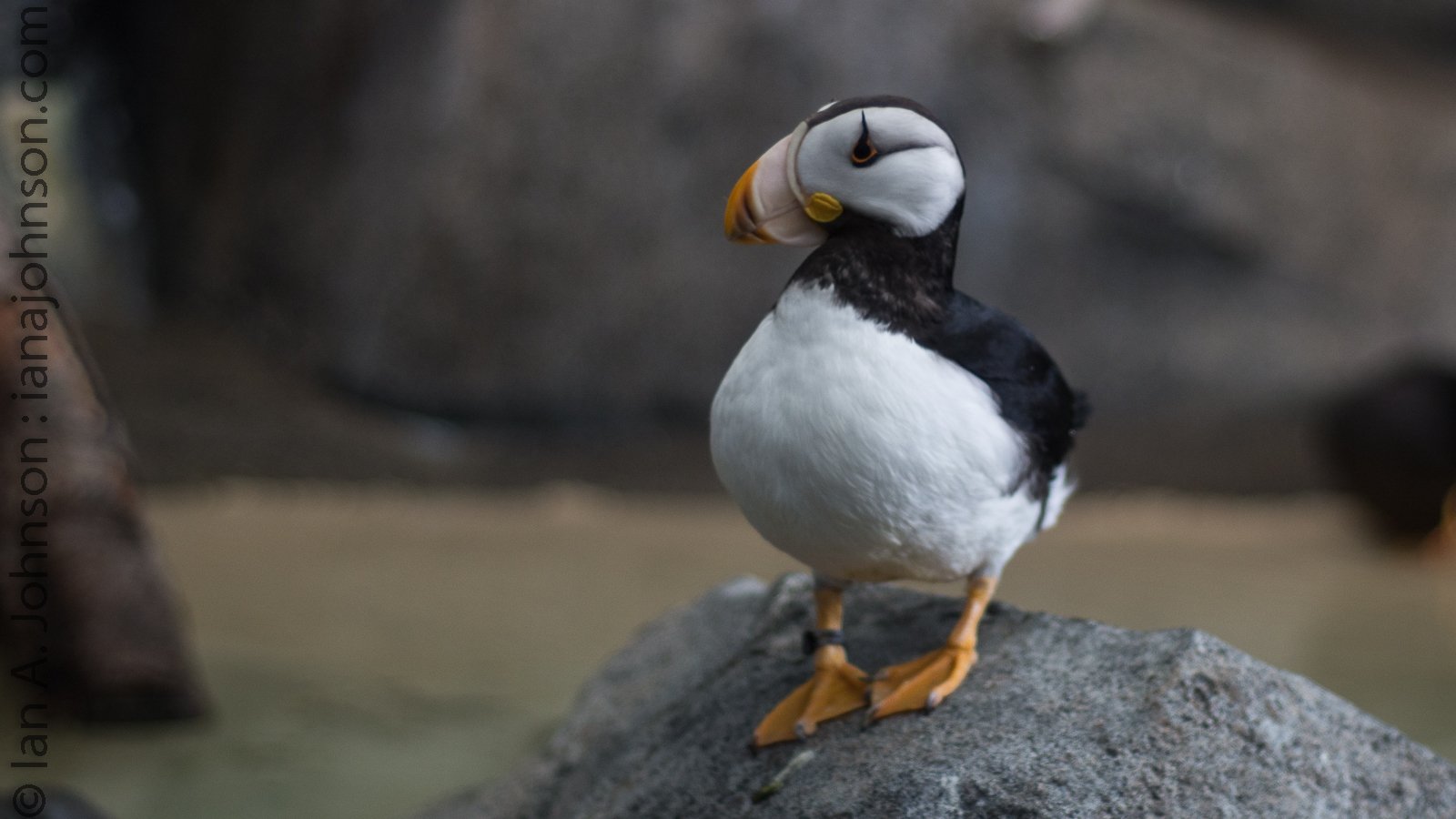
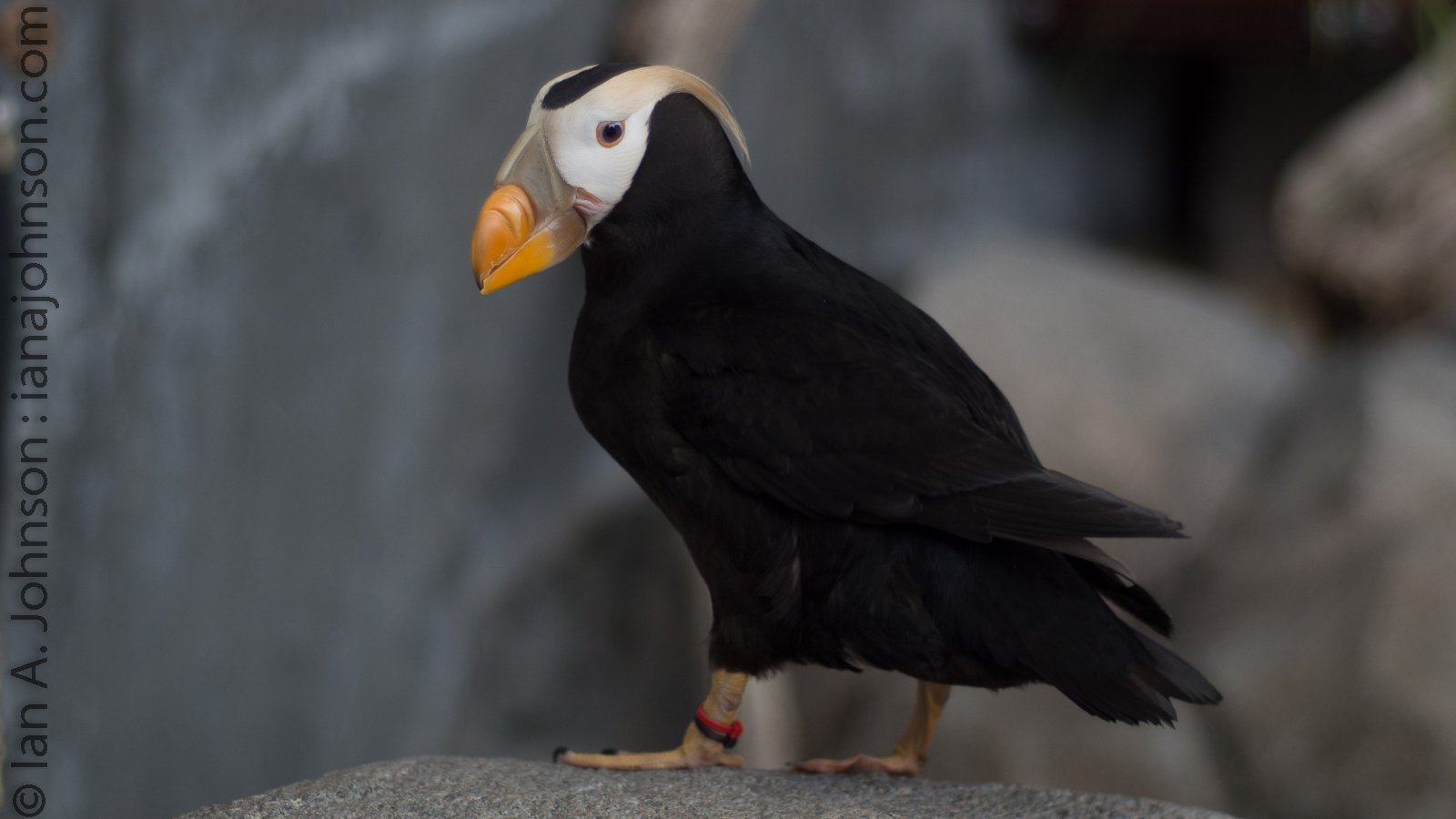
The vertical cliffs Chiswell Islands are perfect for nesting sea birds. Horned Puffins and Tufted Puffins burrow into the cracks to escape predating gulls. Parents are mated for life and separate during the winter, however find each other for every breeding season. Each of the puffin species found around the Kenai coast have extraordinary features. Horned puffins have a dark check-mark patch through through their eye which makes them look as though they have applied makeup to preform at a circus. Part of this check-mark is a horned protrusion comes off each eye like a fancy eyelash. Tufted puffins, the largest of the three puffin species, have large golden ‘eyebrows’ which waggle back and forth when they turn their head. Puffins are recognized by their large bills which they use to catch fish. Both of the pacific puffin species only have orange and cream colored bills, where the Atlantic Puffin’s bill includes blue and red. Puffins can dive up 200 feet beneath the ocean’s surface and they can hold their breath for a minute or two. However Puffins typically only need to stay under for 20 to 30 seconds at a time to catch the small fish that compose their diet.

A horned puffin flying around the Chiswell Islands.
A Horned Puffin flying around the Chiswell Islands.
Horned puffin photographed at the Alaska Sealife Center.
Horned Puffin photographed at the Alaska SeaLife Center.
Tufted Puffin
Tufted Puffin
Tufted puffin picture taken at the Alaska Sealife Center in Seward, AK
Tufted Puffin picture taken at the Alaska SeaLife Center in Seward, AK

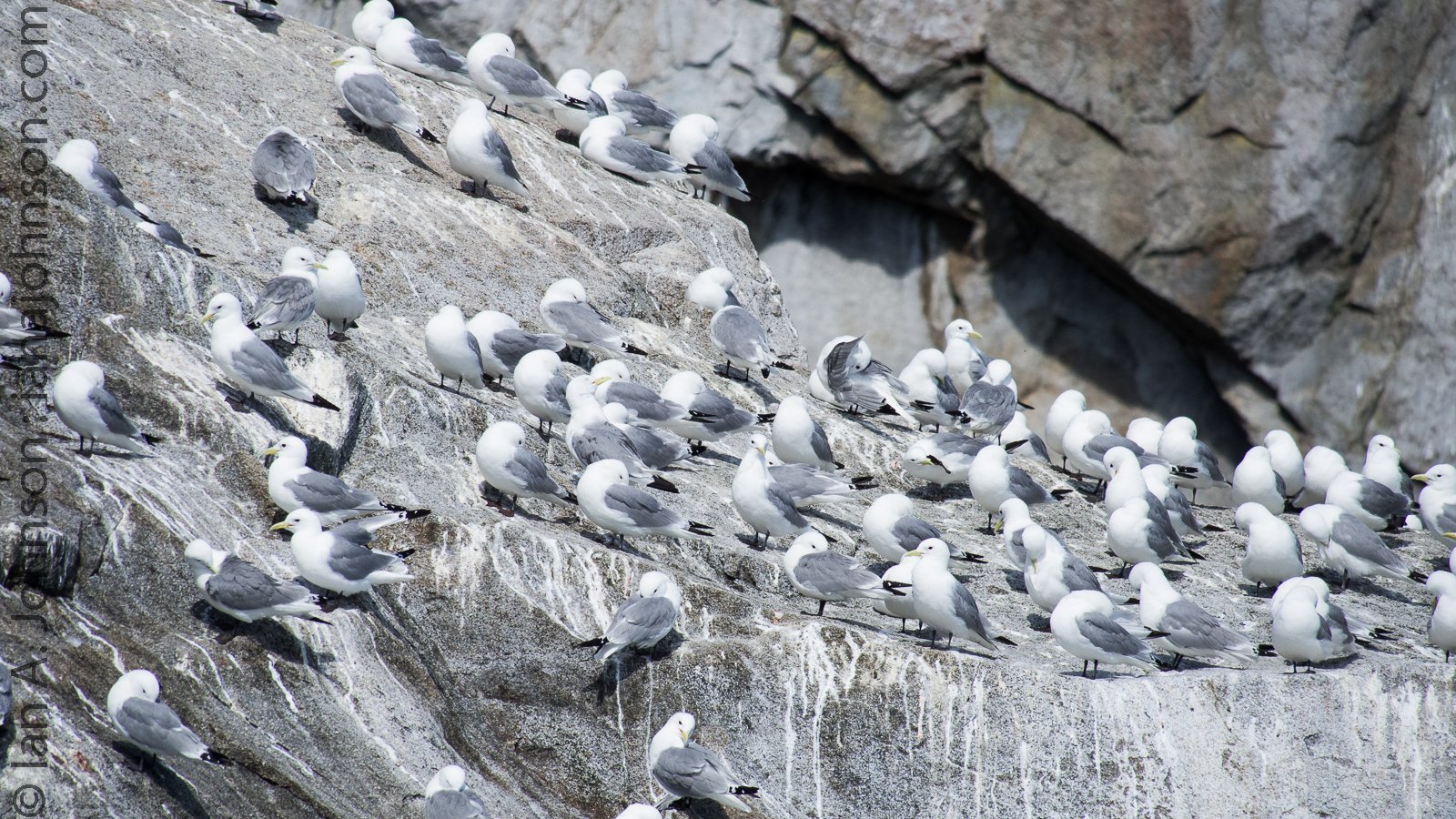
Pelagic birds are often found in large breeding colonies located on islands. For this reason they are referred to as ‘colonial nesting birds.’ These islands provide refuge from land-based predators and the large numbers of birds act as sentries, mobbing any intruder which gets too close. Our Captain informed us that once they had spotted a Black Bear on an island that was a mile from shore. It feed on bird eggs for a couple weeks then swam back to shore. It was a very rare occurrence but it is easy to see how one large predator can decimate the nesting success rates on the island.

Black-legged Kittiwakes nest in large colonies in the Chiswell Islands.
Black-legged Kittiwake

Our bird list added many ‘lifers’ to our life-lists (along with a couple we had already seen) and many photographs to my hard drive. Our list for the day was comprised of Bald Eagles, Rhinoceros Auklets, Horned Puffins, Tufted Puffins, Parakeet Auklets, Pigeon Guillemonts, Common Murre, Pelagic Cormorant, Double-crested  Cormorant, Marbled Murrelet, Black-legged Kittiwake, Mew Gull, Glaucous-winged Gull, and a possible Ancient Murrelet.

Rhinoceros Auklet photographed at the Alaska Sealife Center. These birds develop their 'rhinoceros horn' during the breeding season, and lose it each fall.
Rhinoceros Auklet photographed at the Alaska SeaLife Center. These birds develop their ‘rhinoceros horn’ during the breeding season, and lose it each fall.

 Mammals of the Chiswell Islands

There several species of whales and porpoises in the rich waters of the many estuaries of the Kenai. Sea Otters feed on clams, urchins, and other invertebrates that tend to feed on kelp. The Sea Otter is a keystone species that helps to protect the kelp beds providing shelter for a plethora of other sea creatures. Doll Porpoises, Humpback Whales, Fin Whales and Orcas cruise through the waters. The Fin Whales were a rare occurrence for the tour, our guides said they maybe see a Fin Whale 20 times a summer. Our tour saw a very rare pod of at least 6 Fin Whales surfacing together, which meant they were most likely rounding up bait fish instead of filter-feeding. On the rocks, 1 ton Stellar Sea Lion males watch over their harem of females, and the ice flows at glacier heads provide rest for harbor seal mothers and their pups. We saw several pods of Doll Porpoises throughout the day, on the way back to the harbor we had a small pod that decided to race in our wake.

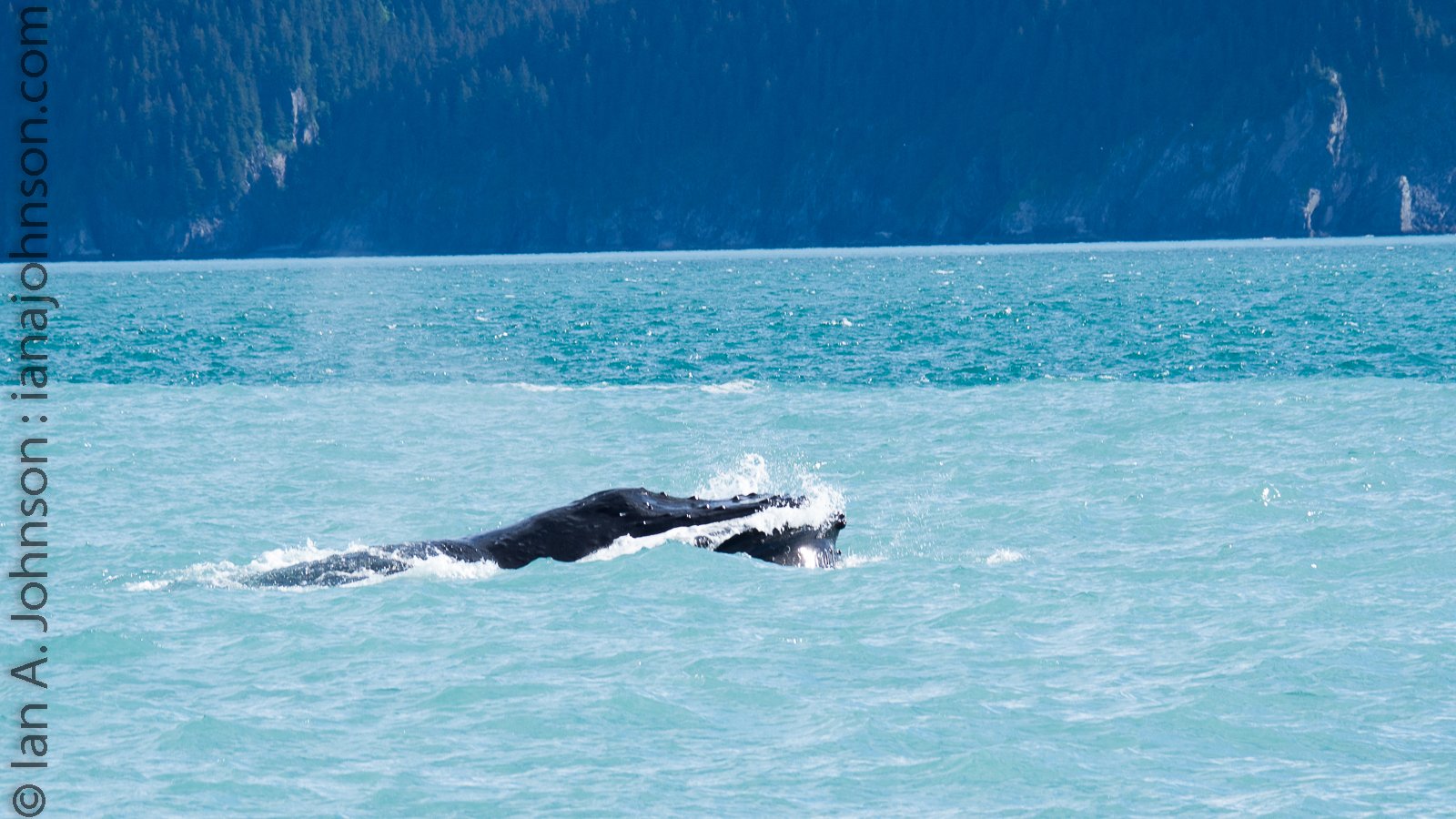
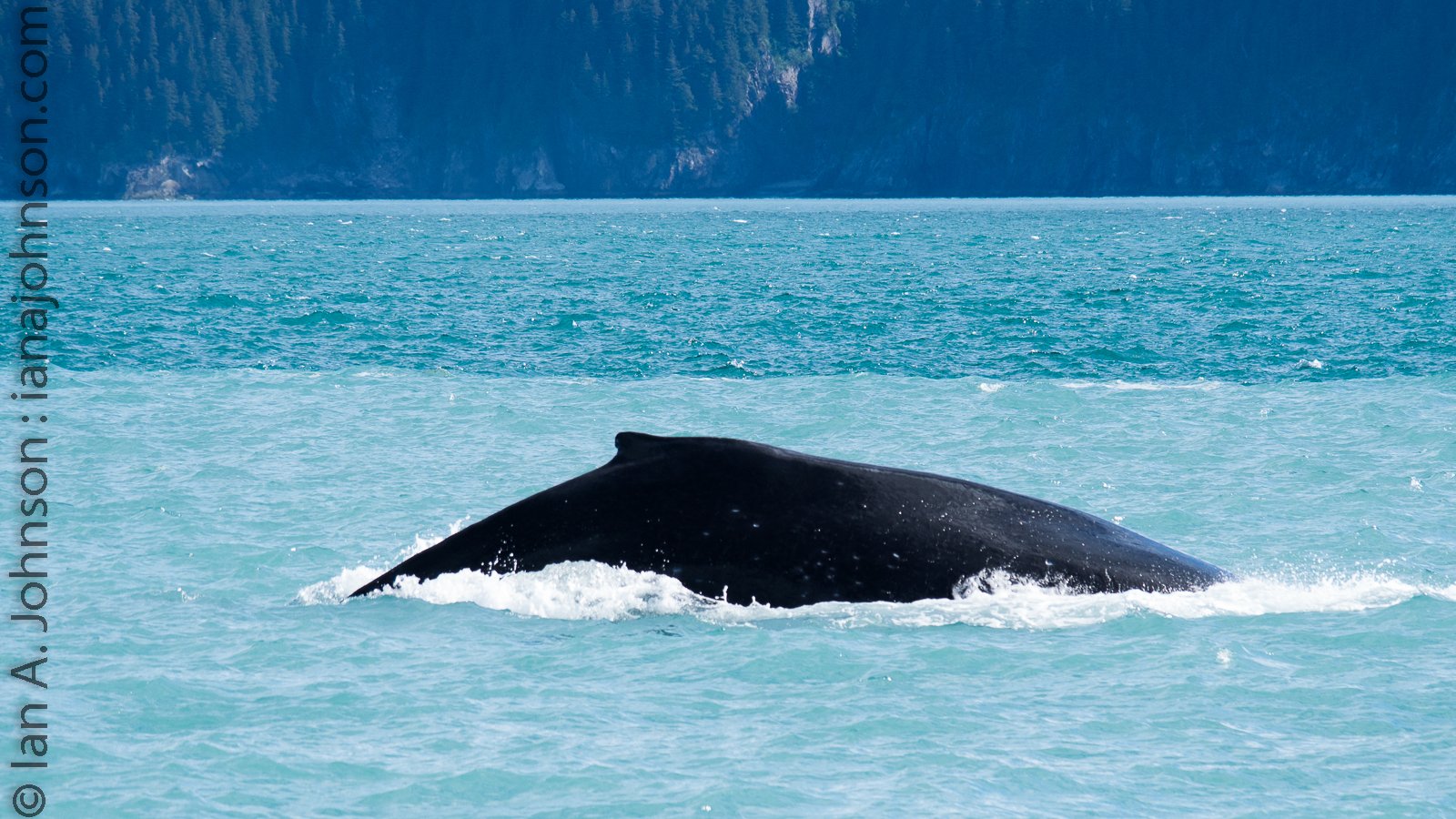
One of the highlights of the trip was observing a “lunge feeding” humpback whale with her calf. Lunge feeding is when a whale dives far below a school of food (krill or small fish). Then, rushing to the surface with their mouth open the burst through to the open air swallowing anything in their mouth!

A humpback whale explodes on the surface, exhibiting 'lunge feeding'
A Humpback Whale explodes on the surface, exhibiting ‘lunge feeding’
This humpback whale is headed back down for some more food.
This Humpback Whale is headed back down for some more food.
A sea-otter floats on its back displaying its classic behavior. They float along and crack clams on their chests.
A Sea Otter floats on its back displaying its classic behavior. They float along and crack urchins on their chests. They spend their whole lives in the ocean, even giving birth in the water. If seen on land it is typically a sign that the animal is sick.
Harbor seal mothers rest themselves and their pups on ice flows which have broken away from the tide-water glaciers.
Harbor Seal mothers rest themselves and their pups on ice flows which have broken away from the tide-water glaciers.
Stellar sealion males control and mate with many females called a harem. Male sea lions can be up to 2,000 pounds!
Stellar Sea Lion males control and mate with many females called a harem. Male Sea Lions can be up to 2,000 pounds!

Glaciers of the Kenai

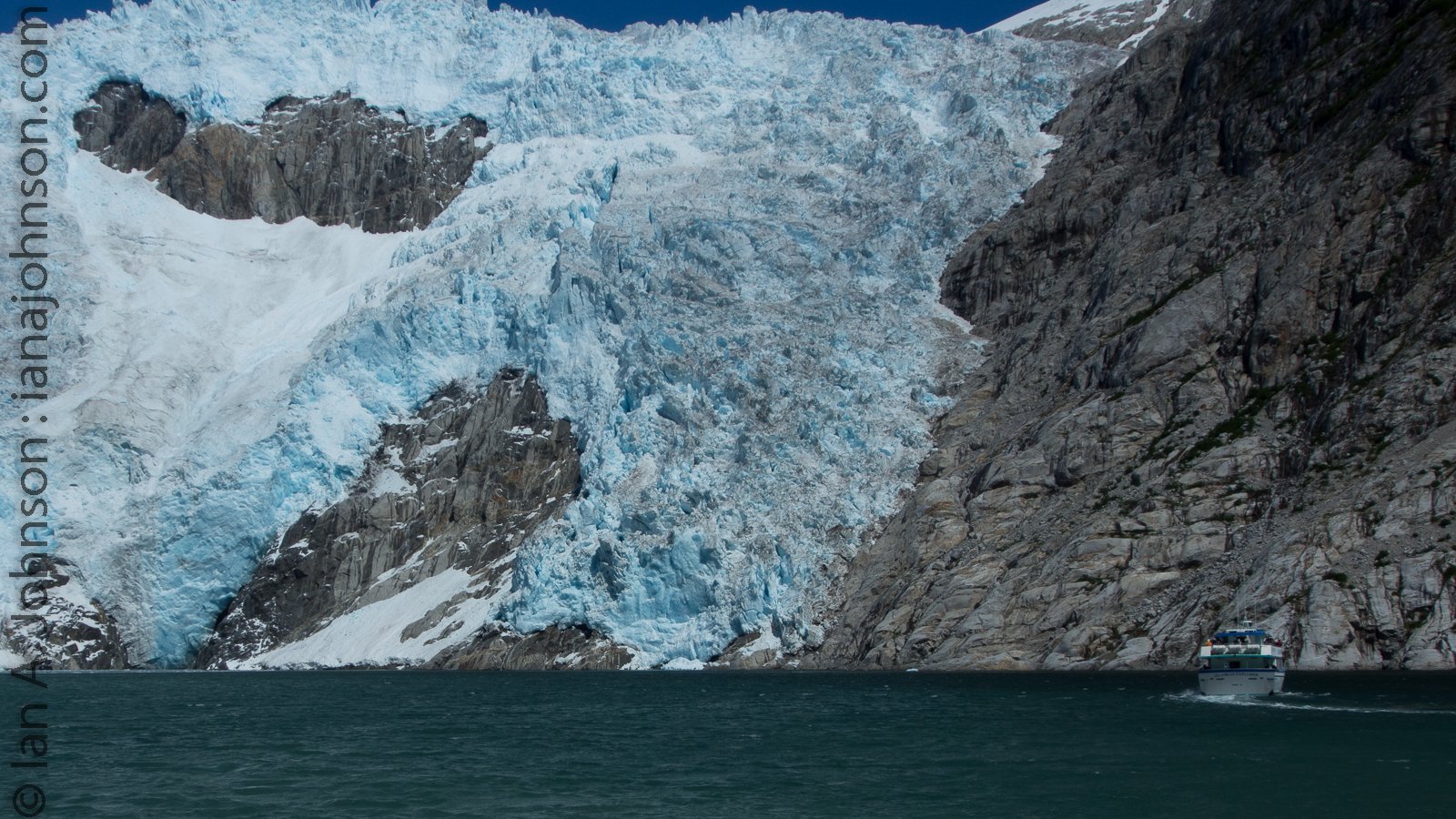
The Harding Ice Field is the largest ice field in the United States and is the source of dozens of glaciers. Some of the glaciers reach all the way down to the ocean and are classified as ‘tide water’ glaciers. These glaciers are constantly being eroded by the oceans daily movements and some of the glaciers have receded miles since the 1800’s when the Russians were exploring the coasts. The receding glaciers open up habitat for mammals and birds. The Northwestern Glacier that we sat in front of stretched for a half mile across the blue fjord, but you would never guess its size by just looking at it!

One can get a true sense of power of the tide-water glaciers by watching them ‘calf’. From time-to-time sheets of ice would break away from the exposed glacier face and cascade into the ocean. Even though our boat was positioned 1/4 of a mile away the rush of sound from the huge chunks of ice sounded like a jet engine rumbling in the not to far-off distance.

The craggy moraine of the northwestern glacier ending at the tideline.
The craggy moraine of the Northwestern Glacier ending at the tideline.
P6280215
Another boat sits in front of the glacier for a bit of perspective. If the boat floated at the front of the glacier it would be a mere speck on the its moraine.
The northwestern glacier reaches about 1/2 mile from side to side. It's split into two 'lobes' by a rock face.
The Northwestern Glacier reaches about 1/2 mile from side to side. It’s split into two ‘lobes’ by a rock face.
This river of ice and snow is the result of a large chunk of ice which broke away hundreds of feet above. The ice-chute that it slid down poured slush and chunks into the ocean.
This river of ice and snow is the result of a large chunk of ice which broke away hundreds of feet above. The ice-chute that it slid down poured snow and ice chunks into the ocean.

If you’ve made it this far I’d like to put in a quick pitch (unsolicited) for the Major Marine Tour company. Their boat the Viewfinder was piloted by a great captain and the tour guide on board was great with kids and had all the answers. The small size of the boat and number of passengers was perfect for us. They were more than happy to concentrate on birds when we told them what we were after. It was an extraordinary day.

Secondly, I would like to put in another unsolicited pitch for the Alaska Sea Life Center in Seward. Their exhibits are truly top-notch, and the chance to experience the pelagic sea-birds up close was wonderful. On top of that, proceeds go towards outreach and science. I am not normally a “zoo type” person, but everything I saw there impressed me to no end!

Thanks for checking in!

Alpine Summer in Full Bloom : Wickersham Dome, AK

It’s been a mild summer in Alaska so far. Temps have been pushing to about 75 degrees in the afternoons and hovering around 50 degrees at night. The conditions could not be MORE perfect to be out-and-about!

I’m just diving in Alaskan flower identification with many of the early summer species coming into full bloom. On the way to Wickersham Dome there is a great assortment of alpine species which can be enjoyed in the open, windy areas out of the clutches of the mosquito clouds. The flowers are beautiful, and this one, 5 mile hike provided well over a dozen species of flowers in all shades of color.

Like I said, I am new to AK flower ID, so I won’t stand by these ID’s 100%. If you know I have one wrong, please tell me. I know several of those who read this blog have great plant ID skills! Also, there’s a section at the bottom of flowers I have not ID’d yet, I would love to get your input!

Low-bush cranberries were common in the open areas along the trail. These small berries are also known as lingonberries and are great to eat once rip! They’re tart and taut with a satistifying pop. These plants, like many of the alpine species, are very, very close to the ground.

Low-bush Cranberry (Lingonberry)


Low-bush Cranberry (lingonberry)
A swallowtail butterfly feeds on and pollinates some low-bush cranberries near the summit of Wickersham Dome

Another edible plant which was common around the trail were the blueberries. They have just formed their fruits and are a rosy pink. Some more time and lots of sun will turn these little morsels blue.

Wild Blueberry
Wild Blueberry

An Alaskan specialty is the cloud berry. I’ve heard no-one makes cloud berry pie, because they’re so good you eat them all before you get home! :D. The berries form a cluster that looks like salmon spawn.

Cloud Berry
Cloud Berry

Mountain avens are small and beautiful. I actually ran into the mustache shaped seed pods last fall which in Denali National Park, so it was great to see what the flowers looked like!

Mountain Avens
Mountain Avens
Mountain Avens overlooking the top of Wickersham Dome.

The rest of the trail was scattered with many other species of flowers which can be seen here along with some of the beautiful scenery.

Lupines along the trail to Wickersham Dome
Pink Plumes! Not even kidding, that's their name!
Pink Plumes! Not even kidding, that’s their name!
Narcissus Anenome
Narcissus Anenome
Arctic Sandwort
Arctic Sandwort

Unknowns

Unknown flower #1, please help you know it! Sorry that I do not have any leaves!
Unknown flower #1 : Probable Cut-leaf anenome or “early thimbleweed”. Both are common names for it.
Unknown Flower # 2! If you know I would love to hear it!
Unknown Flower # 2! – Identified! Elegant Indian Paintbrush
Unknown flower # 3, if you know please tell me!
Unknown flower # 3 : An arnica species (Thanks Justin)… but now… which?

I’ll throw in a shout-out to these great sites which helped me in my Alaska wildflower ID and will be a great resource in the future:

http://www.alaskawildflowers.us/

http://www.turtlepuddle.org/alaskan/wild/flowers-1.html

I’ll leave you with a picture of a super-tree which is defying the odd by surviving on summit and this nesting yellow-rump warbler. She sure was well hid!

This pine tree defied the odds on the summit of Wickersham Dome. Somehow it's thriving when none others could!
This pine tree defied the odds on the summit of Wickersham Dome. Somehow it’s thriving when none others could!
A female yellow-rump sits on her nest along the trail to Wickersham Dome. She was keeping low, but keeping a close eye out.

Meandering around Northern Idaho : Kootenai NWR and Copper Creek Falls

Ahoy! I’ve taken a break from the Alaskan weather and spring to visit my family in Northern Idaho and Minnesota. Northern Idaho is a gorgeous region, and Lake Pend Orielle provides a centerpiece for the surrounding mountains (pictures were taken from the top of Scotchman’s Peak during my visit last summer). During my time there I got to spend some great time with brother, sister-in-law, and nephew whom I had not seen since Christmas.

On a side note, this post falls on the 1 year anniversary of this blog. Thanks all for your support, I’ve really enjoyed writing it and photographing for it, but it wouldn’t be worth it if you didn’t read it. Just in case you are curious, my first post details a dopey porcupine who tried to escape up a short tree :). Thanks all!

Kootenai National Wildlife Refuge

A panorama from the auto-road at Kootenai NWR. Ponds, mountains, and ducks. A beautiful spot that is full of life!

One of the great wildlife retreats in the area is Kootenai National Wildlife refuge. Although much of the refuge is not accessible to people, the auto-road brings you back through ponds were you can get great looks at many, many varieties of waterfowl and other birds. I think on this day we saw over 12 species of ducks and a good smattering of other passerines. A first-of-year meadowlark was trilling loudly and several species of warblers bounced through the shrubs. One of the stark and beautiful ducks is the cinnamon teal. This bird’s red head and eye sure make it stand out!

Cinnamon Teal at Kootenai National Wildlife Refuge

Wooducks are notoriously elusive and shy. As soon as a camera appears they swim or fly away quickly. However, they are almost undoubtedly one of the most stunning North American ducks. Some may match them, but pretty hard to beat!

Wooduck at Kootenai NWR. These birds are ellusive and camera shy!

There were other winged and flowered wonders during our time at Kootenai NWR. The lilacs were just blooming and this western tiger swallowtail made sure to lick up as much as it could from them. It fluttered back and forth looking for whatever it is that butterflies look for. I was just reading that the Koyukon people of Alaska call butterflies nidinlibidza which means “it flutters here and there”. A fitting name and description!

This tiger swallowtail was feeding on the first lilacs of the year. They are stunning and beautiful!

We also stumbled on these beautiful daffodils. I think these daffodils must be a remnant of homesteading in the region – I doubt biologists are planting them for waterfowl habitat!

I'm not sure where these daffodils at Kootenai NWR came from. Certainly there is a homesteading past there, so perhaps a remnant from that?
I’m not sure where these daffodils at Kootenai NWR came from. Certainly there is a homesteading past there, so perhaps a remnant from that?

During my whole time in Idaho I really enjoyed getting to see my nephew, Dane. He’s a little better than 2 now and is a box full of energy and entertainment. He is (as all little boys are) very curious about all that’s around him. I am sure his parents will continue to raise him outdoors. It was great to see the ‘next generation’ out in nature! I’ll put in my pitch and say if you have a chance to bring a kid outside you should make that a priority!

My nephew, Dane, looks out over the wetlands of Kootenai NWR. Although he wasn't interested in all of the birds, he loved seeing the baby geese!
My nephew looks out over the wetlands of Kootenai NWR. Although he wasn’t interested in all of the birds, he loved seeing the baby geese!

The deer have just finished shedding their coats, and some deer are futher into their summer coats than others. I saw a spectrum of coat quality from smooth coated to scrubby deer, which makes you wonder why some are later than others.  We also observed two moose at Kootenai, which was nice! I doubt the moose are enjoying the warm temperatures. Moose in Idaho exist at temperatures which are extreme to them, and do not extend much further south.

The deer have not quite finished shedding their coats look pretty scraggly yet. This one's face says, "HEY!, what are you looking at?" :P
The deer have not quite finished shedding their coats look pretty scraggly yet. This one’s face says, “HEY!, what are you looking at?” 😛
This moth was along the trail to Myrtle Falls at Kootenai NWR. I'm not sure why it was perched so still at the end this stick. The brown and tan banding sure is pretty when you get close to it!
This moth was along the trail to Myrtle Falls at Kootenai NWR. I’m not sure why it was perched so still at the end this stick. The brown and tan banding sure is pretty when you get close to it!

 Copper Creek Falls

Copper Creek Falls, especially in the rush of the spring melt, is one of the most stunning waterfalls I have seen. The drop is uninterrupted and pluges 160 feet to the bottom. However, with some of the smaller rapids, I think the total drop in the falls is 225 feet! A strong, cool, and moist microclimate around the falls is filled with glistening green moss. Further downstream we observed a varied thrush, which are often found in riparian areas.

Copper Creek Falls drops 160 feet to the bottom. It is an incredible rush of water!
All of us posing in from of Copper Creek Falls before rushing away from the cold mist fall on us :)
All of us posing in from of Copper Creek Falls before rushing away from the cold mist fall on us 🙂

I will leave you with a peaceful morning in the Sandpoint Region. The morning fog over the lake was changing and undulating rapidly. How fog forms is fascinating to me! I have no included any music in this timelapse (which documents about 30 minutes of time), but imagine birds chirping and watching deer feed in the field hundreds of feet below you 🙂

Fort Yukon, Alaska : Celebrating Spring!

Spring is in the air! In Fairbanks the trees are leafing out and the days are long and warm. Even now there are only several hours each day that are dark. 150 miles north of here, Fort Yukon is just starting to wake up for the season. I got to spend some time up there (it was much different than the last time I was here) and I made it a point find some of the things which represent spring. All around birds, plants, and humans are celebrating the season.

As an avid birder I am interested  in the new migrants which arrive in the spring. The Yukon Flats National Wildlife Refuge was set up to harbor waterfowl; they flock there by the 10’s of thousands. The small ponds dotting the landscape are ideal for brooding and raising chicks. My waterfowl list for the trip included a dozen species.  Passerines like yellow-rumped warblers and dark-eyed juncos were abundant. These two  species (e.g. yellow-rumps and juncos) are some of the first to show up for spring, and are a great indicator the season is here for good!

A canvasback salutes the sun and stretches its wings near Fort Yukon
A pintail duck takes flight around Fort Yukon. AK
A yellow rumped warbler around Fort Yukon, AK
Dark-eyed Junco around Fort Yukon, AK

Waterfowl are pursued by Subsistence Hunters as they migrate north. Each spring it provides a new source of meat (in a region that depends on 85% of its meat from the wild) to replenish stores until the salmon arrive in July. In particular white-fronted geese, canada geese, and snow geese are shot. When I was touring around the village I found a place where the birds were plucked. An unusual (for the region) strong north wind blew the features onto the trees and ground. It looked like a massive and violent pillow fight had been staged there. I got to share in the bounty of goose soup, which was delicious!

A strong north wind blew up these goose feathers from the beach where they were plucked. During the spring migration, Subsistence users taken many types of waterfowl.
The results of subsistence users. In the spring time geese are actively hunted, I got to share in the bounty with some delicious goose soup!

The breakup for the Yukon River is a celebrated event by all who live on it and depend on it. River travel is fast, and gives residents access to some resources which have been unavailable since the previous fall. Although the Yukon has been clear for over a week large chunks of ice on the banks demonstrate the power it took to push them there and are a testament to how thick/resilient the ice can be! Over 8 feet of ice in some regions.

The Yukon River broke up in early May, but huge slabs of ice still cover the shore making boat access difficult in some areas.
The power of the Yukon River pushed these ice chunks onto shore where they are still slowly melting away and feeding the river.

The leaves have not appeared on the trees yet, but spring pasque flowers, and willows have started to bloom. The bright yellow stems of the willows caught my eyes and were at stark contrast with the surrounding gray bark of the aspens. Especially eye catching was the contrast of the yellow stems and the blue sky! The base of the willows were dirty and marred where river water had washed over them just a few days earlier.

These yellow willows are a beautiful contrast against that deep blue sky!

Yellow Willows

A newly bloomed pasque flower in the sunlight in Fort Yukon, AK
Pasque Flowers are the first flower to bloom in Fort Yukon, AK. Here they have just emerged on 05/15/14

Spring is certainly in the air in Fort Yukon. Overall, it’s one of the ‘last’ springs to arrive in North America. I leave you with a still, spring sunset in one of the river braids of the Yukon. I hope you are having a great spring!

The sunset on a beautiful evening in Fort Yukon. It will not be long before the sun doesn't set at all!
The sunset on a beautiful evening in Fort Yukon. It will not be long before the sun doesn’t set at all!

The Three Bears

Yesterday I got a chance to observe some mothering and sibling rivalry. Bears in the Anchorage area have emerged, and mothers with new cubs are welcoming in the warm temps. Jonathan is filming bear behavior in the region for the BBC and needed a second man for that ‘just in case’ scenario that a bear became aggressive. Incredibly, Jonathan was able to find this sow bear and her two new cubs. Although you’ll see tags in the ears of this female, she has no tracking device – it was very lucky to find where she called home!

As we came up to the tree area it was very important that Mom knew we were there. We talked and walked up to the site, pausing to ensure she had seen us. Once we were settled in she paid little attention to us.

Momma bear hanging close to home and watching the frolicking cubs.

There was lots of opportunity to shoot video of some very classic and cute bear behavior. Check it out! 🙂

The cubs were a constant source of entertainment. The would scramble along logs and tumble off them, fight each other in miniature mock battles, and pester their mother who would sometimes pester them back. The bond between the bear cubs and the mother was evident – there certainly is some truth to that old adage!

The two cubs were always wresting with each other, you'll see this playful see in the video in this post :)
The two cubs were always wresting with each other, you’ll see this playful see in the video in this post 🙂
Two cubs playing 'cub scouts' up the tree trunk.
Two cubs playing ‘cub scouts’ up the tree trunk.
The limb to the left of this cub was their favorite part. They would climb up to it, rest for a bit, and then shimmy back down the tree.
A cute shot of the cubs. One trying out tree bark and the other checking me out.
This cub looks deep in thought... wishing he was a bird?
This cub looks deep in thought… wishing he was a bird?


Through all of the cuteness there was  still a stark reminder of the fragility of life as a small bear cub. These two were meant to have one more sibling. One cub was laying dead outside of the den, and Jonathan had seen it earlier. We experienced the mother eating the dead cub. I can assume this is for two reasons, the first is that she can use the protein. At this time the mother cannot leave the den and feeds little. Second, the rotting body may attract predators or another bear and put her surviving cubs at risk. The mother ate the cub by tearing small chunks of flesh, even though it seems she could have swallowed it in one bite.

We experienced the mother bear eating the remains of her deceased third cub.

Overall I do not know if I could experience more joy in watching wildlife. Watching these two cubs enjoy the spring weather, and the tenderness of the mother was endearing. I feel privileged to have experienced it!

Momma bear and a cub touch noses.

Chugach Mountains : A Rainbow Peak ‘Death March’

This last week I have been attending the North American Moose conference in Anchorage. The opportunity has been top notch, and has really offered me a great to chance to meet area biologists as well as present/develop my thesis ideas. At this time I am developing my research proposal and defend the proposal 1 week from today. These things come up fast!

One of the venues for the conference were a selection of field trips. I elected for a hike in the Chugach Mountains State Park. There were two hikes in the Chugach (pronounced “choo-gatch”). The one which intrigued me was jokingly described as a “death march” up Rainbow Peak. This peak climbs 3500 feet to the summit overlooking Turnagain Fjord. It lies south of Anchorage, but north of Girdwood. For more information check out the peak profile http://www.summitpost.org/rainbow-peak/618183. In some parts of it the death march is an apt description. The trail up forces you to crawl in many locations due to slope, and loose scree fields (broken rock) absorb your steps on the way up and cause small landslides on the way down. It’s a challenging but rewarding hike.

The Rainbow Peak is one of the first peaks to thaw out after winter and on this day we were nearing leaf-up. The buds of the aspens were swelling quickly, fueled by up to 60 degree temps! On the way up we did get to see some great wildlife. Dall sheep were feeding on the hillsides, and a large group of about 10 ewes and young rams milled ab. They should be dropping lambs any day now. We saw one bull moose feeding and overhead two golden eagles circled the peak. I think they are waiting for new lambs – a potentially easy meal! The most colorful bird of the day was this Stellar’s Jay. My first encounter of them was in California last summer, but this was my first chance to get a good photo. They’re a beautiful and curious bird!

Stellar's Jay along the path to the Rainbow Peak Summit
Stellar’s Jay along the path to the Rainbow Peak Summit

I was the only person who actually completely summited the mountain. There were still some small snow fields at the top that kept some of the less adventurous from going the last 1/5 mile. My philosophy on mountains is you are THAT close you have to finish it! I had to take this selfie of laying out on the peak.

I was the only person to brave a small snow field to completely reach the summit. I propped my camera and un-propped by body to get this shot looking over the Fjord.

The views around were stunning. This panorama looks towards Girdwood (left) and Anchorage (right). On the opposite shore is the town of Hope.

A panorama from Rainbow Peak between Anchorage and Alaska. The peak climbs to about 3500 feet and overlooks the Turnagain Arm Fjord.
I was hiking with a group of fellow biologists. You're always surrounded by scenery!
I was hiking with a group of fellow biologists. You’re always surrounded by scenery!

The Chuagach Mountains have many opportunities that I hope to take advantage of in the future!

The Birds of Southern Texas

One of the perks of being back in college is spring break. Kassie and I took the opportunity to head to Rio Grande Valley, South Padre Island, and Corpus Christi regions of Texas for some birding. Why choose those regions? Well, during the year over 400 species of birds and half of North America’s butterflies can be found in this region, which borders Mexico. There are brilliant tropical birds and northern migrants. March marks the time when the migrants are starting to move, and many of the winter residents of Texas move out.

All told we observed 120 species of birds and were able to enjoy many habitat types throughout southern Texas. We birded ‘hard’ for 5 days through grasslands, estuaries, sand dunes and beaches; our time outside gained us some red to cover up the Minnesota and Alaska ‘white’ from the winter. My skin definitely had not seen the sun for awhile!

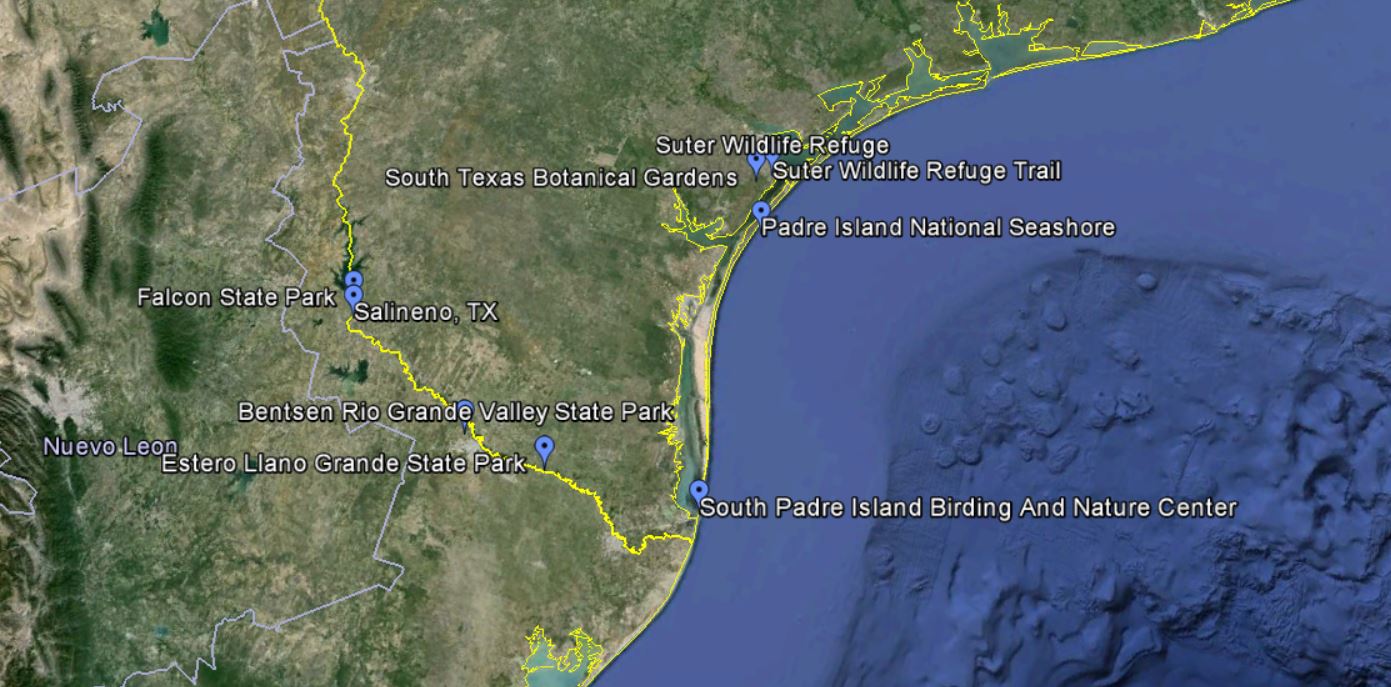
Our stops along the way on our Southern Texas Birding Trip

This was a birding trip, so naturally there were a lot of birds. In order to keep this post a reasonable length I have included a full gallery of birds at separate page. It has a bulk of the photos in it. You will find it by clicking here the or the following link: .

THE SOUTHERN TEXAS BIRD GALLERY


The rest of this post is dedicated to highlights of locations and some of the things we saw/did there. Also, just a tap- clicking the location name will bring you to a Google map of it.

Bentsen State Park

Bentsen was my first look into the “Texas style” of birding. They say everything is bigger in Texas, and their birding blinds fit that bill. By walking into a birding blind you can observe species at close distance thanks to a small, habituated trust of humans and the wooden wall between you and the birds . At these stations  variety of Rio Grande Beauties can be observed.

Green Jay
Green Jay

Bentsen is close to the Mexico border, and it’s pretty normal to see border control and helicopters flying through the area. The region in general is a blend of Mexico and the United States and the mixing of cultures show through the housing and lifestyles of its residents.

Great Kiskadee
Great Kiskadee
Black-crested Titmouse

Estero Llano Grande State Park

This park focuses around wetlands. As a  birder you can expect a variety of ducks, wading birds.  This location provided our first look at white ibis. The bird pictured here is a juvenile, but will become stark white as it ages.

White Ibis - Estro State Park
White Ibis – Estero State Park

Estero was also home to this wee-little Sora and Common Gallinule. Sora are a very shy species, so after spotting them it’s important to be patient as you wait for them to reappear from the cattails. Gallinule are the exact opposite and I think some would consider them to be ‘dumb birds’ because of how close you can get. However, I think they realize there is no threat from us in this location.

Gullinule
Common Gullinule
Sora
Sora

One of the INCREDIBLE bird species in this location are the Common Pauraque. These ground-dwelling birds have camouflage so good that even when you know where to look you have to look twice. Can you see him?!

Paraque - can you see it??
Common Pauraque – can you see it??

Estero is also home to some impressive gators. Stay on the trails and you’ll be OK! 🙂

The Alligator could be found in a variety of wetlands across southern Texas, just keep your eyes out!
Alligator - Esro State Park
Alligator – Estero Llano Grande State Park

Salineno

The highlight of Salineno was seeing both a Hooded and Altamira Oriole. These orange beauties are sought after users of the feeders.

Hooded Oriole
Hooded Oriole
Altimura Oriole - Salineno, Texas
Altamira Oriole – Salineno, Texas

Salineno is very, very close to the border. Can you see Mexico from there? You bet! Just look across the river!

Welcome to the mighty Rio-Grande River! Mexico on one side, the U.S.A. on the other!

Near to Salineno was a far different landscape than the lush river valley. An arid landscape was brought to life by the windmill which still dripped water. Cacti, succulents and mesquite were the predominant vegetation on the landscape.

Llama!
Llama!
This mill still pumped some water which provided a spark of life for the birds in this mostly arid spot
This demonstrates the habitat around the "dump" road just outside of Salineno. Scrubby mesquite and succulents were dominant on the landscape
This demonstrates the habitat around the “dump” road just outside of Salineno. Scrubby mesquite and succulents were dominant on the landscape

Falcon State Park

Meep Meep! Falcon State park brought hopes of the mighty and fabled roadrunner. Although we did not see any empty crates of ACME or a The Wiley C. there we were graced by the roadrunners which were truly running on the road.

The Road Runner - Falcon State Park
Greater Roadrunner – Falcon State Park
The road-runner Falcon State Park
The roadrunner Falcon State Park

The other species that were great to find were the pyrrhuloxia. These birds are similar in sight and sound to cardinals. I’m not sure which habitat is preferred by this species, we found them feeding on the ground as seen here as well as in the shrubs.

pyrrhoxlia - Falcon State Park
pyrrhuloxia – Falcon State Park

While you are walking around the sand dunes there is a common feature on the landscape in the form of small funnels in the sand. These were not made by water drops or meteors, but instead, the vicious ant lion! These predators live in the bottom of their sand pits waiting for prey to fall in. They flick sand up at it before dragging it into the sand for consumption. Remember seeing that movie Tremors or Enemy Mine? Kinda like those. Check it out the video of ant lion vs prey

This ant lion has been removed from his native nest. The bulbous part of his body is at the bottom and the jaws grab insects pulling them into the sand

South Padre Island

At the World Birding Center of South Padre Island (SPI Birding and Nature Center) a small wetland marks what is left of the once diverse island habitat. Here, many shorebirds, ducks, and warblers pile in every spring and fall on their migration route. One of the most memorable moments from the trip was when this scissor-tailed flycatcher landed a just a few feet from us. These birds use their “scissor tail” to do wild acrobatics to catch insects. In front of us they swooped and stooped catching unseen winged invertebrates.

Scissor-tail Flycatcher - South Padre Island
Scissor-tailed Flycatcher – South Padre Island
Scissor-tailed Flycatcher

South Padre Island is highly critical to one species in particular – the Redhead duck. It is thought that 80% of the world’s redheads over-winter here. Although the vast rafts of 1000s of birds had moved out by the time we got there, some of the hungover ducks were still sleeping off their winter blues.

Roseate Spoonbill and Redhead Ducks
Roseate Spoonbill and Redheads

The showiest bird was undoubtedly the roseate spoonbill. These filter feeders use a large spoon shaped bill to sift through the shallow waters for invertebrates and small fish.

Roseate Spoonbill
Roseate Spoonbill

Padre Island National Seashore

Padre Island National Seashore is marked by windswept dunes and long, long, long beaches. At this location, after miles of beach combining we discovered something truly amazing, and it’s not bird related! The butterfly clam shells which was up here can be found alive and well just inches under the sand. They are tossed up in the surf and a scoop of the hands will bring up hundreds. They come in many colors, all of them beautiful! Not sure what I’m talking about?

One of the great discoveries at the Padre Island National Seashore were these buttefly clams. Their old shells were scattered up and down the beaches. By digging a few inches into the sand you could pull up vast handfuls of these beauties!
One of the great discoveries at the Padre Island National Seashore were these butterfly clams. Their old shells were scattered up and down the beaches. By digging a few inches into the sand you could pull up vast handfuls of these live beauties!

Port Aransas

Never have a seen a more docile duck. I’m not sure what was ‘in the water’ so to speak but it was truly incredible to be mere feet from Blue-winged Teal, Northern Shoveler, and Green-winged Teal. This location also contained an uncountable amount of Black-crowned Night-herons which roost there day.

Blue-wing Teal
Blue-winged Teal
Northern Shoveler
Northern Shoveler
Green-wing Teal
Green-winged Teal

One of the other firsts for me in this location was the Nutria. These invasive rodents from Eurasia were brought here for the value of their fur. However, once here it was discovered there was no market for these wetland destroying terrors. Nutria breed rapidly and are renowned for stripping native wetland vegetation bare.

Nutria - Los Aranos, Texas
Nutria – Port Aransas, Texas

South Texas Botanical Garden

This spot is a cool juxtaposition of sculpted gardens and wild-wetlands. There was a good variety of ducks and waders to be found in this area. However, one of the highlights was their blooming orchid greenhouse which has varieties from across the continent. Incredible!

This slideshow requires JavaScript.

Hans Suter Park – Texas A&M University

This stop was the last of our trip and yielded an unexpected (but exciting!) bird. Behold! The black skimmer. This feeding specialist has a bill that allows it to fly next to the water and skim small fish and invertebrates from the surface. We got to watch these birds feed up and down the coast. On top of that dowitchers, godwits, a variety of ducks, laughing gulls, spoonbills, a crested caracara, and many other species were found along the board-walk.

Black Skimmer - Corpus Christi, Texas
Black Skimmer – Corpus Christi, Texas
Black Skimmer - Corpus Christi, Texas
Black Skimmer – Corpus Christi, Texas

I hope you have enjoyed the birds! I wanted to leave you with one last thing. Bird-watching is all about seeing bird behavior. Throughout the trip I took video of bird behavior. I have compiled just some of it here. I hope you get a feel for what it’s like to see them!

The Boreal Travel Plaza : A Cold Day at Sax Zim Bog

Ahoy Readers!

Yesterday Kassie and I made it to Sax Zim Bog (http://www.dnr.state.mn.us/sax_zim_bog_iba.html) to go look for some of the boreal bird species that move in for the winter. In the region there are northern hawk owls, great grey owls, boreal chicadees and black-backed woodpeckers – of course there are many, many more!. Our goal was to beat the cold snap we are having in Minnesota right now – in fact due to the cold Governor Dayton called off school for Monday on Friday! That hasn’t been done since 1997. Although with windchill values exceeding 60 below for Sunday and Monday night I think it’s warranted. Amazing that I can experience the same intense cold in Alaska and Minnesota.

Cold temps in Perham this week!!

Sax Zim bog is located just south of Buhl, Minnesota on the ‘Iron Range’ (http://goo.gl/7mBiuM). I actually spent quite a bit of time up there as a kid, my dad is from the Hibbing region, and attended high school at Buhl.Here is the description of the area from the DNR website : ” Level to gently rolling topography are characteristic of this region. The largest landform is a lake plain. Soils include extensive areas of peat over both fine-textured and sandy lacustrine deposits. This site includes sledge meadows, lowland brush and hayfields. There are stemless lady’s slippers and other species of bog vegetation including sundew, pitcher plant, leatherleaf and bog birch.This well known wintering area for Great gray owls, Northern hawk owls, and Rough-legged hawks is an ideal habitat for more than 240 species of migrant and breeding birds.”. The opportunities are indeed great there! For more information on the area and the opportunities there visit : http://www.dnr.state.mn.us/sax_zim_bog_iba.html http://sax-zimbog.com/ http://sax-zimbog.com/birding-festival/ http://www.saxzim.org/

Birding at Sax Zim Bog. Image credit goes to : http://www.askthebirds.org/2012/07/sandhill-cranes-at-sax-zim-bog.html

One of the northern migrants in Sax Zim are the northern shrikes. These birds are classified as song birds, but are carnivores. The eat insects and small rodents. They are known as ‘butcher birds’ because to cache food they impale their prey on sticks, thorns, or even barbed wire! The northern shrike below was stooping over the field hunting an unknown prey. I was able to capture the bird as he stooped into the blustery winds as and perching on a nearby branch.

Northern Shrike stooping in the blustery winds at Sax Zim Bog
Northern Shrike at Sax Zim Bog

Even with the condition of blustery wind we had some great opportunities to see some cool birds. Boreal chickadess are a migrant here we found a couple at the feeders there. Gray jays and a red-breasted nuthatch were also found at the feeders.

Boreal Chickadee at the feeders in Sax Zim Bog
P1040067
Gray Jay at Sax Zim Bog
Red-breasted nuthatch at Sax Zim Bog

As we were driving along the roads looking for owls Kass spotted a ruffed grouse sitting in the trees. She thought it was an owl right away, and so did I!!

Ruffed grouse at Sax Zim Bog

At the end of the day we never did see any owls. The windy and cold conditions kept the owls hunkered down. However, I didn’t want to leave you without some pictures of them! Part of the reason we went up there was Erik Bruhnke, who runs Naturally Avian. Naturally Avian is his bird tour, education, and photography business and I absolutely encourage you to check out his Facebook page (https://www.facebook.com/NaturallyAvian). If you enjoy birds and just feeling happy subscribe to his page, his posts and photography are both incredible. By visiting the page you’ll be able to see a lot of the birds that we ‘dipped’ (did not see) on. His pictures of boreal, great grey, and northern hawk owls are honestly second to none and are award winning. By visiting the Sax Zim bog website you can see great photography of the owl species and the boreal migrants.

3500 miles of Wow. Our Journey from Perham, MN to Fairbanks, AK

Well Readers, it’s been a long time since I’ve put up a post here. And it’s not from lack of desire, rather lack of time. I’ve been Very, Very, Very busy. Capitalized “V”s are supposed to emphasize. Here’s the first part of our journey to Fairbanks. I have been involved heavily in RA training. I’m working at the “sustainability village” for the year and am very excited about! I’ll be the head of 16 residents that are dispersed amongst 4 apartment buildings. The buildings are hyper efficient, and residents that live here pledge to live sustainably (which manifests itself in many ways). My interests and past experiences in Northland College will fit me very well. Residents grow some of their own food (I ran the campus greenhouses for 2 years at Nortland) and are asked to bike, walk or carpool when necessary.

On top of my RA duties, I’ll be diving into my graduate work very soon, and classes start just after Labor day!  I’ve actually been so busy that I didn’t have time to write it, fortunately, Kass could help out again! Without futher ado, here she is, with small interjections from me:

HERE’S TO ALASKA!!!!

Our planned trip to Fairbanks, Alaska was a total of 61 hours not including stops for fuel, food, or road construction! Then we added another 12 hours or so to head down to Denali National Park and to see Anchorage then head back to Fairbanks. It was a little daunting to think of all those hours in Ian’s pickup but we were up for the challenge!

Out west again…

We left Perham on the 8th of August and headed to the first destination on the way to Alaska, 16 hours to Sandpoint, ID.

WP_20130808_002

As you can see we were pretty heavily loaded. Ian planned to have his entire load of luggage on the trailer then we would “boondock” (park in random spots for the night, mostly rest stops or pullouts) in the back of the truck were we rigged up a bed instead of having to pull out a tent every night. Nice thinking Ian! He created the trailer from an old popup camper his parents let him use. He tore the whole camper off of it, leaving the strong frame and built it all up for this journey in the last few remaining days we had before leaving. (CRAZY!)

We drove about 12 hours that first day before hitting a rest stop, and then we finished the rest of the way the next morning to Sean and Jada’s house. We got to see the little man again and spend some quality time with the loved ones we miss rather dearly! We dropped off a few things for them, Ian’s kayak for them to use while he is up in Alaska, and a huge china hutch for Jada that was her grandmother’s, and some clothes for Dane from Darla. We spend all of Friday and a good piece of Saturday morning with them. It was a very nice spot to stop and rest up for the remaining chunk our journey.

WP_20130810_002

As a side note, those of you who know Ian well enough, know that there is a part of his brain that just so happens to be a human jukebox. (If you didn’t know that, now you do ; ] ). This jukebox is always on random (well typically) and it rarely ever can finish a song before its attention has skipped into another piece of a different song. One of the many songs Ian often had on repeat during this trip was of course John Denver’s, Alaska and Me. He often sang, “When I was a child and I lived in the city I dreamed of Alaska so far away… somehow I knew that I’d live there someday.”  It popped up more and more in the jukebox’s playlist the closer we came to Alaska. He typically ended almost shouting every time, “Here’s to Alaska!!!” Good thing I’m a John Denver fan! : ]

Canada

Our destination for Saturday night was Banff National Park. I have had the pleasure of visiting Banff before but this was Ian’s first journey there. Banff was only about five and a half hours from Sandpoint so we made it their easily. It started to pour as we got to the park and managed to find an overlook to pull off on and we boondocked for the night. Ian captured the rainy mood of the mountains the night before and then the subequent sunrise of the same mountain range. What a difference!

P8100047 P8110053

The next morning we rose and greeted the beautiful view once more before continuing up Highway 93 (Icefields Pkwy) that drives through Banff National Park in British Columbia/Alberta, and up to Jasper National Parks in Alberta, Canada. The highway was amazing! It led through the mountains, next to glacial rivers and lakes, all the way up to the glacial ice fields themselves! If you are ever in the area we highly recommend this drive! So awe-inspiring! The mountains continue to change a head of you showing new types of geological structures and chemistries. We stopped at the Athabasca Glacier, that had a trail up to it and even showed signs of where the terminal moraine used to be in decades of the past all the way back into the late 1800’s. We weren’t able to touch the glacier as I was hoping; the river at the end of the moraine was just too fast and wide (and probably freezing!) for us unprepared visitors in our sandals.

P8110059

NOTE FROM IAN: This glacier was full of “Nerdy” glacial stuff. Here’s a little bit about what I learned while looking at this glacier!!

ATHABASCA GLACIER

The glacier has receded greatly in recent years. Here is a panoramic of the glacier:

Athabasca Glacier Pan 1

Glacial recession has been going on for centuries, however has sped up in recent years. This glacier has retreated about 1.5 km (.93 miles) in the last 125 years!! (http://en.wikipedia.org/wiki/Athabasca_Glacier). The location here had each 20-or-so year mark posted to you could see the progress of the glacier. What an eye opener! In fact, at the location (picture below) shown you can see the vegetation growth that has occurred since the glacier left that spot 105 years earlier. It isn’t much growth!

P8110107

Glaciers play a key role in the landscape and the evidence of their movement can be seen everwhere. Here, the glacier has grown over the solid surface of the rock cutting into it as it recedes. This is a classic show of the power of a glacier. You can also see the typical glacial rocks in the area. Each of these shows the glacier in the background with some of its left over rocks in the front. COOL!!

P8110097 P8110091

Another piece of a glacier is the glacial moraine. This area is covered in silt and rock that has been ground by the glacier. In many instances it may look like land, however, we were lucky enough to see where the terminal moraine has shattered away exposing some of the ice beneath.

P8110099

So there you have it, a little bit about the Athabasca glacier!

As we headed up the road and got closer and closer to the town of Jasper it was my turn to sing John Denver, “Up in the meadows of Jasper, Alberta, two men and four ponies on a long lonesome ride…” However we didn’t see any meadows, just lots of mountains, trees, and streams. It is so beautiful I can see why in inspired John Denver to sing about it. However the town of Jasper was completely PACKED! I’m sure it was a nice little town but it looked like rush hour in New York City! We couldn’t even get into a gas station, so we just drove right through.

I wanted to see Maligne Lake and Canyon so we took the little side road that led there and when we got to the canyon we couldn’t believe how packed it was! We got out and started on the trail and even made it to a bridge overlooking the canyon before we just couldn’t handle the amount of people. It was gorgeous but just too packed to truly enjoy. So we left the park and continued our drive northwards. That night we ended up boondocking in a the Walmart parking lot in Dawson Creek, the start of the Alaskan Highway, along with about a dozen or two other dockers.

Note from Ian: Boondocking is awesome! Here we are boondocking the Dawson Creek Walmart.

P8120114

Monday arrived early; we noticed that the sun kept waking us up earlier and earlier if the truckers and other early morning drivers didn’t beat the sun to it. Another day on the road, we had an actual goal of where we were going to stop for the night though which made us anxious to get going. One of Ian’s coworkers in Maine suggested to we visit Laird River Hot Spring Provincial Park. With such a pleasant name to it and rave reviews we were excited to get there, which made time go rather slowly. To make time speed up and keep our minds occupied through the drive I got Ian to play “My cows” with me. This was a game my parents got my sisters and I to play when we were young and bored on the long car trips to my grandparents’ houses. Ian and never heard of it and maybe you haven’t either so I’ll break down the rules (or at least what I could remember) in the way I was taught by my parents. Every time you see a cattle or a cow you say “my cow” or if you are bored with the small amount of cows around, whatever the animal happens to be so “my deer” if I saw a deer etc. Scoring is rather up to whoever is in on the game or that’s how we used to play. So Ian and I decided (or mostly I decided, him being new to the game) the following.

Points Justification
Ravens 1 They were everywhere!
Cows 1 Common for a while in the bit of farm country that exisited
Horses/Deer 2 Rare-ish (horses should have only been 1 there were common)
Elk/Caribou 3 Hadn’t seen any yet but figured they would be more common than the following
Mountain Goats/ Big Horned Sheep 4
Buffalo 5
Black Bear 7
Grizzly Bear 10

Now typically when playing my cows anytime someone sees a graveyard they can shout out, “Bury Your Cows!” then all of the members playing the game start back at zero except for the observant player that spotted the graveyard. We figured we wouldn’t be seeing many graveyards in our drive through the mountains and boreal forests so we decided to cancel the burring of cows. 😉 All that is left before you start to play is deciding on a number that wins say first to 10 or even 21 animals. We played a few rounds over the next few days. Ian was very quick at catching on; I think he won most of our games.

Eventually we made our way to northern BC, the mountains came and went and the roads and construction got worse. We pulled over by a campground on Mucho Lake, which was a beautiful lake surrounded by stony mountains. I’m banking on Ian adding a picture HERE: 😉 If you drive this way make sure to slow down and you go farther north because the mountain rock comes all the way to the water and so do the Bighorn Sheep! Other notable species in this area were Caribou, and a little farther north were Bison and a Black Bear right by the side of the road!!!

P8120184 P8120186 P8120194

NOTE FROM IAN : This goat has a satellite tag! I thought that was pretty cool. I’m assuming he’s being used to look at the movement of goats around the roads. He was right on it! He’s at MUNCHO LAKE, which can be seen here:

P8120165

Finally after the last hour of excitement we made it to Liard River Hot Springs! It is a nice little campground which fills up fast during the peak season so get there early. The main spring was beautiful and super-hot! Over 110 degrees F, this is above my comfort level but Ian loved it right from the mouth of the spring. I had to go down to the next tier where the water was a little cooler. The water was a clear dark blue to green and lovely. The only problem was the smell of the sulfur, but well worth the relaxing temperature! Even more so after driving long distances every day, cramped muscles are able to loosen in that hot water.

P8130339P8120245

That night at the campground Ian got up at 1am to take pictures of the slowing Perseid Meteor shower. I eventually got up to look at the stars as well, some of the brightest I’ve ever seen. Ian set his camera up to take more photos during the night with his intervalometer and we went back to bed. In the morning when viewing the photos we realized we had missed the Northern Lights by mere minutes, if it wasn’t already out faintly when we headed back to sleep. Shucks!

NOTE FROM IAN: The great thing about having the intervalometer set up was that I could timlapse it! Although it wasn’t set up ideally for capture, here’s my first timelapse of the northern lights (very short video <<<<CLICK HERE>>>) . Many, many more to come! Also, I didn’t manage to capture any meteors, however, I was able to capture a stunning movement around the north star, which I thought was very cool! It hasn’t been enhanced in any way beyond the original shot.

P8130268

From here we decided to make it up to Fairbanks as soon as possible so we could still have time to spend in Denali and Anchorage before Ian had to move in next Monday. We managed to make it up to the Yukon and we stopped in Watson Lake at an information center.

P8130347

At the center we were informed that you could win a 5 ounce or 10 ounce gold nugget if you participated in a Yukon passport challenge. If you visited 10 or 20 of the cultural sites while driving through Yukon and get your passport stamped at each site as proof you would be entered into a drawing when you hand the passport into your last stop. Most of these were on the way so we were gung-ho about winning some gold. However, our chances of winning when out the door a little while later in Teslin our second spot to pick up a stamp we were waylaid. We had stopped to find a museum and a gentleman came over to our car and asked us if we had enough room on our trailer to fit a BMW motorcycle. I was a little taken aback not understand at first, how would this be possible? He explained that his clutch had gone out and he had been waiting for hours hoping someone would come a long that would have enough room to bring his motorcycle to Whitehorse. He explained that he would give some compensation but the $700 to get a tow truck was too expensive for him to be able to afford. I was leery, as horrible as it is sometimes it’s hard to take people at face value these days. I figured Ian is a big guy we would have no qualms were I normally would balk at picking up a man I didn’t know, following the rules my dad had set down for me as a female driver in the past. The only thing left that worried me was that I wanted to know if the bike was really his. I asked if he had his title with him, he didn’t but he had his insurance and an ID. So no stealing a BMW bike here! We rearranged the trailer and with the help of Randy and his friend, Ian got the bike on the trailer. Randy had to sit in the jump seat of the truck but he didn’t seem to mind. The next two and a half hours to Whitehorse flew by with a new conversationalist joining in our little two person foray.

P8130358 P8130361

We got our first and only meal in a sit-down restaurant that night with the $50 Randy gave us for bringing him to Whitehorse. After eating we headed out of town a few miles and stayed at little a rest stop for the night. By this point I was getting rather tired of using latrines… Rest stops never seem to have good bathrooms once you leave the states. So hold your breath, put a good layer of toilet paper down, and make sure to bring lots of hand sanitizer!

Wednesday was all about getting to Alaska. We jetted down the road, stopping only briefly at gas stations. Ian picked up a book by Velma Wallis, an Athabascan native of Alaska, called Bird Girl and the Man who Followed the Sun (http://en.wikipedia.org/wiki/Bird_Girl_and_the_Man_Who_Followed_the_Sun). So I set about reading the book out loud for the rest of our journey to Fairbanks. I made the mistake of reading the back of the book incorrectly. It stated, “This story speaks straight to the heart with clarity, sweetness, and wisdom. When you’ve read this book, you will feel that you are a slightly better person that you knew you were.” –Ursula K. Le Guin. I got all excited for the book and then was disappointed. Don’t get me wrong the book was good, but it was very sad I thought it was going to be a pick me up. I looked at the back of the book again and it turns out it was a review for her last book, Two Old Women, not this one.

P8140371

Thursday, we pulled into Fairbanks, we made it!! We dropped my gear off on campus and then headed south for the second leg of the journey. Blog to come!

NOTE FROM IAN:

So, how much does it cost to do a trip like this? Lucky for you, I kept almost all of the receipts and put them into a convenient table! If gas was purchased in Canada I put it into Gallon equivalent and if it was purchased in the US I put it into liter equivalents. All told we drove 3,500 miles between MN and Fairbanks, and this is the breakdown from those miles.

Alaska Gas Table

Still reading? Not too much else to read for now, however, here’s a few more images from the trip that didn’t make the blog. Thanks for reading!

P8100003 P8110082 P8120166 P8120176 P8120210 P8130334 P8140366Crowfoot Glacier Pan 2 Lake Along Alaskan Highway Pan 1

Travels to the West: Chapter 3: 06/22/13 – 06/28/13 (Family, and, Headed East for the First time in 3 weeks!)

So Ian is giving me the reins here to document  the last leg of our incredible  journey west. For those of you who don’t know me I’m Kassie, Ian’s girlfriend of 7 years. It’s been a long and wonderful relationship although most of it has been long distance but we make it work somehow, I suspect God has a had a big hand in that. : ] Ian and I are alike in many ways and that is probably why we get along so well, one of the best parts of our relationship is we both see God in the creation He has given us and there is nothing we enjoy more than being out in His creation.

I’ll give a similar disclaimer to that of Ian’s, I’m not the best writer or storyteller and I make lots of grammatical and syntax mistakes so please bear with me as this is not my strong suit! :S Also I have a feeling this will get rather long since we have done much in the last week, even if Ian said it would be a short one we’ll have to see how long it gets…

Ian left of last time with our stop at Allyson’s in Corvallis, OR. After that amazing stop we drove the left over 8 hours back to Sandpoint, ID on Friday. Sunday we went to Farragut State Park with Sean, Jada, and Dane. The boys played disk golf while Jada, Dane, and I did some biking and hiking. Dane, Ian, and I also played at the playground in the campground. Dane loves the swings and Uncle Griz!

P6230058

P6230039

That night we had some awesome venison shish-kabobs over the fire, they were a little messy but so good! It was Dane’s first camping trip and he did very well, we did have to drive him around in the car to get him to fall asleep that night but he definitely enjoyed the outdoors and the s’mores! Dane is 17 months, and has been running since he was 10 months!

P6230073 P6230078 P6230069

The next day, Sunday, it was a rainy morning so we found a picnic shelter to hide under and made a breakfast hash of potatoes, eggs, cheese, and tomatoes. Then we took a couple of short hikes around Lake Pend Orielle before it started to downpour. Ian got nice pictures of a Rufous Hummingbird and a Black-chinned Hummingbird (see chapter 2, https://ianajohnson.com/wp-content/uploads/2013/06/p6240135.jpg, https://ianajohnson.com/wp-content/uploads/2013/06/p6230042.jpg) and managed to get this cute picture with Dane before heading back to Sandpoint.

P6240208

The next morning we went back to the  Pend Oreille Wildlife  Area Oden Bay, as our last morning birding trip in Sandpoint. Again the little Calliope Hummingbird was guarding his little patch of land and Ian was able to take those amazing pictures in chapter 2 of him (https://ianajohnson.com/wp-content/uploads/2013/06/p6250012.jpg).

Tuesday we went to Round Lake State Park with Dane and Sean. It was a beautiful little spot. We took the trail around the lake and Ian got some great pictures of a female Goldeneye. i’m not positive if it was Common or Barrow’s they are so similar but here she is with her young of the year. (NOTE FROM IAN: I was walking on ‘solid’ but muddy ground along the lake shore when I went into waist deep mud on the next step. Fortunately, saved the camera!!! :S. Once that happened I decided I enough pictures of the lady with the red head.)

P6250079 P6250084

I was pretty excited when I saw them, never having seen a female Goldeneye, I thought it was some species of duck I’d never seen or a hybrid…  I got Ian pumped up to until Sean ruined my parade after looking at the pictures he knew exactly what they were… Oh well, still nice to see the little family.

Wednesday, It was time to say good bye to the Johnson family and head eastward again. It was a sad morning but also a bit exciting for the next leg of the journey.

P6260097 P6260091

We headed out for Great Falls, MT so we could hit up Benton Lake NWR that night and the next morning. We had a spectacular birding time out there, it was a great site. We saw over 33 species of birds in 2 hours the first night we visited it. Some highlight species for us were Cinnamon Teal, Chestnut-collared Longspur, Upland Sandpipers, Black-crowned Night-Herons, White-faced Ibis, Black-necked Stilt, Ruddy Duck, and Marsh Wrens.

P6270372 P6270459P6270403 P6270431 P6260183P6260196P6270064P6270494P6260224


NOTE FROM IAN 🙂 We were treated to an explosive sunset over the hills of the refuge. I, for one, have a preference for sunsets with clouds in them. The oranges, purples and blues were spread for almost 180 degrees.  One last meadow lark was singing for the night silhouetted against the array of colors. Pretty!!!

GreatFalls_Benton_NWR_Sunset_Pan1 P6260297

The rest of Thursday was spent driving to Washburn, ND.My old stopping grounds. 🙂 When I was a sophomore in college I spent my summer out at Cross Ranch as a Piping Plover Technician through The Nature Conservancy. Ian and I went to the John E. Williams Preserve by Turtle Lake and walked around some of the lakes I did my research at. It was sad to see how high the water had risen this year! There were hardly any areas with enough beach for the plovers to nest. We saw around 10 pairs on one lake that still had some beach left, but only one chick was spotted. I hope next year will be a little easier on these beautiful little birds.

P6270050P6270052

While the water was too high for plovers it was great for some species of birds I had never seen in this area, a couple of them being Black-crowned Night-Herons (BCNH) and Black Terns. We saw around 30 BCNH in about 2.5 hours! They just kept flying over us from East to West, I’ve never seen so many in my life! Some other noteworthy species were Marbled Godwits, American Avocets, William’s Phalaropes, Willets, Upland Sandpipers, Common Nighthawk, Northern Shovlers, and Northern Pintails.

P6270366 P6270300 P6270089 P6270069 P6270440P6270352P6270089P6260272

**NOTE FROM IAN 🙂 : The common nighthawk flying around in the daylight was a real  treat! on top of just seeing one in the daylight, he complied with picture taking by flying right over head! The red-eyed bird (you can’t miss it!) is an eared grebe. Their red eye was so intense that it was actually really difficult to photograph because of the saturation.

The warning calls from the shorebirds (NOTE FROM IAN: INCREDIBLE), specifically American Avocet, Marbled Godwit, Upland Sandpiper, and the cute little Piping Plovers brought me back to a summer of being yelled at as I walked and surveyed these lakes. At times it was a bit much to take in when you are being dive bombed by Avocets but I can say I stood tall and never actually got hit by one of those sharp beaks! (They were all pretty good about flying up at the last second ; ] )

After birding we went back to Washburn and stayed with one of my previous supervisor’s, Chris Gordon.  We stayed up late chatting and reminiscing with Chris and Karen, we had such a great time! The next morning Ian made crepes and Chris took out some walleye civeche which was amazing.  We then had to say good buy as Ian and I headed out to do some more birding this time at TNC’s Cross Ranch Preserve. Before we hit the trails we got to visit with my past boss Eric Rosenquist before heading out. It was so nice to be back in this part of North Dakota, I miss this area with all of its natural beauty, its wildlife, and its down to earth residents. While hiking the trails at the preserve we were hoping to see a Baird’s Sparrow and a Spragues Pipit which have been spotted in the area before but no luck. However, Ian got pictures of a Clay-colored Sparrow and some beautiful Prairie Lilies!

P6280478 P6280480 P6280475

And finally we hit up the last leg of our journey home, about 5 hours back to Perham. We have about a month to relax (and do some summer school here for me) before we head out to another long road trip but this time to Alaska! (NOTE FROM IAN : Looking forward to the AK TRIP! 🙂  🙂 🙂 )

Thank you all for your time I hope you enjoyed Ian’s amazing photographs! More soon!