Tag Archives: m 4/3

The First Taste of Spring

Like a chick pecking its way out of a shell, one by one the patches of snow fell off the trees of the forest. As each ounce was shed from the trees, they raised up their still lifeless twigs up as if glorifying the sun, thanking it for removing the burden of many months. Throughout the forest cascades of snow starting from the tops of the highest branches tumbled and glinted like diamonds in the sun as the chunks were forced through the sifter of small branches by gravity. The warm rays of sun, an unknown entity through winter, warmed the dark branches. One by one they were free. 

The first time you taste spring after the winter is a moment of true joy. The resilience to cold developed through the winter makes you bold enough to walk in the 30 degree temps in a flannel. Moist air on your lips from evaporating snow, the heat of the sun on your face, and a touch of warm breeze on your face may make you bound for joy. Literally bound. It’s a bound that brings a smile to your face, and if others saw you, they would smile too. The feeling of spring is infectious.

Watching the bonds of spring being softened and eventually broken is a great thing! As the sun warmed my face this week the world was a visual wonder. Snow fell from the trees in smatterings and piles, sliding off from its own weight or from external catalysis. Busy chickadees feeding around the well-stocked feeder at my house perched on twigs, gleaned through the branches, soaked up the heat, and ensured all of the snow was sloughed away from the imprisoned trees before taking flight again. 

The first taste of spring is bittersweet. The knowledge that it ‘came too soon’ only pushes me to enjoy it more while I can. Winter certainly will try to take hold once again, and I will inwardly smile knowing that the next time it may be vanquished for good.

A few days ago the winter wonderland at the Sustainable Village was erased in an afternoon. I realized that the moment was happening so quickly that it could be captured on camera. Setting my up my camera I timelapsed the scene for the rest of the day. As you watch this video, focus on a spot and watch the change. I hope it gives you cheer and excitement for spring. Even if it is just a taste!

February 16th, 2015 : The “Coronal Hole” Red Aurora

Traditionally I think of the aurora being generated from a sun event. Often C-class flares, M-class flares, and X-class flares (the largest) hurtle plasma towards at the earth resulting in brilliant auroras. I have dug into the science of auroras during previous posts, and wrote about some of the science of the auroral colors and why the aurora can go from a nice show to a great show.  However, last nights aurora event was generated by a “Coronal Hole” in the sun. That term was new to me, and although it sounds like a headline from an end of days article, it’s really not that bad!

Coronal holes are a simple concept. The sun normally has a stable magnetic field that controls solar winds and energy from the sun. During a coronal hole event, magnetic field lines extend far away from the sun and allow high speed solar winds to escape. Solar wind speeds may exceed 10,000,000 km/hr! Translating that to terms I understand more, solar winds can travel at 500 miles/second. That’s a quick commute to work, or in this case the earth!  If the coronal hole is ‘geo-effective’ it means that those solar winds are headed towards our planet. These events can lead to a lot of high energy resulting in red and multicolored auroras even during times of low solar activity. (http://www.spaceweatherlive.com/en/help/what-is-a-coronal-hole, http://www.exploratorium.edu/spaceweather/holes.html)

Last night’s show was stopped at 10:30 due to clouds over Fairbanks. From 8:30 – 10:30 it remained subtle, but beautiful. The high energy from the coronal hole produced a quickly changing, but not well defined red aurora. I hope you enjoy!

Aurora Borealis Panoramas

Last night’s unexpected G1 (minor storm) came with high solar winds and a LOT of early promise. The data was looking good as I polished my lens and charged my batteries. By 9:30 the Aurora had flared up into great form with evidence of the high solar winds showing. The speed of the aurora was astounding – it rippled and flowed in one direction like a river of green light in the sky. However, in truly unpredictable fashion, the fat lady sang at 10:15 PM and it was over. That’s an early considering peak, average activity is at midnight.

I’m continuing to push the envelop of what I’m capable of for shooting the aurora.I took the opportunity last night to experiment with my first aurora panoramas. Often times a single image cannot capture the scope of the aurora, so the advantage is capturing the whole arc of the aurora in the sky. These images were stitched in Photoshop 6 and are comprised of 4 – 5 images each. I am happy with a first attempt!

Aurora borealis panorama 2. These images of the aurora were taken after the aurora activity picked up. I wanted to test how well the panorama would stitch with the higher activity - pretty good! The 'break' you see in the aurora is exactly how it looked. 2 bands in the sky.
Aurora borealis panorama 2. These images of the aurora were taken after the aurora activity picked up. I wanted to test how well the panorama would stitch with the higher activity – pretty good! The ‘break’ you see in the aurora is exactly how it looked. 2 bands in the sky.
Aurora borealis panorama early in the night. Stitched in photoshop, these are 4 second images which capture the whole arc of the aurora.
Aurora borealis panorama early in the night. Stitched in Photoshop 6, these are 4 second images which capture the whole arc of the aurora.

Beyond the panoramas I experimented with timelapse last night too. Incredibly, the timelapse here has shots taken down to 0.5 second exposures and at only 1 second apart. It gives the aurora incredible flow! I am getting closer and closer to it really feeling real which is my auroral goal. The speed of the technique differs from the past (2-4 second exposures and 2 seconds buffer) because of some high speed SD cards I got for Christmas which removed the need for much buffering/write time. It’s great!

There’s PLENTY of snow on the north side of Spinach Creek and it can make moving around a bit of a hassle. The snow itself is pure powder and easy to navigate, it is the grabbing stems of vengeful, cut black spruces which muddy the waters! You are often in the trap before you know it, and several times I was successfully taken down during my saunter. For scale I plopped down on the hillside and snapped an image – a good 3 feet or so!

Celestial Sights : Comet Lovejoy in Alaska

Comet Lovejoy has been visible in the Northern Hemisphere, but peaked in magnitude on January 15th and is now headed away from Earth. Viewers can still see it with binoculars for probably only a while longer, so get out there soon. It will not be visible for another 8,000 years! Last night I went comet chasing, which I think is the first time since Hale-Bopp! I was just 9 years old at the time, but I remember sitting on the back deck at the house and observing the skies. You may have heard of comets in the news lately. During November 2014, the Rosetta Comet landing (Philae Lander) by the European Space Agency made history as the first time humans have landed a craft on a comet. Some incredible science will hopefully be done once the lander’s solar panels start gathering light again. However, one of the incredible things to come from the observation of the comet was the “sound” that a comet makes. “ESA’s Rosetta probe detected cyclical changes in the comet’s magnetic field environment. To make the comet’s magnetic ‘song’ audible to people, researchers sped up the data 10,000 times its actual rate.” (www.space.com). It has been likened to Predator (the movie), and the similarity is uncanny! The timelapse below includes the eerie and amazing ‘song’!


Comet Lovejoy does not have a huge tail, however is very, very distinctly green. I was told it was green, but the forest/lime green color was much more distinct that I was expecting! Through the night I shot the Lovejoy comet in a variety of methods, I learned a lot! The three images here are meant to give you an idea of where to find Lovejoy current, as well as the look of different focal lengths. At ~300 mm the maximum length of exposure without star trails is about 1.5 seconds.

If you want to get out to see Lovejoy in the next couple of nights let me know. It is worth it!

This image of Lovejoy will give you a good idea of where to look in the skies. The cluster of stars you see is the constellation the '7 Sisters'. On 01/17/2015 the comet was located below, and to the right of that constellation. This image was taken at 17mm, f/2.8, 25sec, ISO 1600
This image of Lovejoy will give you a good idea of where to look in the skies. The cluster of stars you see is the constellation the ‘7 Sisters’. On 01/17/2015 the comet was located below, and to the right of that constellation. This image was taken at 17mm, f/2.8, 25sec, ISO 1600
This images of Comet Lovejoy was taken at 100mm. f/4.0, ISO 3200, 3.2 seconds.
This image of Comet Lovejoy was taken at 286 mm. It starts to give you a pretty good idea of the green halo/fuzz which surrounds the comet. f/5.6, ISO 2500, 3.2 sec
This abstract shot of the Comet Lovejoy was assembled in Star Trails. Because of the noise associated with these shots I had to edit it heavily. However, I love the neon green path that it it plows across the sky!
This abstract shot of the Comet Lovejoy was assembled in Star Trails from ~200 shots. Because of the noise associated with these shots I had to edit it heavily. However, I love the neon green path that it it plows across the sky!

January 17th : Alaskan Snapshot

When I was home for Christmas break one of the questions I got asked fairly regularly was “what’s it like to live in Alaska in the winter?”. I always grin, which seems to be what people expect because they grin back, but I think I disappoint them by explaining that a lot of times the winter conditions are not as desperate as you think. Yes, 40 below is cold, but in Fairbanks the wind rarely blows making the cold very tolerable. 20-25% humidity ensures that it is a ‘dry cold’ (think of someone from Arizona explaining the dry heat). In the eyes of many, the hardest thing to adapt to is the short days in the winter. Although we are gaining length now, the dark days at bottom of winter make getting out of bed hard and sleeping easy. In Alaskan winters I celebrate and cherish the sun because I miss it! The darkness lately has been compounded by cloudy skies, so when the sun was out this morning I knew I wanted to be outside for it as much as possible! I gathered together my gear for setting burbot lines (more on that soon!!) and headed to the Tanana river. But, my trip to the river certainly was not linear, all along the way I found things to swing my camera lens at in that beautiful sunshine. So, today I give you a snap shot of January 17th in Alaska, a beautiful day! Photos are time-stamped and in order of occurrence. Hopefully you’ll see that not all winter days are so bad in Alaska!
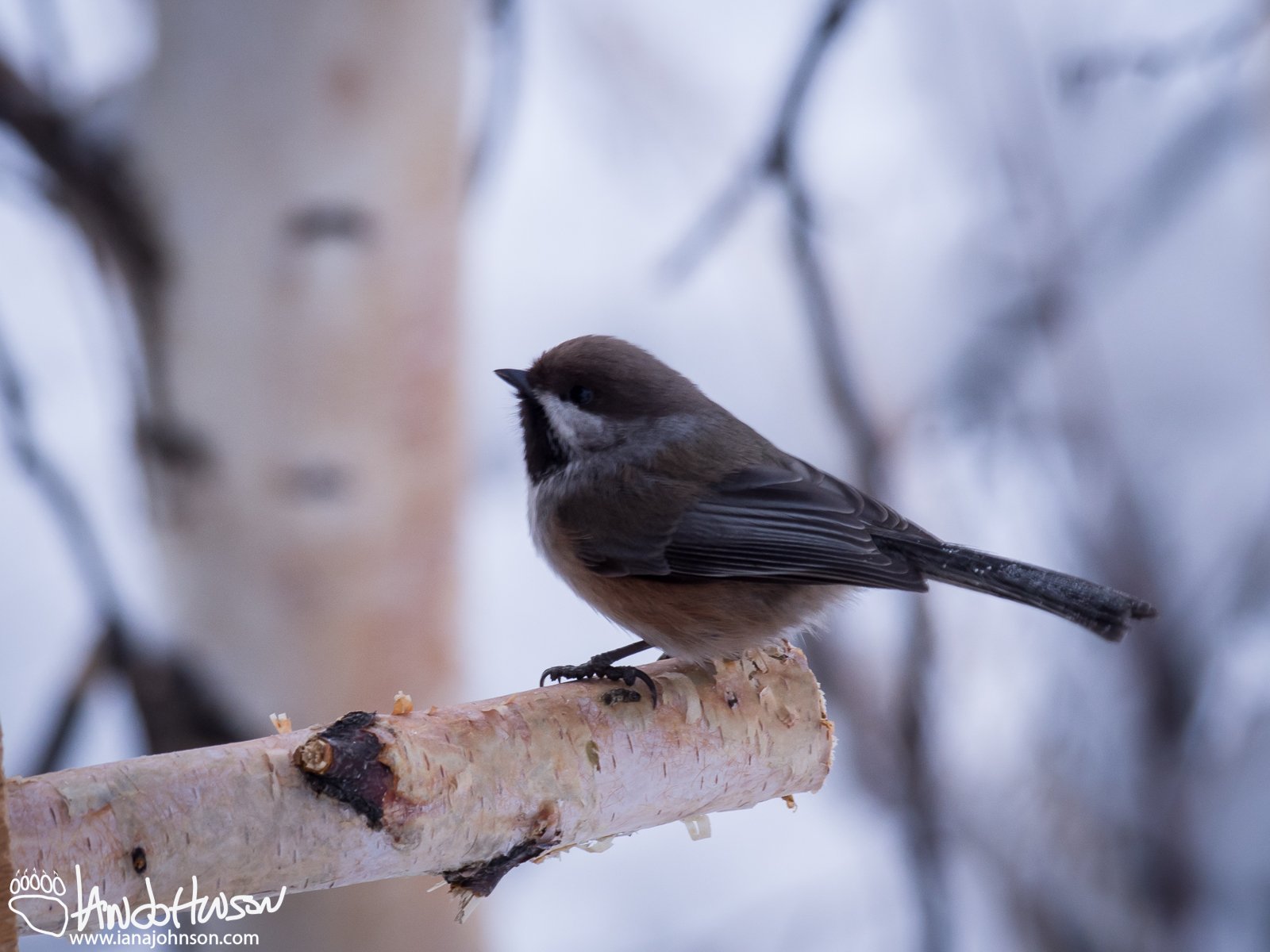
11:37 AM : A boreal chickadee poses for a cute picture just outside of my house
11:37 AM : A boreal chickadee plans its next move at my feeders outside of the house
11:37 AM : A boreal chickadee looks before it leaps and is eyeing up some suet.
11:39 AM : Red-backed voles are a common Alaskan rodent. I have counted up to eight at a time under my feeders scavenging what they can find.
11:39 AM : Red-backed voles are a common Alaskan rodent. I have counted up to eight at a time under my feeders scavenging what they can find. Red-backed voles have actually been demonstrated to spend a large portion of their days in black spruces which is a recently documented behavior!
11:43 AM : A sharp tailed grouse sits under the spruces.
11:43 AM : A sharp tailed grouse sits under the spruces. This seems to be a pretty normal winter behavior – move as little as possible to conserve energy.
12:06 PM : The sharp-tailed grouse is actually a pretty small bird. Tucked up high in the spruces it is safe from almost any predator present in the Alaskan winter. Most raptors have migrated for the season, although a lingering great-horned owl could get bold and try for this big meal!
12:06 PM : Sharp-tailed grouse moved to the birches to pick at the catkins
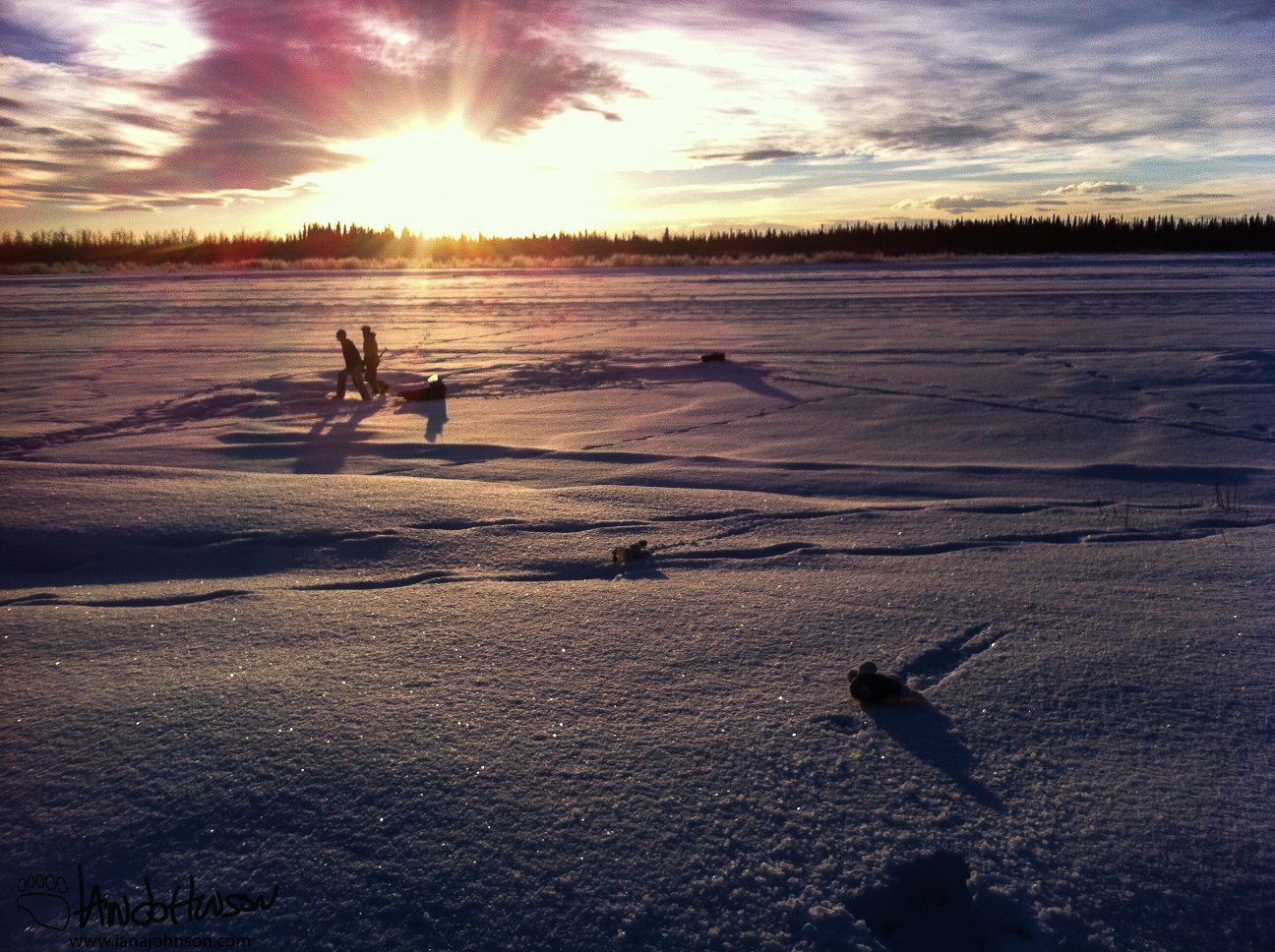
2:18 PM : I spent the afternoon drilling through the Tanana River to set burbot lines. The ice was thick! About 36 inches. However, early in the season the river broke up and formed "jumbled ice". The shadows of small snow-dunes are beautiful!
2:18 PM : I spent the afternoon drilling through the Tanana River to set burbot lines. The ice was thick! About 36 inches. However, early in the season the river broke up and formed “jumbled ice”. The shadows of small snow-dunes indicate a rough texture underneath!
4:29 PM : As I got back into town the Alaska Range (South of Fairbanks) was lit up by the low sun. The mountain range is always beautiful, but on nights like this you cannot stop watching! The pinks and purples of this sunset were amazing!
4:29 PM : As I got back into town the Alaska Range (South of Fairbanks) was lit up by the low sun. The mountain range is always beautiful, but on nights like this you cannot stop watching! The pinks and purples of this sunset were amazing! This is easily my favorite panorama to date because it is a view I get to enjoy everyday, and this picture captures it well!
4:32 PM : The sun is almost ready to disappear. We've gained an amazing amount of time back since December 21st when the day length was 3.5 hours. Todays day length is just over 5 hours!
4:32 PM : The sun is almost ready to disappear. We’ve gained an amazing amount of time back since December 21st when the day length was 3.5 hours. Today’s day length is just over 5 hours!

2014 in Review : A Good Year!

It’s incredible that one 36th of the year is already gone as I type this. Weren’t we just clinking champagne glasses as the ball dropped in New York just last night? As 2015 begins, I wanted to take the time to thank all who support this blog and my writing. I would not just write to myself; your comments and input are much appreciated!

I am incredibly thankful for my time here in Alaska. My travels have taken me to hundreds of miles south to enjoy the coastal ranges in Anchorage and Seward. In the opposite direction, I have beaten the punishing gravel of the haul road to cross the Brooks Range onto the Northslope three times. Within the Alaskan wilderness I have hunted big game, fished its rivers, and enjoyed bears, fox, and wolves, along with a plethora of bird species. During the dark skies of winter I have been graced by the dancing Northern Lights and cloaked in inky darkness. I have found there is always something to do in Alaska, and I feel that in the last 365 days I have had the adventures worthy of two year. It has indeed been a good year!

Below is a small gallery of the hundreds of photos that have been taken in Alaska during 2014 and featured in the blog. I have opted out of any captions, but if you would like to know more about an image, leave a comment. Thanks again everyone, and here’s to 2015!

January


Burbot Fishing

P1260008

February


P2131151

P2210770

P2120449

March


P3030128

P3090080

April


P1011625

P4300018

May


P5010171

June


P6220008

P6270123

P6280121

July


DSC00451

August


P8070762

P8081088

September


P9120879

P9110016

P9062154

Igloo Campground Fall Color Pan 2

October


PA040042

November


PB151929

PB101310

PB140005

PB080288

December


PC011626

PC150102

At the Bottom of Winter : Alaskan Tradition

This composite of the sun was compiled from 6 shots throughout the day. Quite beautiful! The composite was compiled in the "Star Trails 2.3" software.
This composite of the sun was compiled from 6 shots throughout the day. Quite beautiful!

For months we have been losing daylight. June 21st marks a daylight decline which has defined cultures and natural systems in Alaska for millenia.  The short days of winter psychologically effects the mind and  physically alter the body. As it we roll out of our beds the morning after solstice we know that today is just a little bit longer the last! It is uplifting. Until that moment when the days lengthen, the waning light indoctrinates residents into the darkness. You simply get used to doing things in the dark! The changes of daylight we experience now have been celebrated by the traditions of the Inuit and Athabascan people of Alaska; their traditions are symbolic of change and new times. The Athabascan name for the solstice is “dzaanh ledo” which means “the day is sitting”. This description of the actual phenomena that defines solstice is fitting, the day is not gaining or losing time; it is stationary (ttp://goo.gl/cFN613). The Inuit of far north Alaska experience times of no sun at all, and during solstice communities held feasts where shamans prayed for the communities. Meat was eaten by each individual at the same time, and each person eating the meat focused on Sedna. Sedna is a diety of the Inuit underworld and a god of marine animals. After the meat was consumed, water was drank one person at a time in succession, and each person stated the time and place of their birth. To the Inuit this distinguished the summer and winter people. After a trading of gifts, the festivities ended by extinguishing lights in all of the homes which were kindled by a common, newly-lit fire garnering a new relationship with the new sun (http://goo.gl/aRyByZ). Inuit people were able to indentify the solstice when the star Aagjunk (literllaly “sunbeam”) lay directly below the sun which, although unseen, was just below the horizon (http://goo.gl/Rzzttg).

The solstice occurs at 8:30 PM in Alaska, but occurs at different times throughout the world (http://goo.gl/G6QEvw), and rekindles hope that winter is ending and that the new day will be longer.

I shot this timelapse of the Solstice sun on December 19th to give you a feel of the solstice sun (fear not, we only lost 2 more daylight minutes by the 21st). In Fairbanks Alaska, it barely crests the Alaskan mountains (Mount McKinley/Denali visible) before dropping below the horizon again. You can always check out the timelapse of summer solstice when it it never sets in the land of the Midnight Sun. Happy Solstice!

Finals Week Aurora Borealis

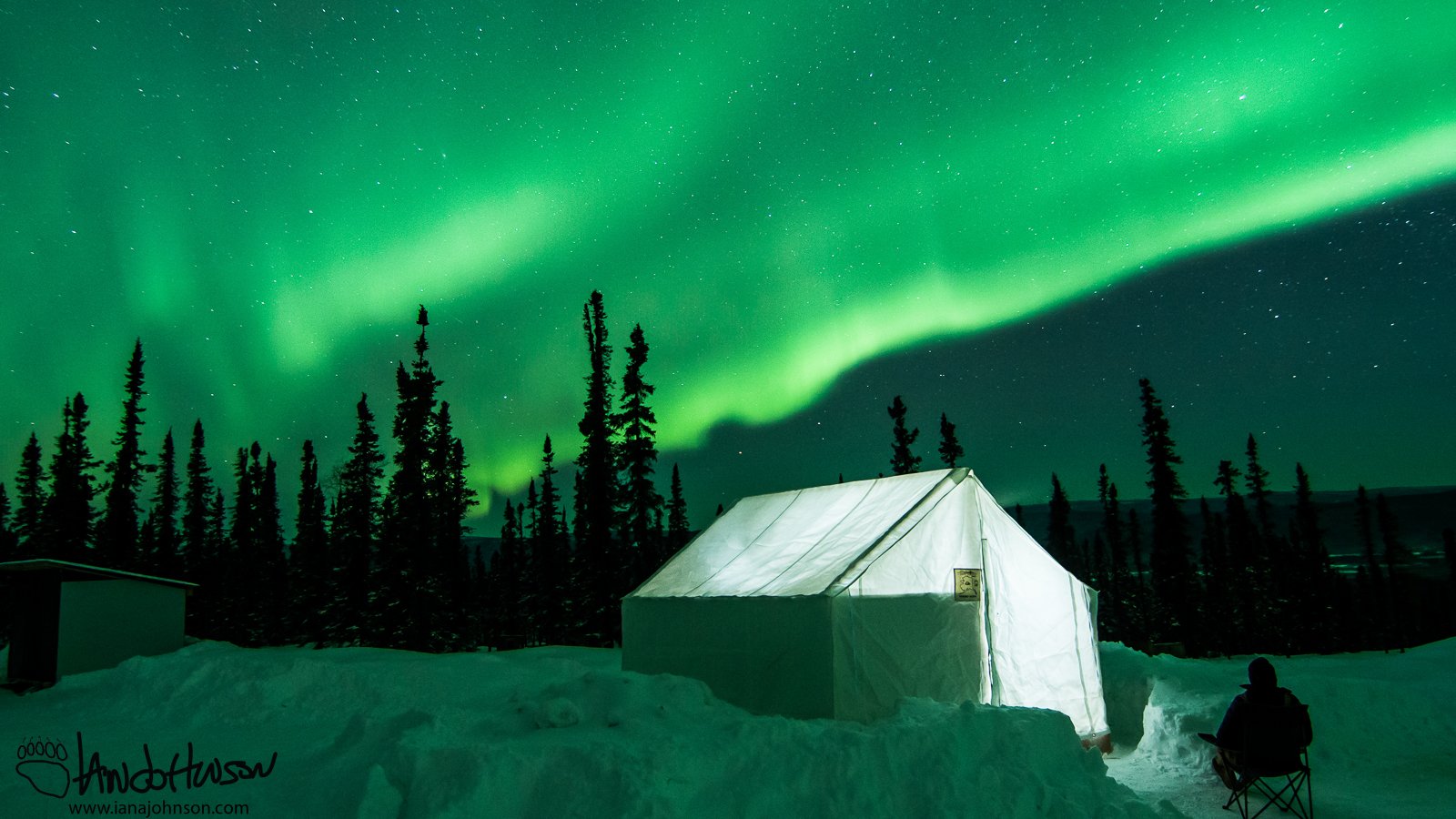
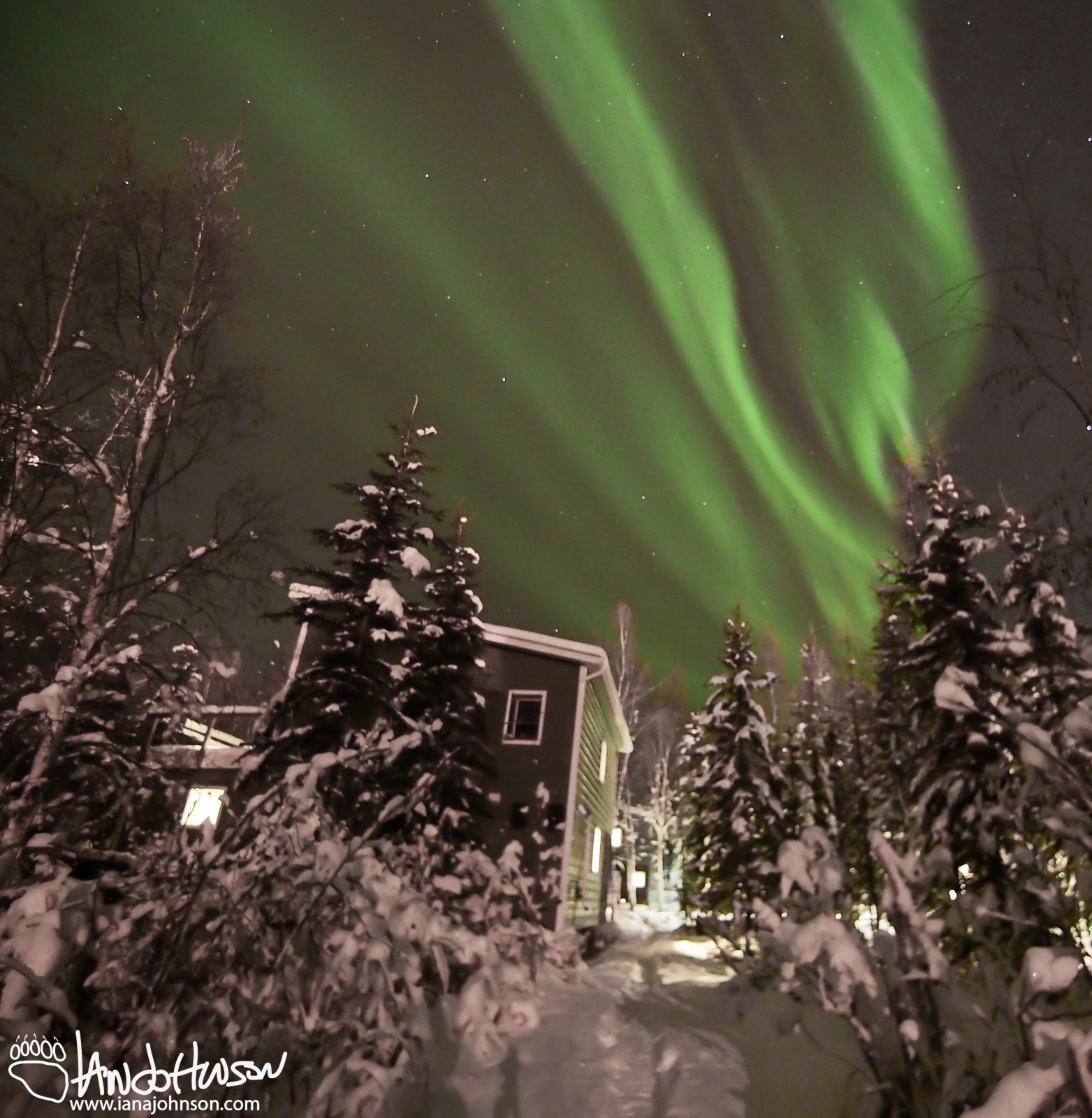
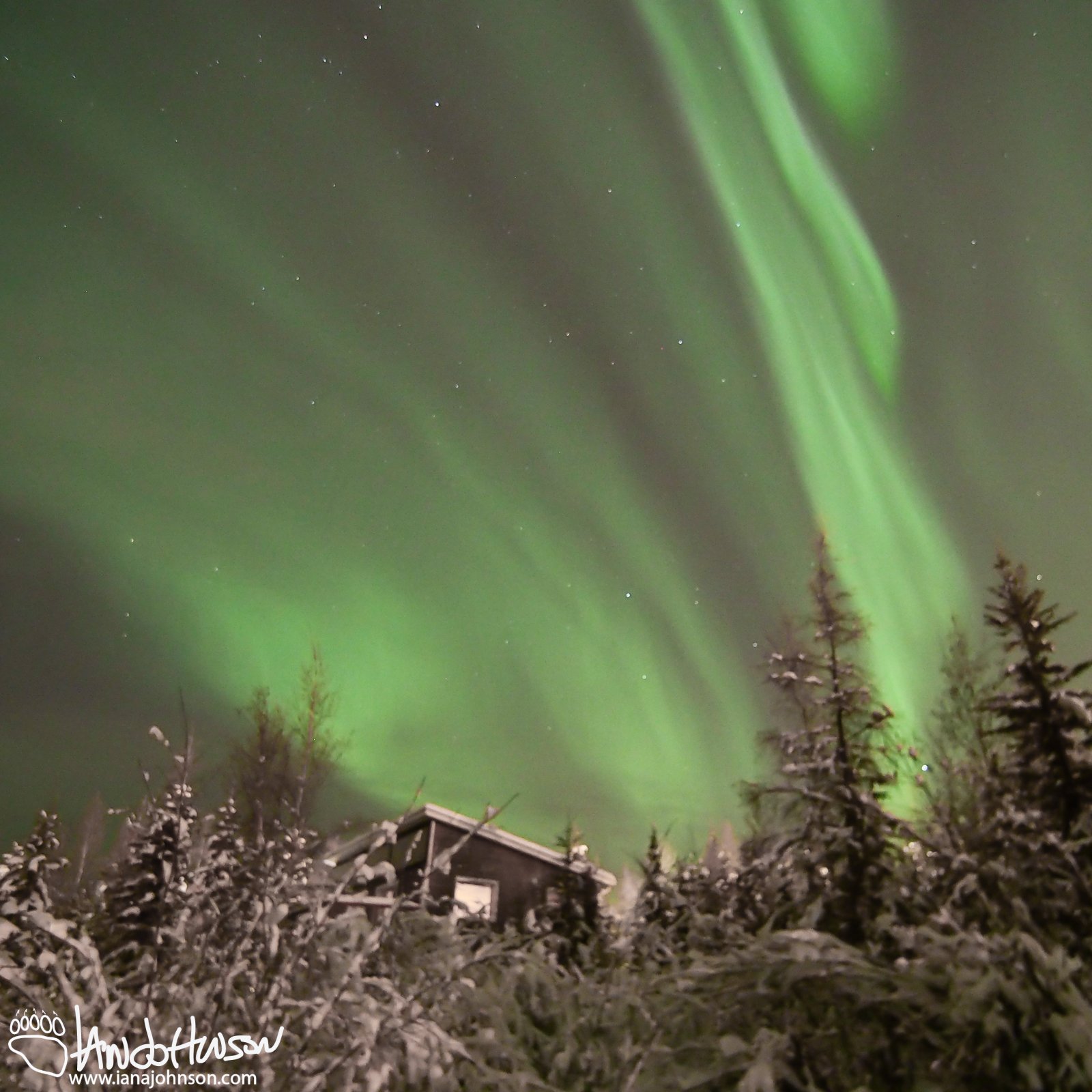
It’s finals week here at UAF and that means no sleep because you’re studying… or, because the aurora is out! Last night I simultaneously watched the aurora “oval” (i.e. the prediction of aurora visibility as provided by NOAA Space Weather) on my screen and studied for my evolution exam on Tuesday. When the aurora perked up overhead  at 10:30 PM I abandoned my books, and headed outdoors. For the sake of my education, I decided to stay close to home last night and shoot over the UAF Sustainable Village so that I wouldn’t stay out too late. It was a stunning night to be out!

I am continuing to improve on my timelapsing technique. Last night these images were shot at 1sec with no buffer for card write in the middle. In the past I have left 2 seconds for card write. Often in those two seconds the aurora changes so much that a small gap has been created. You’ll notice without that gap, that the Aurora is silky smooth! Although this isn’t real-time, at 1 second intervals it’s getting pretty close! The 1 second exposure captured the vertical banding of the high aurora well.

Here is the timelapse from the night:

And, here’s the imagery.

The Green flame morphs a little bit over the Sustainable Village. A beautiful night out!
A Facebook Follower described this as a 'green flame' to me this morning. I think that's a pretty apt description!
A Facebook Follower described this as a ‘green flame’ to me this morning. I think that’s a pretty apt description!

PC150651

In all of these images I have desaturated the foreground to remove light pollution. I think the effect is pretty nifty!

Moonlight Winter Wonderland in Black-n-white… or Color?

I’m looking for your opinion. In the future,  I’m going to try ask questions of you (the readers) more often, because you all always have good insights, and I love to hear from you!

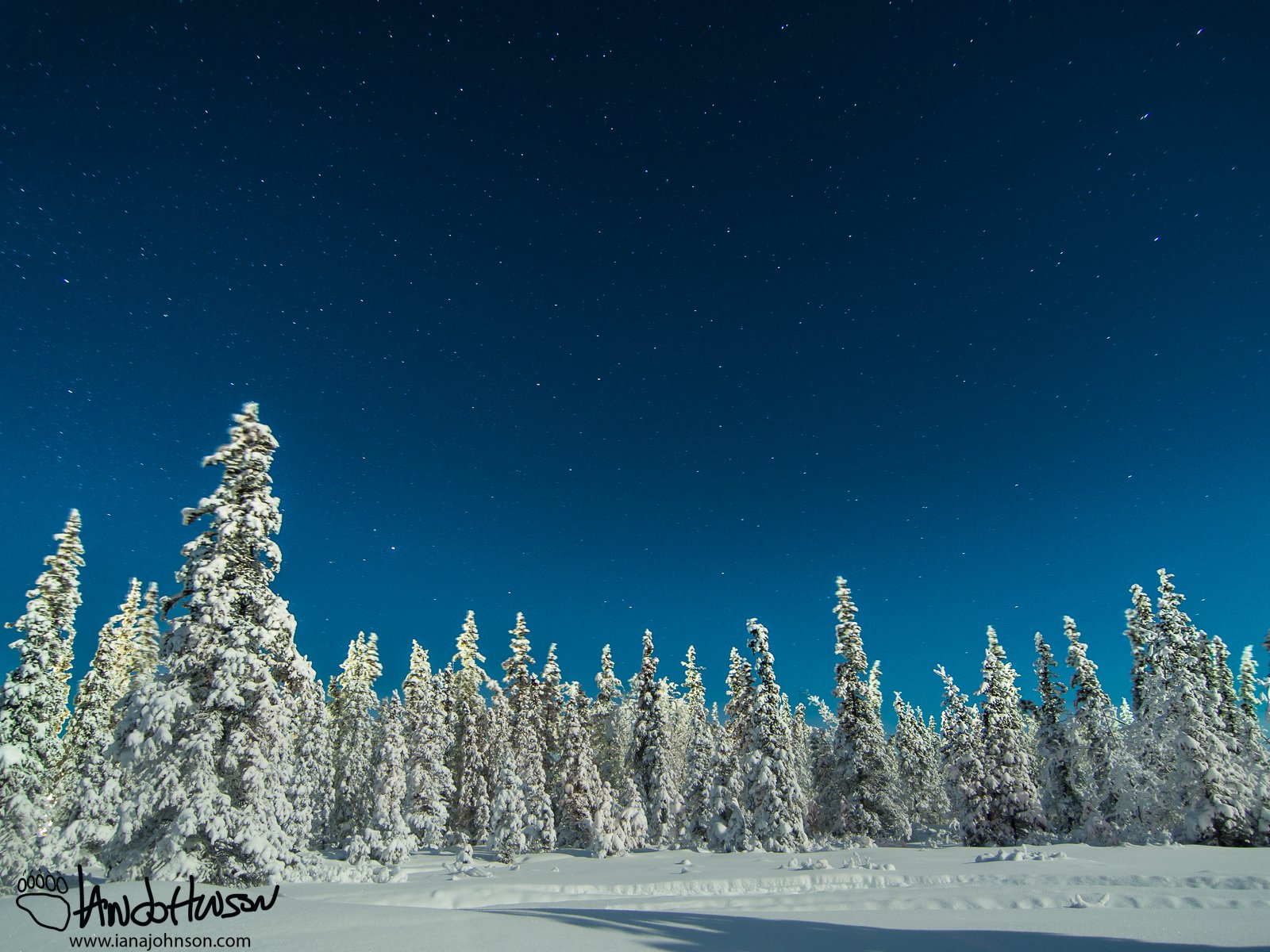
Last night was a simply beautiful night in Fairbanks. We received a lot of snow over Tuesday and Wednesday, and typical windless conditions in Fairbanks have left it hanging on the trees. A 90% full moon floated to the south over the Tanana and the temperatures hung around 8 below. It was the kinda of night you could read a book by! I was out chasing the aurora, and the data online looked AMAZING, however, I think a northern facing magnetic field kept the show at bay. In the end, a smudge of aurora was the best it got.

Of course, no aurora does not mean no pictures. So, now here’s the question. How do you prefer to see the moonlit landscape of Fairbanks? In black and White? Or in color? I think this is a case where black and white wins the day – but maybe you think elsewise?? These images will open in a gallery if you click them for easy comparison. Let me know! 🙂

This small band of aurora was the best that the heavens could conjure last night. Still a beautiful night to be out!

Experiencing the Aurora Borealis in Denali National Park

This last week has been really amazing in regards to the weather in Fairbanks, Alaska. While my Minnesota family and friends hunted whitetails in 20 degree weather, we enjoyed temperatures nearing 30 degrees all week. To boot, it was sunny, you betcha! The Geophysical Institute forecasted high aurora activity starting on Friday night the 14th and extending all the way through Monday! With the warm weather, and aurora forecast it was just a matter of deciding where to go!

Panav, Logan and I arrived at the gates of Denali National Park at 9:30 PM. The winter regulations only allowed us to drive in 3 miles, and from there we packed our gear another 1.5. We located a place where the black spruces were shorter, and the mountains stood tall around us. The heart of Denali Park was absolutely dark, and as far as I know we were the only ones in the park that night! Meteors from the Leonid meteor shower flashed overhead leaving their long trails and thrilling the watchers on earth. This shower peaks on 11/17/2014 – so be sure to check it out if you have some clear skies tonight! Over the mountains, the aurora was already building as our three shutters started popping, and we did not have to wait long for the lights to explode around us. Energy of the northern lights always seems to originate from on horizon, and on this night the jagged horizon in front of us swelled with an intense green light that erupted overhead throwing pinks and greens in racing lines overhead.

The building aurora over Denali had a real treat in store for us! It was almost a year ago that I posted about my first “incredible” (I use quotations because they’re all pretty amazing) aurora, and I tried to explain the corona of the aurora. Officially, it is defined as “a circle of light made by the apparent convergence of the streamers of the aurora borealis” (MW Dictionary). My analogy was to think of single beam of the corona as a pencil, which you balance on your nose and then concentrate on the eraser; the corona is made of hundreds of green, red, and pink ‘pencils’! It is fast moving and pulses with energy. I am happy to say that I’ve captured a corona on timelapse for the first time!

Before leaving you with the the timelapse and images from the night I would like you to know I now have a page on Facebook, come check it out and follow along : www.facebook.com/ianlww. Thanks all!

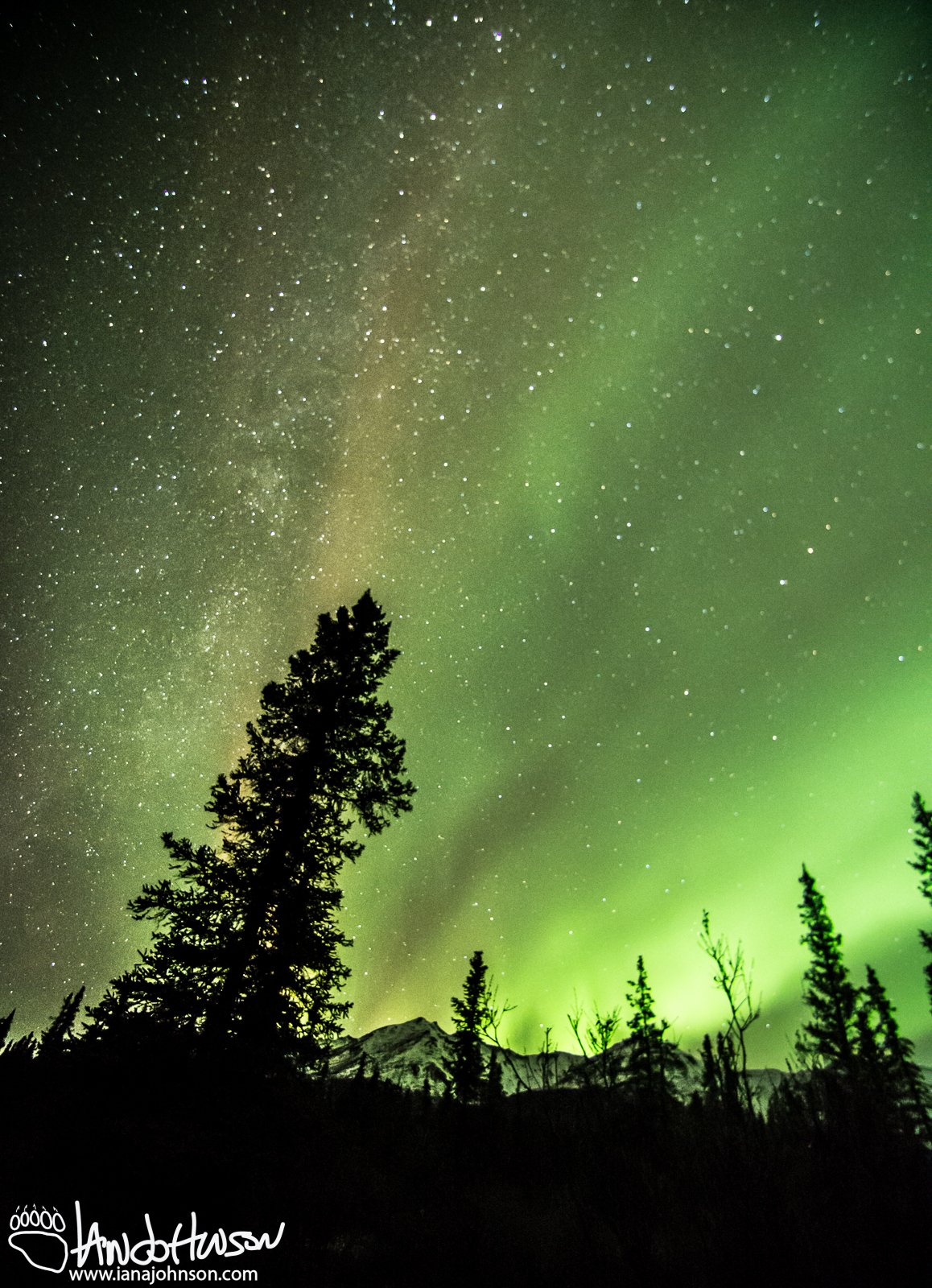
The Milky Way and Aurora Borealis collided in Denali National Park! What an incredible thing to see!
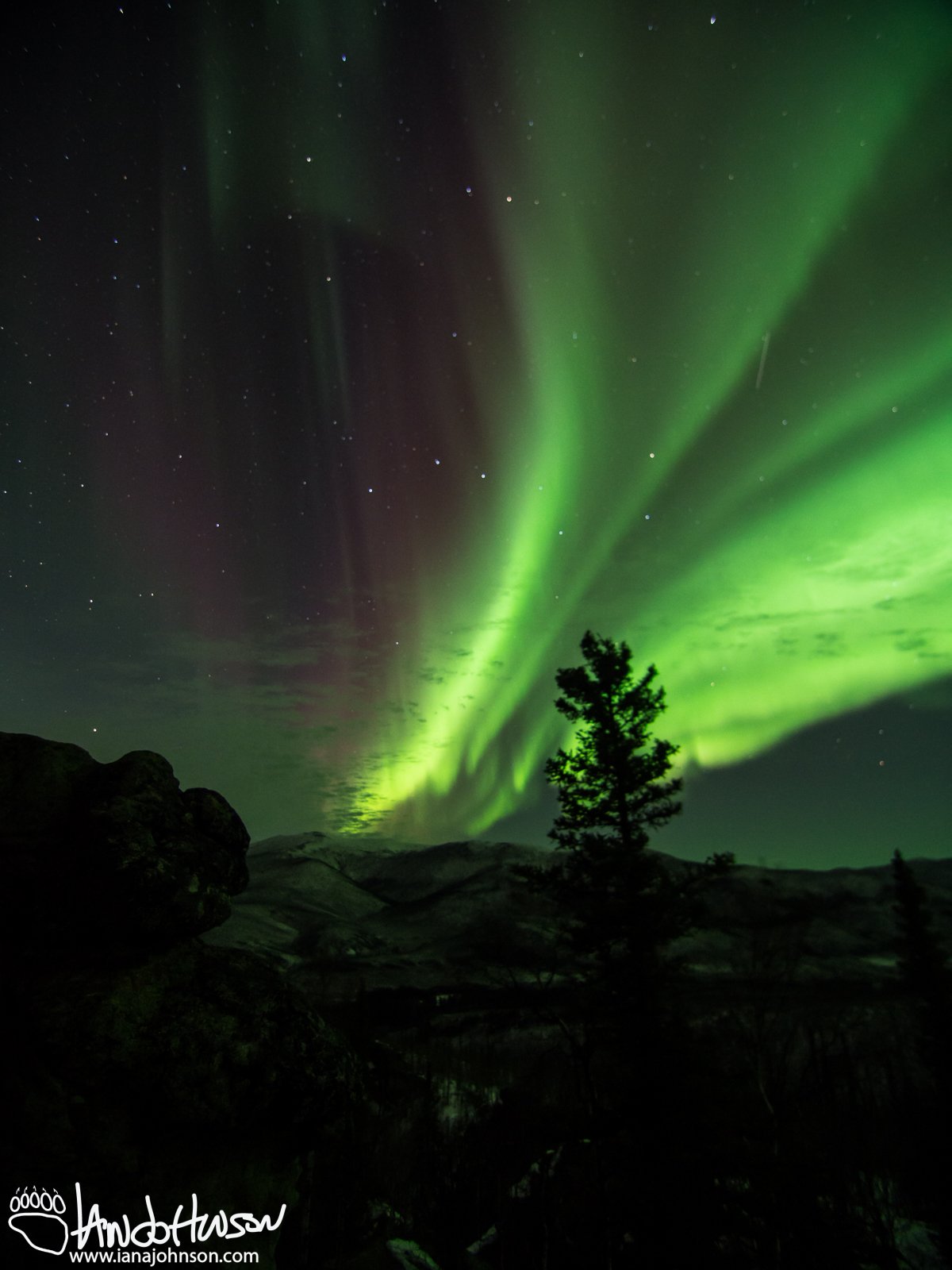
A huge flare of northern lights dance across the sky in Denali National Park
A small ribbon of pink pulses behind the black spruces and over the mountains
An image of the corona 'pencils' flashing overhead!
An image of the corona ‘pencils’ flashing overhead!
The corona often has a focal point where the beams of light originate from. You can see that focal point here.