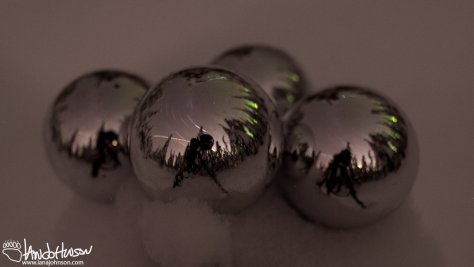
The feedback on An Early Christmas Part 1 has been really great, thanks! I wanted to share with you how I have embellished on that first concept of shooting Christmas ornaments under the Northern Lights and also get a bit poetic about the aurora. The aurora this week has been remarkable thanks to a coronal hole from the sun allowing high speed solar winds to reach earth.
I walked out on the ski trails behind my house because the broad and brilliant band of aurora overhead indicated to my aurora-sense it was going to be an early showing. I meandered through snow covered trees maintained in their icy encasement by complete lack of wind for nearly two months. The trail was firm, but as I stepped off my body sunk into thigh deep snow which even though it had fallen 6 weeks ago, was still perfect, soft powder thanks to consistently cold temps. In fact, on this night my breath steamed away at -15F, and a few days earlier I woke up to -23. My anticipation grew as the aurora continued to build in strength and at 10:30 PM an auroral bomb exploded in the sky. The metaphor of a bomb is perfect because it was so sudden that I was caught off guard, and was forced to shoot my camera where I stood in an effort to capture adequately the green and pink shrapnel which rippled and writhed in the sky. The explosion caught me in a towering cathedral of spruces which in the images all point to the source of the disturbance. In five minutes the waves of light ended, but it was only the beginning of series of barrages that kept me awake and in awe until 3AM.
“The Lady Slipper” – In a towering cathedral of spruces that point to a brilliant display of aurora.“Aurora around the bend” – The ski trail I was on rounds the bend, and makes me wonder what views would have awaited if I were not rooted to the spot.
I have been building on the initial ornament concept in a few ways. Although it is difficult to hide a camera in front of a mirror, I am placing it in ways that is not obtrusive. From its hiding place I have shot a full 90 minute star-lapse in the bulb! That image, featured below, is the only one not taken on the night I described. I have also shot a full time lapse in the ornaments which turned out quite wonderful! I hope you enjoy the festive twist on the aurora 🙂
This concept shot builds on the original in An Early Christmas by shooting a 90 minute star-lapse!
Now that we are past Thanksgiving I am definitely in the Christmas Spirit. I took my festive passion into the Alaskan wilderness last night to fuse together a little Christmas Cheer and the aurora borealis. I sat in the waist deep snow and tossed Christmas ornaments into the powder as I belted Christmas carols and watched a crescendo of pink and green aurora dance over my head like the twinkling lights of a monstrous, celestial Christmas tree. Of course, there is no reason to put a star on top of this metaphorical tree, it is a tree that is covered in them, not crowned with one. There were no presents under this tree, because it was already a gift. I had a lot of fun doing this shoot last night, I hope you enjoy!
If you are interested in a one-of-a-kinda Alaskan Christmas card and before you send your greeting cards this year, consider a purchase from my Fine Art America website. To browse a selection of these images as a greeting card, framed print, phone cover, or many other products please visit my page : Ian’s Fine Art America.
Merry Christmas!
I experimented with a variety of arrangements through the night, but I trended towards ones with color in front.
The aurora is reflected perfectly in this shiny Christmas Ornament
A drop of green aurora fell from the sky and landed in the snow 🙂
I took advantage of this fully covered black spruce to make a Christmas tree!
The hoar frost on top of the snow just adds to the beauty of the scene!
I love the splashes of color the Christmas Ornaments provide!
I am reflected in this stack of Christmas ornaments 🙂
A big moon shadows the ornaments, and is a brilliant aurora reflection shines from overhead.
I love the reflection in these ornaments!
A full sky of aurora. I stood nearly waist deep in the snow and framed up this wonderful leaning tree.Brillant pinks are a sign of strong aurora! Lots of energy last night.Crouching low to the snow I watched the aurora flow through and over the moon.A beautiful full sky of swirling aurora, like oil in water.
Last night I did it again, and I enjoyed every minute of it. Yup, when I bring someone out for their first aurora and they are so excited that they can barely stand, I share in that excitement. Their grin is my grin and their joy is my passion. Their exuberance was warranted, as the aurora put on a beautiful show for us over the dogyards of Black Spruce Dog Sledding and for Alaskans across the state. It was hard not pull up one of the empty sleds that beckoned to the watcher to layback, relax, smile, and enjoy the show. It truly is a beautiful world.
If you are interested in purchasing “Take A Seat for the Aurora”. Please top by my Fine Art America Site 🙂
A Happy Trio under the Aurora!
This image of empty sleds beckons the viewer to come take a seat and enjoy a beautiful show.
The aurora creeps in over the Dog Yard of Black Spruce Dog Sledding.
A powerful flare of aurora threatens to blow out this image. Such a beautiful scene!
The aurora lights up the scene behind these snow-laden black spruces.
I never leave out the horizon in my shots, but did in this one for some reason. And you know what – I kind of like it! The milky way is showing up alongside the aurora in this shot.
Jason and Megan were visiting Black Spruce Dog Sledding, and I was more than happy to get an image of them under their aurora. A great couple!
Wide vistas over Murphy dome showing off a beautiful sky.
It has been awhile since you’ve heard from me, but all of that is about to change as I get my blog’n legs back under me. Until now I have been prioritizing my thesis which has now been defended. There will be several upcoming articles on the results of my work. I see no use in writing it if noone is reading it! I deem the upcoming articles as science communication”, and I hope you will find them informative.
I want to give you an update on the calendars too. Thanks SO MUCH to those who have purchased one. The response and feedback to them has been tremendous. I am now on my second and last printing. If you have been considering ordering one, now is the time! Visit: https://ianajohnson.com/customproducts/index.php/product/2016-alaskan-calendar/
Now onto the meat of this entry. Yesterday was my first day back in Fairbanks after being away for over 10 days. When I left, the remnants of a huge September snowstorm (17″) still lingered on the ground in low, shaded areas, but for the most part the ground was barren. It is amazing how only 10 days can change that. We now have 16″ of pure powder on the ground which is maintained by cold nights. Yesterday morning when I awoke it was -15F with a promise from forecasters that those temperatures will continue through at least this week. A seasonally late sunrise began at 9:15, and by noon the low light illuminated the tree tops and extenuated the shadows. I nearly skipped with joy into the spruce bog behind my house where snow hung on the trees. I passed under trees that with a touch would have doused me in snow, and found pure joy in the beauty of this winter wonderland.
Later that night the landscape of refracting light and black spruce shadows transitioned to twinkling stars shining through a moonless night. I retraced my steps from only a few hours earlier and watched as the aurora built to the north. I watched for awhile and smiled outwardly at my knowledge of the stark contrast in light from just hours earlier.
The sun highlights the top of a snow-pillow smothering an arched black spruce.The dynamic light of the landscape is what makes it so beautiful. Shadows of the low sun contrast heavily against lighted spires.I really like how the black and white contrast of needles, snow, sky lend themselves to back-and-white photography.The sun erupts through a gap in the trees, but has no heat this time of year.The large snow-load has bent many of the black spruces over. They will rebound in the spring once their burden has been lifted.At night, the aurora lit up the landscape where I watched the the sun play across the tree tops hours earlier.A combination of short and tall black spruces creates a beautiful effect in this winter wonderland.This starspin shot was set up for 2 hours. Focusing on the north star, it is amazing to see how much they shift over that time!
I jumped when my alarm went off at 11:30 PM, and I looked at my surroundings to remind myself where I was. The sleeping bag wrapped around me and my reclined seat reinforced I was in my truck as my blurry eyes brought the steering wheel in focus. My memories flooded back to me; I arrived 30 minutes ago, and with no aurora in sight had set an alarm and took a nap. I was expectant that a G2 storm forecast was going to pay out, and as I peered out of trucks window it seemed I was in luck. The aurora was starting to show a band high in the sky. I turned the ignition, and drove down the road to find the “perfect”, golden tree – my goal for the night was to fuse autumn colors and the aurora together.
I stood on the road with my head craned up, watching a beautiful, green aurora band overhead. This aurora was Mr. Jekyll which soon morphed into Mr. Hyde – albeit a beautiful version of him. I was not ready for the full force of the aurora as it transformed the sky into a green and pink blanket of shimmering, dancing lights so different than what I had been looking at minutes earlier. The energy that rolled overhead, I learned later, was the result of a monstrous, KP7 event, that pushed the aurora into Washington and the Midwest. I was so overwhelmed by the aurora that I expressed myself by simultaneously singing, praying, and taking pictures by myself under the vast display of lights. For those who know me, you might guess that I was also grinning broadly from ear-to-ear. My smile would not have disappointed you!
For parts of the night, my only focus was to capture the overhead aurora corona to the best of my ability. The last time I successfully captured the corona was in Denali National Park last year. I couldn’t be more happy to show you this gallery of images from last night – there were many more taken! The gallery is chronological, and hopefully gives a sense of the scale of the aurora and how quickly it built. These images are taken at 9mm, and hence have a ~120 degree field of view!
This road points E/W and the fact that the aurora started on the left (south) side of the road indicated a huge amount of energy coming in!
This image was captured with my camera pointed directly to the south. Intense greens that reach far into the sky.
Autumn colors in the front of a striking green aurora
Autumn colors in the front of a striking green aurora
A panorama capturing this vibrant band of aurora stretching across the southern sky.
A towering green aurora.
Multiple bands of aurora swirl together.
This image was taken due south and towers high into the sky.
Aurora coronas occur during high energy. A focal point forms in the aurora and its the only thing you want to watch – it is impossible to tear your eyes from it!
This image is 120 degrees wide. Hopefully that can give some perspective to the proportion of the aurora in the sky!
The corona of the aurora broadened and began to show vibrant pinks.
This insane push of energy came from the north and quickly grew.
The aurora is punctuated by a intense white band.
Like two circus performers, this these bands of aurora are folded together like they are dancing with each other.
Swirling greens of aurora during a incomprehensibly large push of energy.
The aurora opens up in a broad sickle that I think looks like an ear.
This particular auroral formation takes one last swirl before dissipating.
By 1 AM the aurora was still broad across the sky, but became less structured. Brilliant pulses of light races across the sky in waves rather than bands.
The trees in this image have been “light painted” so they show up and fuse together autumn with the aurora.
Mission success! Capturing this full-sky aurora over some beautiful autumn foliage.
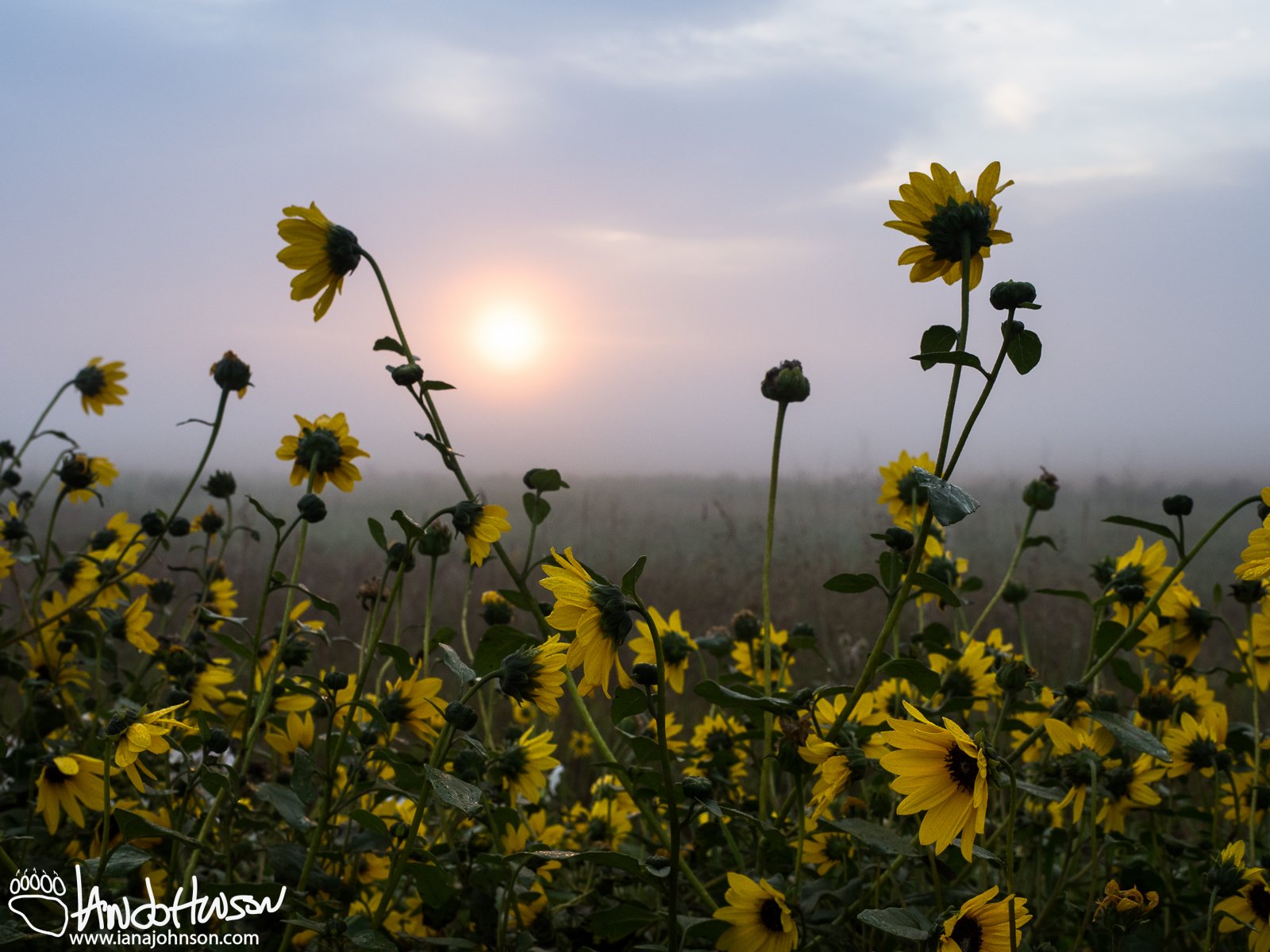
“August in Minnesota” has a connotation to it for those who have lived here long enough. Hot, sticky, humid days boost electricity bills as air-conditioners stay on full time to beat the heat. A result of the moist conditions is heavily dewed grass in the mornings. I stepped outside and thick fog hung in the air. It was 7:00 AM, and the sun was beginning to burn through the mist with some filtered reds and oranges. A large moon hung high in the sky, and my truck passed under it on my way to our land in Butler, Minnesota. Pulling up, I unlocked the gate and pushed it open. Dew hung heavy on the grass and bejeweled thousands of spider webs across the 30 acre pasture. In a few moments I had my camera in hand as I passed through the knee high grass.
Many of us have a location that we’ve visited many times, and a stop there brings back many important memories for us. For these spots, there are peak experiences when conditions or moments are at their best. This sweaty, August morning was one of those for me. The foggy sunrise catalyzed the transformation of the scene from dewy, shadowed pasture to a hot, new day. As it did so I tried to capture the beauty of the morning dew on the webs and flowers that it encrusted in shiny droplets. Some of the spider webs had drops so large and heavy that they reflected the world over-and-over while dragging their grass pylons down around them with their collective weight. I feared a slight wind would cause them to drop off before I was done.
The sun rose higher and I turned my meandering around; I was headed south but turned to heading north. I passed along the edge of the grassland and sank below a small rise. As I came over the top hill my eye caught movement and then the body of a deer. The deer (Odocoileus virginianus) was a small fawn accompanied by its mother. Somehow I had caught the attention of the fawn only, and the mother continued to graze. His curiosity got them best of him, and he started to walk towards to me. I stood post-like with camera clicking. By the time the fawn was satisfied that something wasn’t-quite-right he stood 10 yards away. The mother had moved silently up the hill and stood about 20 yards away to contemplate me too. Finally she stomped a foot, snorted, and brought her offspring into the shelter of the woods.
My conclusion to you is this : every day is a new day, and you can only go enjoy what you go to see. If you have a favorite spot, I challenge you to go experience that location when it is at its best.
The sunrise begins to pierce through the mist, and illuminated this ditchful of black-eyed susans (Rudbeckia hirta)The large dew drops on this spider web performed the function of thousands of magnifying glasses. Each water drop magnified within itself the unfolding sunrise beyond.The collected dew on this spider was was so heavy that the grass bent under its weight. Already the sun was high in the sky and drying the landscape out.A Meadow Goat’s Beard (Tragopogon pratensis) holds on to dew drops in the morning.A honey bee flies up to sip on the nectar of mullen (Verbascum thapsus) flowers. The honey bees on our land are a great asset for pollination!This dragonfly was too cold and wet to escape, so he perched waiting for the sun’s warmth.A monarch caterpillar clings on to a milkweed.These orb weaver spiders were very common in the pasture. Although I did not capture it in this image, they weave an incredible zig-zag patterns into their web called a stabilimentum. The patterns reflect UV light and are thought to attract prey.
A young white-tailed deer steps forward to get a look at me. Unable to quite decided if I was dangerous or not.
The mother of the young buck scopes me out after being alerted by her offspring.
This young white-tailed deer buck ended up within 10 yards from me in his quest to figure out what I was.
The white-tailed fawn is scouting me out here from about 18 yards away.
Getting a bit closer! This white tailed deer comes forward to check on me.
During my trip home to Minnesota I have taken what I have learned about aurora watching in Alaska, and transferred it to conditions in the midwest. In doing so, I traded watching the aurora over snow drifts to squinting my eyes over bean fields with moderate success! A big push of energy from the sun has elevated geomagnetic energy to KP 6 or a G2-“Geomagnetic storm level 2”, which boosts the aurora to Minnesota, and even beyond. The two nights I chased the aurora brought success in both capturing the aurora in central Minnesota, and for playing with some new techniques which I will be honing in the upcoming year and are featured below. I would love to hear your feedback!
This timelapse below is fairly short and does not have a brilliant aurora, but does give a great idea of where to look for the aurora in Central Minnesota. During this G2 storm. In Alaska the aurora during a G2 storm would be far overhead and taking up the whole sky. In Minnesota it rose slightly above the horizon. Viewing would have been better if the smoke haze and moonlight could have been removed.
The first night that I chased the aurora, a strong wing was rapidly pushing the clouds past this moon, which was fortunately setting. I really like the wind in the trees of this particular shot, as well as the long shadow cast by the moon.This star spin shot captures a 1.5 hours timelapse of star movement in the sky. Fortunately I captured the faint glow of aurora on low on the horizon, and directly below the pivotal star – the North Star.
One of the techniques I am very interested in growing is the ability to capture full panoramas of the milky way. The progression of images below shows a little bit on how that works. I learned a lot in this first attempt. A few key findings : 1) find the darkest skies possible! The light pollution shows here. 2) need to have more overlap in the shots 3 ) I tried to capture the whole galaxy in one sweep of the camera. I now know I can stitch multiple rows of shots to capture a larger area 4) keep the ISO of the camera low-ish to reduce noise. For those reading this with experience in capturing the Milky Way, please contact me, it would be great to pick your brain!
This image does a nice job of capturing a single image of the Milky Way. However, I would like to find darker skies. By taking multiple shots with the camera on the same plane, I can stick them together into the results below.Here is one of the things I am struggling with in capturing a full panorama of the Milky Way. This image has a gorgeous amount of contrast, however, after stitching, I did not have enough horizon to create an image that can be cropped well. I would love to get feedback on the best way to straighten and correct these images.This image is the best example I have of stitching the Milky Way, but is far from the entire arch. I do really like the bit of aurora that shows up here. Hopefully I can apply what I learned in my next attempt!This image of the aurora was taken in Rice, Minnesota during a G2 auroral storm. If it weren’t for the moon and the haze it would have been a much nicer show!
I have done a lot to curate my aurora gallery on Fine Art America. I would love if you checked it out!
Alaska is famous for its rivers which fill with salmon each summer. Each species comes at an expected time, first the kings (chinoook), then the reds (sockeye), and finally the silvers (coho) and pinks. Anglers throughout the state pursue them by boat, rod-and-reel, and nets depending on the location and intent. A specific section of the Alaska fishery is deemed a “personal use fishery”. Even more so than other fishing regulations, harvest in these regions is meant to fill freezers for the upcoming winter. Alaskan residents are allowed to use a variety of nets on poles to harvest up to 25 salmon each.
Chitina River is a 112 mile tributary of the Copper River. As of July 28th, 2015, 1,341,545 sockeye salmon had made the run upriver (adfg.alaska.gov)!! The abundance of fish attracts hundreds of fishermen each day. The Chitina River is highly braided and variable in depth, and flows out of the Wrangell-St. Elias National Park from the Chitina Glacier. Because of the glacier melt, the water is chocolaty brown all year. Chitina drainage is a truly rugged and beautiful area; the banks of the river are renowned by the anglers who walk down them for their steepness.
This picture captures the scale of the river size and the sheer banks of the Chitina River. It also shows off the turbid, chocolate-brown water.Looking far up the Chitina River from the bluffs along O’Brien Creek Road
The Technique
I had a lot to learn before hitting the trail to the river. I was lucky that on a Friday evening it was packed wall-to-wall with fisherman. Most were standing around recounting the action of the day, cleaning fish, or planning for the next morning. I heard a group of four guys giving out tips to a fifth guy standing with them, and inched in to listen and then ask a few questions. The first thing the leader of the group emphasized was safety. Fishing in the “canyon” can be particularly treacherous due to the steep walls. Many fisherman choose to tie themselves to the rocks when fishing the canyon. Second, be ready to stay out for awhile because the fish come in pulses based on the flow of the water among other factors. Last thing was to find an eddy behind a bolder or point where the current was headed back up stream. Placing your net in the swirling, upstream current ensured it stayed open for passing fish using the eddy as an energetic rest-stop. Visibility was 0 inches due to the turbid waters from melting glaciers, so it was necessary to wait for the “bump” which signified a fish in the net. As he described the bump I could only hope I would know what he meant the next day.
The eddy behind this boulder proved a perfect eddy. As you can see my net is facing up river (the current is flowing from left to right).The hoop on the net is pretty large, and I bottomed out in the river. This eddy provided only two fish while I stayed there.
The Result
Early in the morning we skittered down the steep banks of the Chitina River. I picked an eddy that seemed fitting, and as I dipped my net in the water its pocket billowed out perfectly. I perched expectantly on the shore and leaned lightly on the net to keep it turned open in the rushing current. As it turned out the bump was pretty distinct! Although I could not see the salmon swim into the net, I could imagine its nose hitting the mesh, it becoming disorientated, and lying flat in the mesh bag as it was pushed sideways by the swift current. It was at that moment that I raised the net out of the water to catch my first sockeye from the Chitina. It only took 7 minutes from the time I started fishing, and I had visions of completing my 25 fish limit quickly! However, the second piece of advice became very evident to me as I stood on the banks of the river. The fish only trickled into my net, and then after 4 stopped completely. I did not catch another for the entire day.
The personal use fishery at Chitina River allows you to literally scoop them from the raging waters.A great looking Sockeye scooped from the cold waters of the Chitina River!My first salmon from the Chitina River!
After two days of fishing I ended with seven beautiful sockeye salmon, and although I did not “catch my limit”, I felt very grateful and blessed to be able to partake in this unique, Alaskan fishery! As important as it is to put what you need away for the winter, it is important to save a couple for the grill too! These fresh salmon on the grill with lemon pepper and olive oil, and grilled sweet potatoes was as good as it gets, and a gratifying way to celebrate a successful trip to the Chitina River.
Sockey on the grill with olive oil, lemon pepper and a bit of salt. Side of sweet potatoes!Total time for this salmon on the grill is ~ 13 minutes. 8 minutes on the meat side to keep the moisture in and then 5 minutes on the skin side to finish cooking it!
It seemed like a good omen that the clouded skies cleared to bluebird conditions as we pulled into the parking lot of Wickersham Dome. The unexpected blue skies cheered us on as we went about threading our ganglines, clipping on snowhooks, and packing our sleds. Eager and expectant dogs watched our progress, and when we began to hook them up their tug lines, they fed upon each others energy. Leaping, pulling, and baying they waited for me to pull my snowhook and quickrelease. When I did, the sled lurched over the hardpack of the parking lot, banked left onto the main trail, and we were on our way to Crowberry Cabin, 30 miles into White Mountains.
Sled dogs have a plethora of personalities. Jeff (friend and owner of Black Spruce Dog Sledding) let me know that Sooner, one of my dogs in lead only pulled well for “people he liked”, and I was conscious of that trait as we made our first stop. I walked up to the front of the team and gave Sooner a good pat on the head. “Keep it up, bud”, I stated. I’m not sure if my initial approaches made a difference or not, but Sooner and Stoic, the lead along with him, pulled great the entire trip with their heads down, and always with some tension on the tuglines. Behind the leads, Simon, an old veteran pulled well too. As a veteran dog he knew his roll in the team and worked hard. Sniffing the tip of Simon’s tail was Beaver and Scorch. Finally, taking “wheel”, Grizz and George were responsible for pulling hard. George can be a great worker, and out of my entire team he is my favorite. He loves to check out what’s going on, and since his position was closest to the sled, every time I opened the sled bag he craned his neck to get a look inside. Together they were my team of 7, and I was happy to be pulled by them!
Simon : a veteran knows to get some sleep at camp!
Sooner : Taking a quick break on the trail
Stoic and Sooner : Nose to the wind
Beaver : lots of character
Scorch : Those floppy ears!
Grizz : my youngest pup, and a great puller
George : a goofy and fun loving dog
Crowberry cabin sat on a facing to the west, and the peaks of the White Mountains surrounded us. The wooden cabin looked iconic for the Alaskan Wilderness. Throughout the Whites, these public use cabins serve as refuge for those who venture far. Trappers, hunters, mushers, or snow machiners make use of them. The full log construction of this cabin was wonderful, and when once we built a fire and warmed the inside, it was a truly incredible getaway. The four bunkbeds, dinner table, and camps stove, and lantern made it into a 5 star Alaskan Suite. However, admiration of the cabin was actually secondary to the task at hand. I walked along the gangline of the staked out dogs and tossed out beef snacks. We layed down straw for each of the pairs to keep them off the snow, and started heating up water for their main course – kibbles and meat. Building a fire, we enjoyed the sunset and fed the dogs their final meal.
This was Jeff’s dog, and a notorious chewer. To prevent any damage to the gangline or necklines, this dog got his own bed of straw and post at a tree.Our lookout.A moody landscape over the White Mountains.Curved black spruces in the white mountainsCrowberry CabinThe sunset over the white mountains illuminating the edge of the snow-carrying front.
The next morning an inch of powdery snow had fallen over the night. My team was wide awake as I stepped outside for the first time, and George gave me a happy tail wag. I dusted the snow off my sled, packed my gear, harnessed my team and hit the trail. The dogs were just as eager to set out on the trail as the day before. The intermittent, light snow shaded the hills and made our ride home far different. The sprawling vistas of the White Mountains were gone, replaced by a moody gray. The next 4 hours breezed by, and before I knew it the Wickersham Dome parking lot was back under foot, ending an incredible experience and trip!
The opportunity to experience dog sledding for an overnight trip is the fulfillment of a life-long dream. I have literally wanted to drive my own team since reading about fictional characters “Lew and Charlie” in Fur Fish Game, stories by Jack London, or books like Jim Kjelgaard’s “Snow Dog”. Those stories have fueled my imagination and desire to visit open spaces since I was twelve. I have always been drawn to the mystery, adventure, and vastness of remote areas. The White Mountains are just one of the broad wilderness areas of Alaska, and the opportunity to experience it using the low-impact “Alaskan” method was truly a gift!
Lindsey’s team was a bit faster than mine, and I captured them here as we headed back home.The crew. Jeff, KattiJo, and Lindsey. A great trip!