It has been awhile since you’ve heard from me, but all of that is about to change as I get my blog’n legs back under me. Until now I have been prioritizing my thesis which has now been defended. There will be several upcoming articles on the results of my work. I see no use in writing it if noone is reading it! I deem the upcoming articles as science communication”, and I hope you will find them informative.
I want to give you an update on the calendars too. Thanks SO MUCH to those who have purchased one. The response and feedback to them has been tremendous. I am now on my second and last printing. If you have been considering ordering one, now is the time! Visit: https://ianajohnson.com/customproducts/index.php/product/2016-alaskan-calendar/
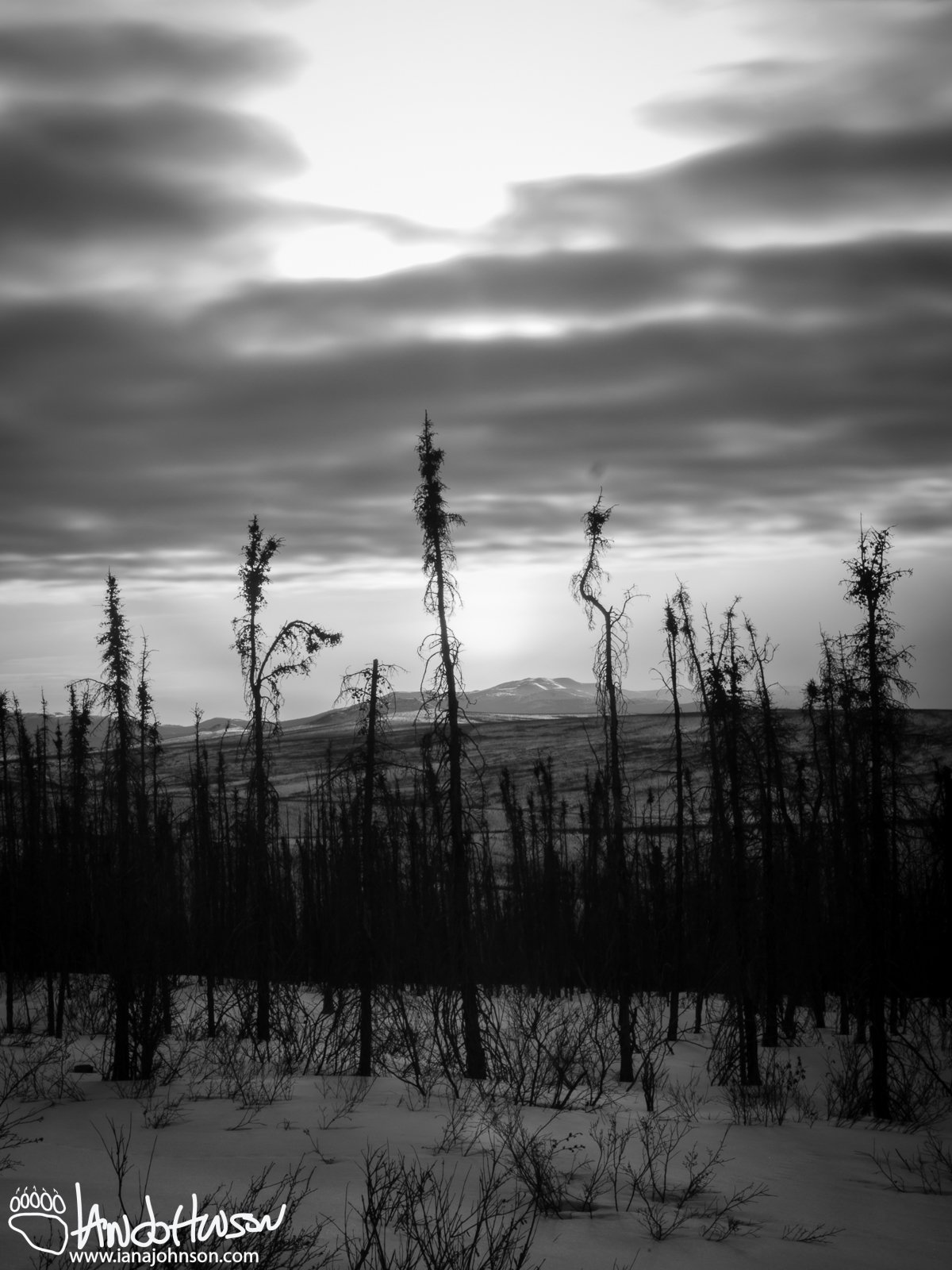
Now onto the meat of this entry. Yesterday was my first day back in Fairbanks after being away for over 10 days. When I left, the remnants of a huge September snowstorm (17″) still lingered on the ground in low, shaded areas, but for the most part the ground was barren. It is amazing how only 10 days can change that. We now have 16″ of pure powder on the ground which is maintained by cold nights. Yesterday morning when I awoke it was -15F with a promise from forecasters that those temperatures will continue through at least this week. A seasonally late sunrise began at 9:15, and by noon the low light illuminated the tree tops and extenuated the shadows. I nearly skipped with joy into the spruce bog behind my house where snow hung on the trees. I passed under trees that with a touch would have doused me in snow, and found pure joy in the beauty of this winter wonderland.
Later that night the landscape of refracting light and black spruce shadows transitioned to twinkling stars shining through a moonless night. I retraced my steps from only a few hours earlier and watched as the aurora built to the north. I watched for awhile and smiled outwardly at my knowledge of the stark contrast in light from just hours earlier.
The sun highlights the top of a snow-pillow smothering an arched black spruce.The dynamic light of the landscape is what makes it so beautiful. Shadows of the low sun contrast heavily against lighted spires.I really like how the black and white contrast of needles, snow, sky lend themselves to back-and-white photography.The sun erupts through a gap in the trees, but has no heat this time of year.The large snow-load has bent many of the black spruces over. They will rebound in the spring once their burden has been lifted.At night, the aurora lit up the landscape where I watched the the sun play across the tree tops hours earlier.A combination of short and tall black spruces creates a beautiful effect in this winter wonderland.This starspin shot was set up for 2 hours. Focusing on the north star, it is amazing to see how much they shift over that time!
I jumped when my alarm went off at 11:30 PM, and I looked at my surroundings to remind myself where I was. The sleeping bag wrapped around me and my reclined seat reinforced I was in my truck as my blurry eyes brought the steering wheel in focus. My memories flooded back to me; I arrived 30 minutes ago, and with no aurora in sight had set an alarm and took a nap. I was expectant that a G2 storm forecast was going to pay out, and as I peered out of trucks window it seemed I was in luck. The aurora was starting to show a band high in the sky. I turned the ignition, and drove down the road to find the “perfect”, golden tree – my goal for the night was to fuse autumn colors and the aurora together.
I stood on the road with my head craned up, watching a beautiful, green aurora band overhead. This aurora was Mr. Jekyll which soon morphed into Mr. Hyde – albeit a beautiful version of him. I was not ready for the full force of the aurora as it transformed the sky into a green and pink blanket of shimmering, dancing lights so different than what I had been looking at minutes earlier. The energy that rolled overhead, I learned later, was the result of a monstrous, KP7 event, that pushed the aurora into Washington and the Midwest. I was so overwhelmed by the aurora that I expressed myself by simultaneously singing, praying, and taking pictures by myself under the vast display of lights. For those who know me, you might guess that I was also grinning broadly from ear-to-ear. My smile would not have disappointed you!
For parts of the night, my only focus was to capture the overhead aurora corona to the best of my ability. The last time I successfully captured the corona was in Denali National Park last year. I couldn’t be more happy to show you this gallery of images from last night – there were many more taken! The gallery is chronological, and hopefully gives a sense of the scale of the aurora and how quickly it built. These images are taken at 9mm, and hence have a ~120 degree field of view!
This road points E/W and the fact that the aurora started on the left (south) side of the road indicated a huge amount of energy coming in!
This image was captured with my camera pointed directly to the south. Intense greens that reach far into the sky.
Autumn colors in the front of a striking green aurora
Autumn colors in the front of a striking green aurora
A panorama capturing this vibrant band of aurora stretching across the southern sky.
A towering green aurora.
Multiple bands of aurora swirl together.
This image was taken due south and towers high into the sky.
Aurora coronas occur during high energy. A focal point forms in the aurora and its the only thing you want to watch – it is impossible to tear your eyes from it!
This image is 120 degrees wide. Hopefully that can give some perspective to the proportion of the aurora in the sky!
The corona of the aurora broadened and began to show vibrant pinks.
This insane push of energy came from the north and quickly grew.
The aurora is punctuated by a intense white band.
Like two circus performers, this these bands of aurora are folded together like they are dancing with each other.
Swirling greens of aurora during a incomprehensibly large push of energy.
The aurora opens up in a broad sickle that I think looks like an ear.
This particular auroral formation takes one last swirl before dissipating.
By 1 AM the aurora was still broad across the sky, but became less structured. Brilliant pulses of light races across the sky in waves rather than bands.
The trees in this image have been “light painted” so they show up and fuse together autumn with the aurora.
Mission success! Capturing this full-sky aurora over some beautiful autumn foliage.
During my trip home to Minnesota I have taken what I have learned about aurora watching in Alaska, and transferred it to conditions in the midwest. In doing so, I traded watching the aurora over snow drifts to squinting my eyes over bean fields with moderate success! A big push of energy from the sun has elevated geomagnetic energy to KP 6 or a G2-“Geomagnetic storm level 2”, which boosts the aurora to Minnesota, and even beyond. The two nights I chased the aurora brought success in both capturing the aurora in central Minnesota, and for playing with some new techniques which I will be honing in the upcoming year and are featured below. I would love to hear your feedback!
This timelapse below is fairly short and does not have a brilliant aurora, but does give a great idea of where to look for the aurora in Central Minnesota. During this G2 storm. In Alaska the aurora during a G2 storm would be far overhead and taking up the whole sky. In Minnesota it rose slightly above the horizon. Viewing would have been better if the smoke haze and moonlight could have been removed.
The first night that I chased the aurora, a strong wing was rapidly pushing the clouds past this moon, which was fortunately setting. I really like the wind in the trees of this particular shot, as well as the long shadow cast by the moon.This star spin shot captures a 1.5 hours timelapse of star movement in the sky. Fortunately I captured the faint glow of aurora on low on the horizon, and directly below the pivotal star – the North Star.
One of the techniques I am very interested in growing is the ability to capture full panoramas of the milky way. The progression of images below shows a little bit on how that works. I learned a lot in this first attempt. A few key findings : 1) find the darkest skies possible! The light pollution shows here. 2) need to have more overlap in the shots 3 ) I tried to capture the whole galaxy in one sweep of the camera. I now know I can stitch multiple rows of shots to capture a larger area 4) keep the ISO of the camera low-ish to reduce noise. For those reading this with experience in capturing the Milky Way, please contact me, it would be great to pick your brain!
This image does a nice job of capturing a single image of the Milky Way. However, I would like to find darker skies. By taking multiple shots with the camera on the same plane, I can stick them together into the results below.Here is one of the things I am struggling with in capturing a full panorama of the Milky Way. This image has a gorgeous amount of contrast, however, after stitching, I did not have enough horizon to create an image that can be cropped well. I would love to get feedback on the best way to straighten and correct these images.This image is the best example I have of stitching the Milky Way, but is far from the entire arch. I do really like the bit of aurora that shows up here. Hopefully I can apply what I learned in my next attempt!This image of the aurora was taken in Rice, Minnesota during a G2 auroral storm. If it weren’t for the moon and the haze it would have been a much nicer show!
I have done a lot to curate my aurora gallery on Fine Art America. I would love if you checked it out!
There is nothing more beautiful than a wildflower, but what about them makes them so beautiful? Surely the details in them are often astounding. Long stamens, unique petals, or colorful flowers may dazzle the eyes. Alternatively, the beauty of a wildflower may be linked to its overall surrounding. We often find them perched in rocky crags, in front of mountain vistas, at the edge of our favorite pond, or along our favorite hiking trail. Each wildflower represents a detailed, wild beauty, and that beauty grows as you consider the ecosystem and ecology that surround them.
Wildflowers excel at telling us the progression of summer. In Alaska, one of the first wildflowers of spring, pasque flowers, spring up in large purple and yellow blossoms welcoming the queen bumble bees which have just woken up from a long winter. Similarly, the early blooms of purple mountain saxifrage provide a critical nectar resource for queen bees. However, the timing, or phenology, of wildflowers in Alaska is changing with a warming climate. Changing flower timing can effect insects populations, and in turn birds by growing at different times than they have for milleniums. An example that we (I believe) have all noticed is a quickly melting snowpack. As snowpack melts earlier it has repercussions on when a flower starts to grow and bloom by moving it earlier, and buds may freeze in the still cold temperatures (Inouye 2008). This changes the plant’s fitness and also the flowers available to pollinators. Although the genes of plants may have enough flexibility accommodate some of the effects of climate change, they may need to evolve to ultimately survive (Anderson, Jill T., et al. 2012).
This summer I’ve turned my lens to all of the wildflower blooms I can. I am actually pretty astounded by the number of species I have photographed and learned! When photographing them I both put them in their surroundings, and captured the fine details of their beauty. Some of these images are availble for purchase through my Fine Art America gallery. I hope you enjoy this extensive collection of the colorful seasons of Alaska! Photos are featured in the month that I captured them, rather than when they first start blooming.
June
Fireweed (Chamerion angustifolium), Chatanika River, Fairbanks, Alaska
Fragrant Bedstraw (Galium triflorum), Chatanika River, Alaska
Purple Aster (Aster spp), Chatanika River, Alaska
Arctic Bell Heather (Cassiope tetragona), Galbraith Lake, Alaska
Pink Plumes (Bistorta plumosa), Galbraith Lake, Alaska
Pink Plumes (Bistorta plumosa), Galbraith Lake, Alaska
Whorled Lousewort (Pedicularis verticillata), Galbraith Lake, Alaska
Capitate Valerian (Valeriana capitata), Galbraith Lake, Alaska
Common Name Unknown ( Micranthes hieraciifolia), Galbraith Lake, Alaska
Common Name Unknown ( Micranthes hieraciifolia), Galbraith Lake, Alaska
Lousewort (pedicularis spp), Solistice, Galbraith Lake, Alaska
Arctic Poppy/Alaska Poppy (Papaver gorodkovii), Galbraith Lake, North Slope, Alaska
Cuckoo Flower (Cardamine pratensis), Galbraith Lake, North Slope, Alaska
Dwarf Arctic Butterweed (Packera cymbalaria), Galbraith Lake, Alaska
If you’ve made it this far then I want to let you know that these images are available in a single page as well with some images that are not featured in this post:
Inouye, David W. “Effects of climate change on phenology, frost damage, and floral abundance of montane wildflowers.” Ecology 89.2 (2008): 353-362.
Anderson, Jill T., et al. “Phenotypic plasticity and adaptive evolution contribute to advancing flowering phenology in response to climate change.” Proceedings of the Royal Society of London B: Biological Sciences 279.1743 (2012): 3843-3852.
The 18+ foot tides of Homer Alaska define life on the seashore. Its consistency and rhythm are the drumbeat of the ocean. During the summer each day, salmon return to the “Fishing Hole” with the incoming and outgoing tide chasing schools of baitfish, only to be chased by fisherman. Shorebirds feed at the tideline and in the exposed rocks which contain many insects and invertebrates in the crevices. Tide pools contained trapped wonders to because observed with curiosity, and which have evolved to survive the temporarily dry conditions. They often closing up, or shrinking under the sand to conserve water. My time in Homer, Alaska was focused around the seashore, fishing, beach combing, birding, and peering into tide pools. These pictures and experiences are both through my lens, and Kassie’s too.
Tide Pools
Peer into a tidepool, and what shall you see? Small creatures, shells, or an anemone.
As the tide goes out, large boulders hold water and sea creatures – tide pool!
The tentacles of a green anenome reach for the surface in a a tide pool.
This large, lone, mussel displays one of its unique characterists. The strong, hair fibers of its holdfast which secure it to a a rock.
Within a tidepool I watched this tiny hermit crab discover, and then attempt to pry loose this limpet for dinner. For scale, this tiny limpet is half the size of a dime, and the crab even smaller.
This particular anenome in the tide pool was very striking. Wedged between two rocks, I was able to capture it through the surface of the water!
(1) The sand flats in between the rocks may holder larger treasures….
(2)… like this starfish! This large star fish was 10 – 12 inches across. We moved it to a wetter, and safer tide pool.
This image of a dead clam among the rocks, and surrounded in seaweed seemed to imbibe the whole concept of tidal change to me.
The tideline in Homer is far, far above the ocean level. By nature’s laws, the ocean and the hill have reach an agreement on who’s domain is who’s.
Birding
As we walked along the beach a northwestern crow began to dig a hole along the surf line. To our astonishment it jerked out a thin, silvery, and wriggling Sandlance from the bottom of the hole. Hopping forward a bit further the crow did it again, and again. Other crows were doing the same thing, and were apparently highly efficient hunters. I relayed this video (below) to a birding group, and was informed this hunting behavior may be specific to Homer crows. Have a watch, and let me know your guesses on how they locate the eels. I have not a clue!
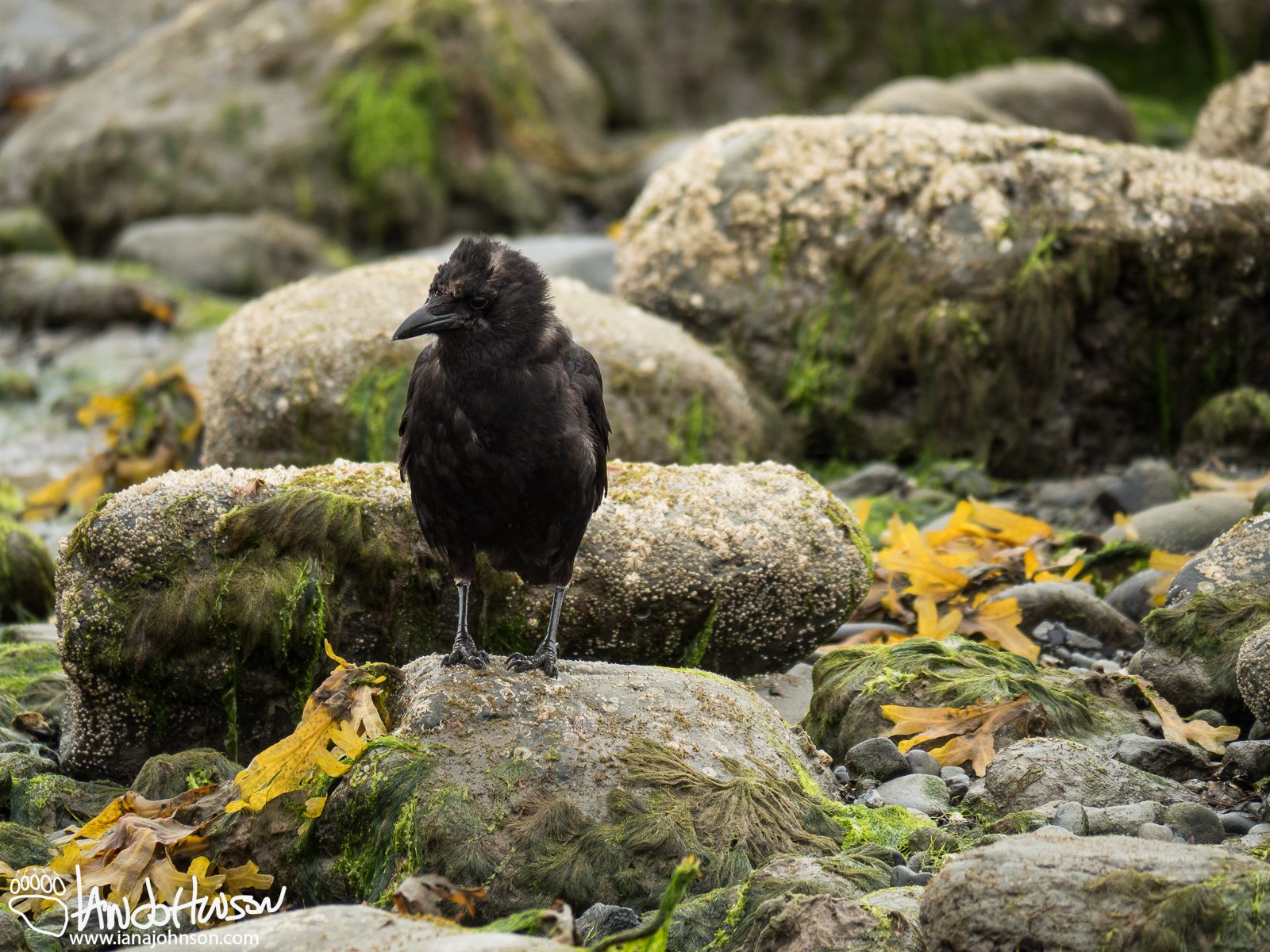
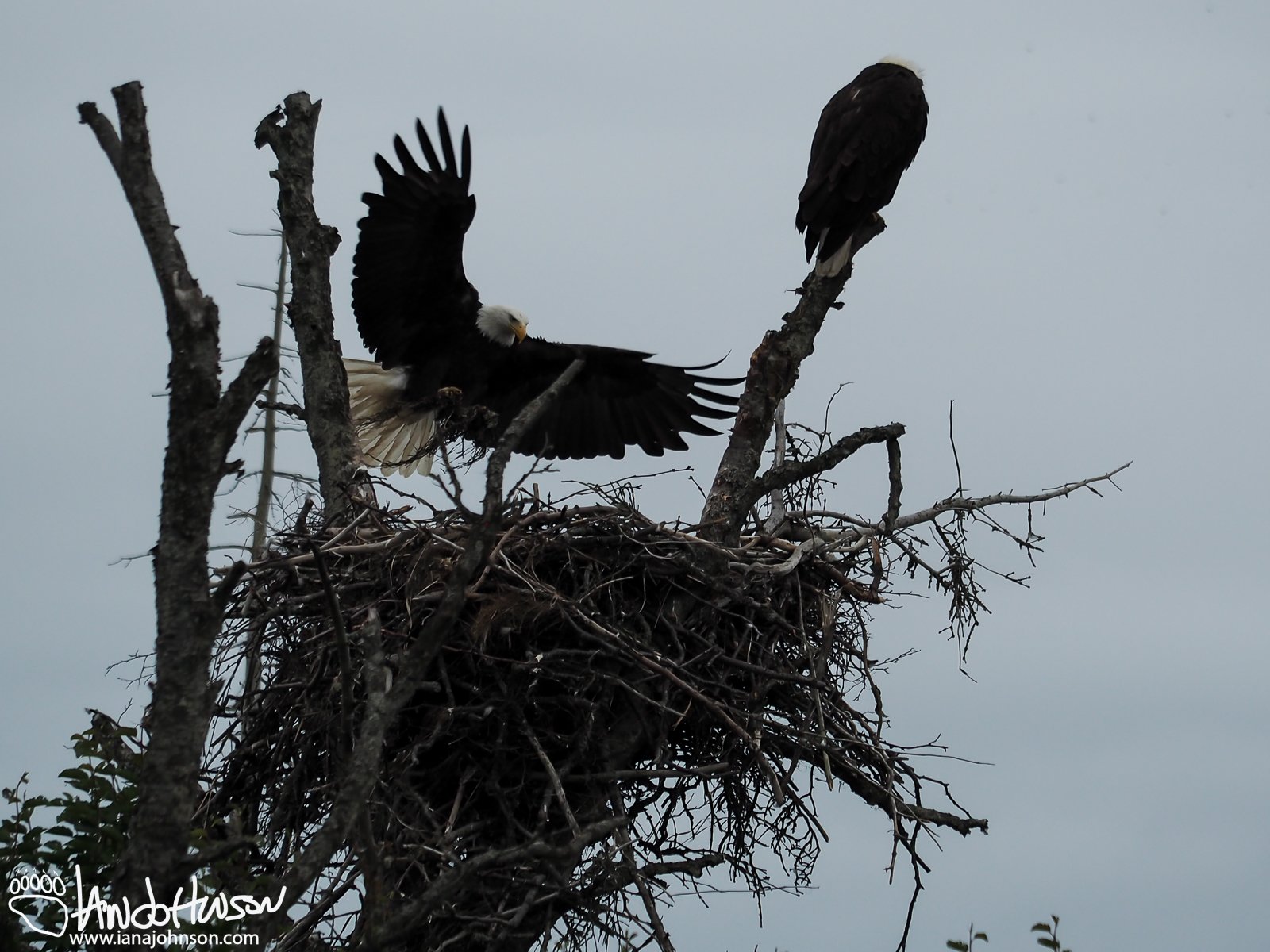
A disheveled northwestern crow pecks among the rocks looking for leftovers in the tides. He stopped long enough to shoot me an eye.A black turnstone moves through the rocks in a shallow tidepool. These birds, along with many others, are sought during the Kachemak Bay Shorbird Festival each year, when tens of thousands of shorebirds stop through the food-rich shores of the Kachemak Bay.A lone black-legged kittiwake stands on the beach, with just a shade of the mountains of Homer visible in the background.Nesting eagles are a common sight in Homer. This particular pair nests near the outskirts of Homer, and were constantly bringing fish back to its eaglets.As this eagle lands at its nest, the talons are particularly dangerous looking!
Homer in Its Place
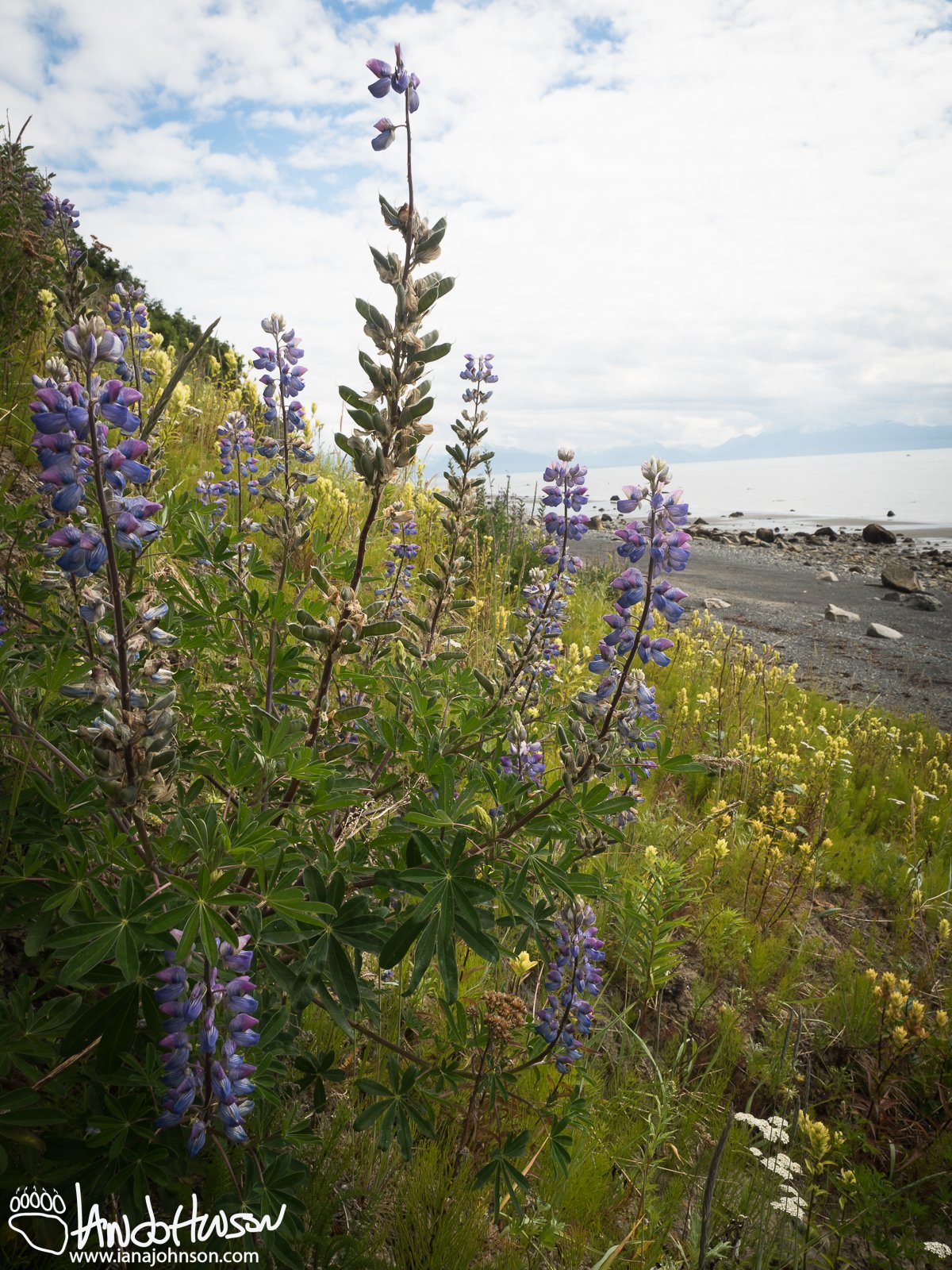
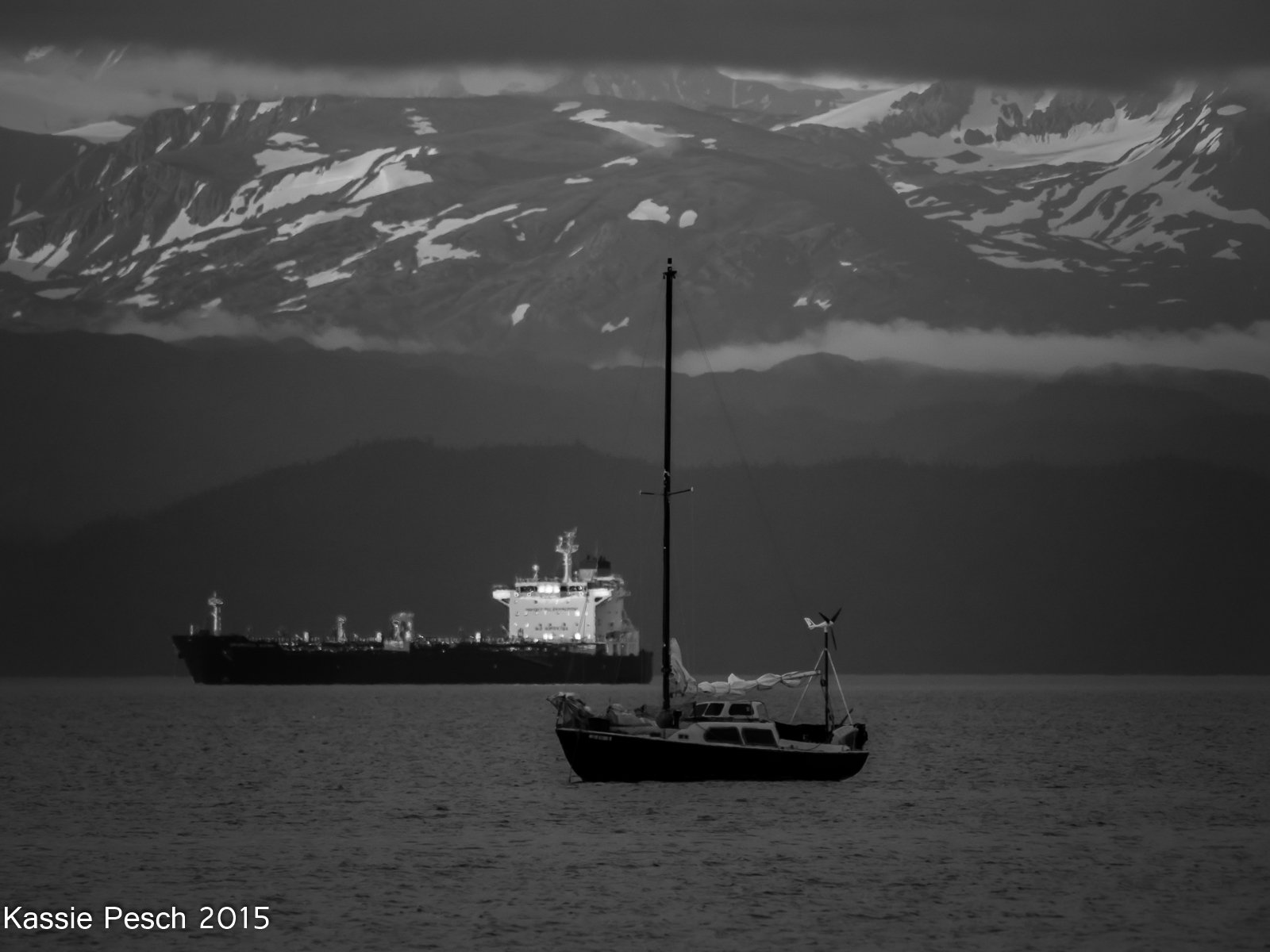
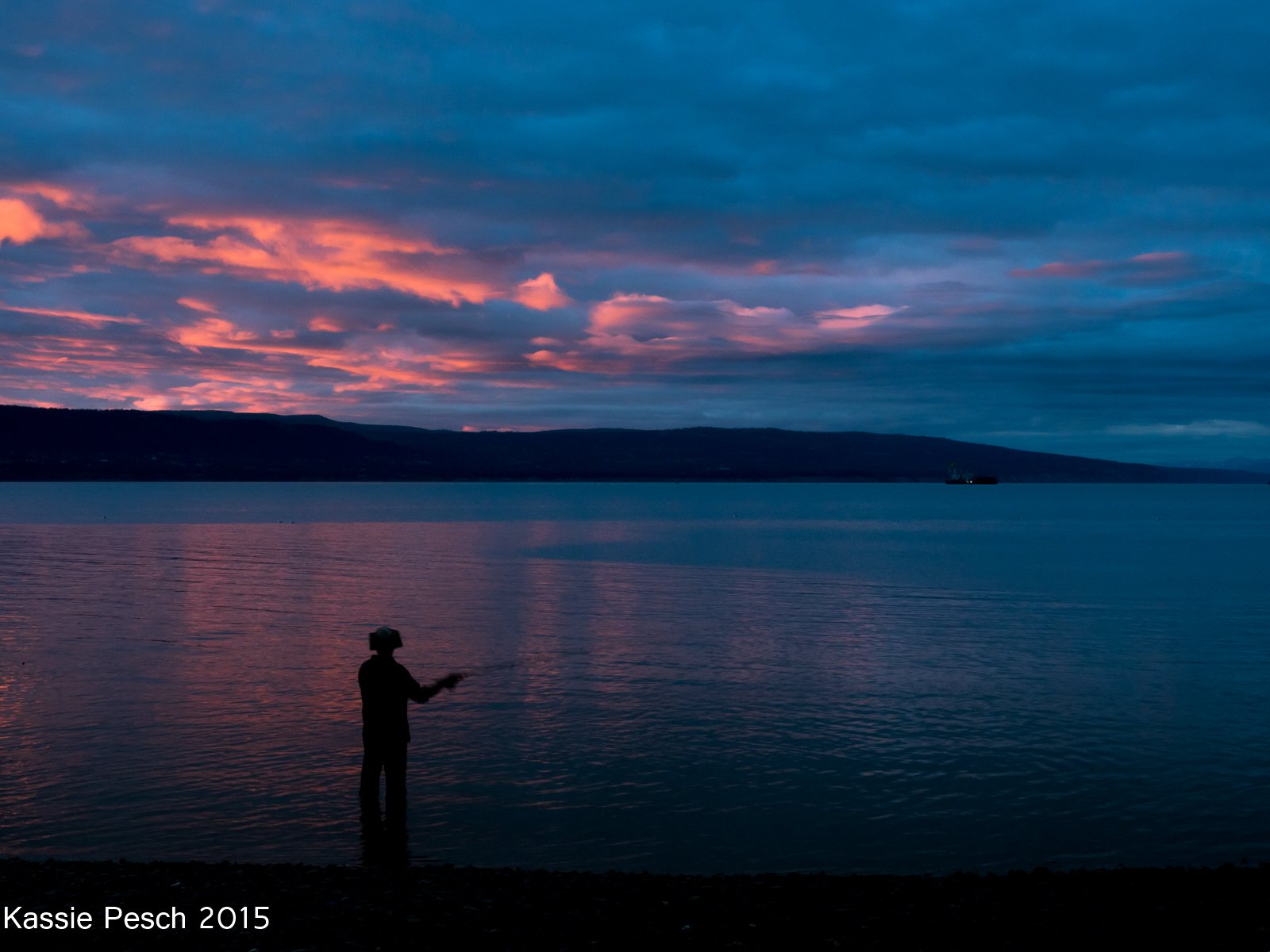
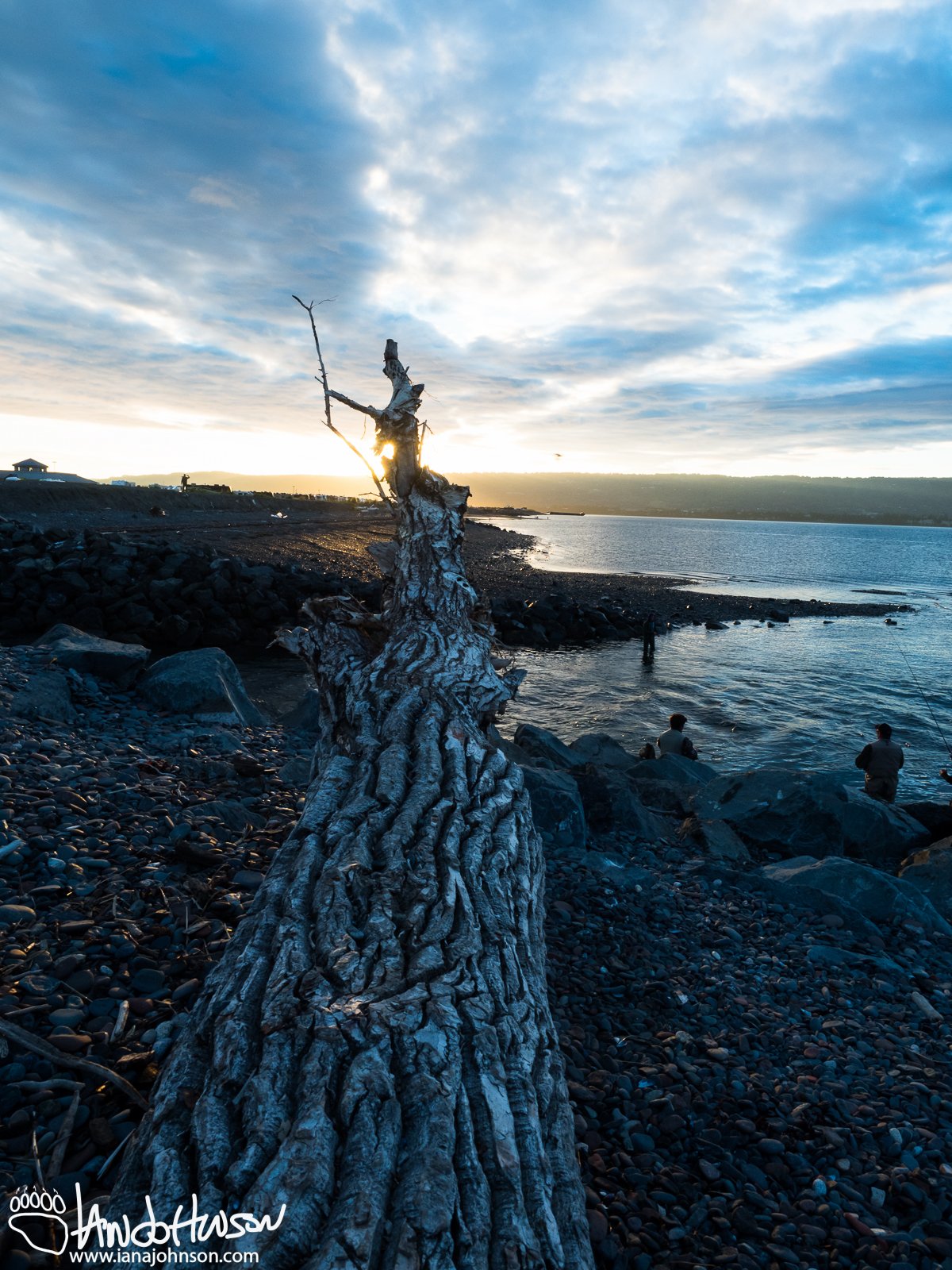
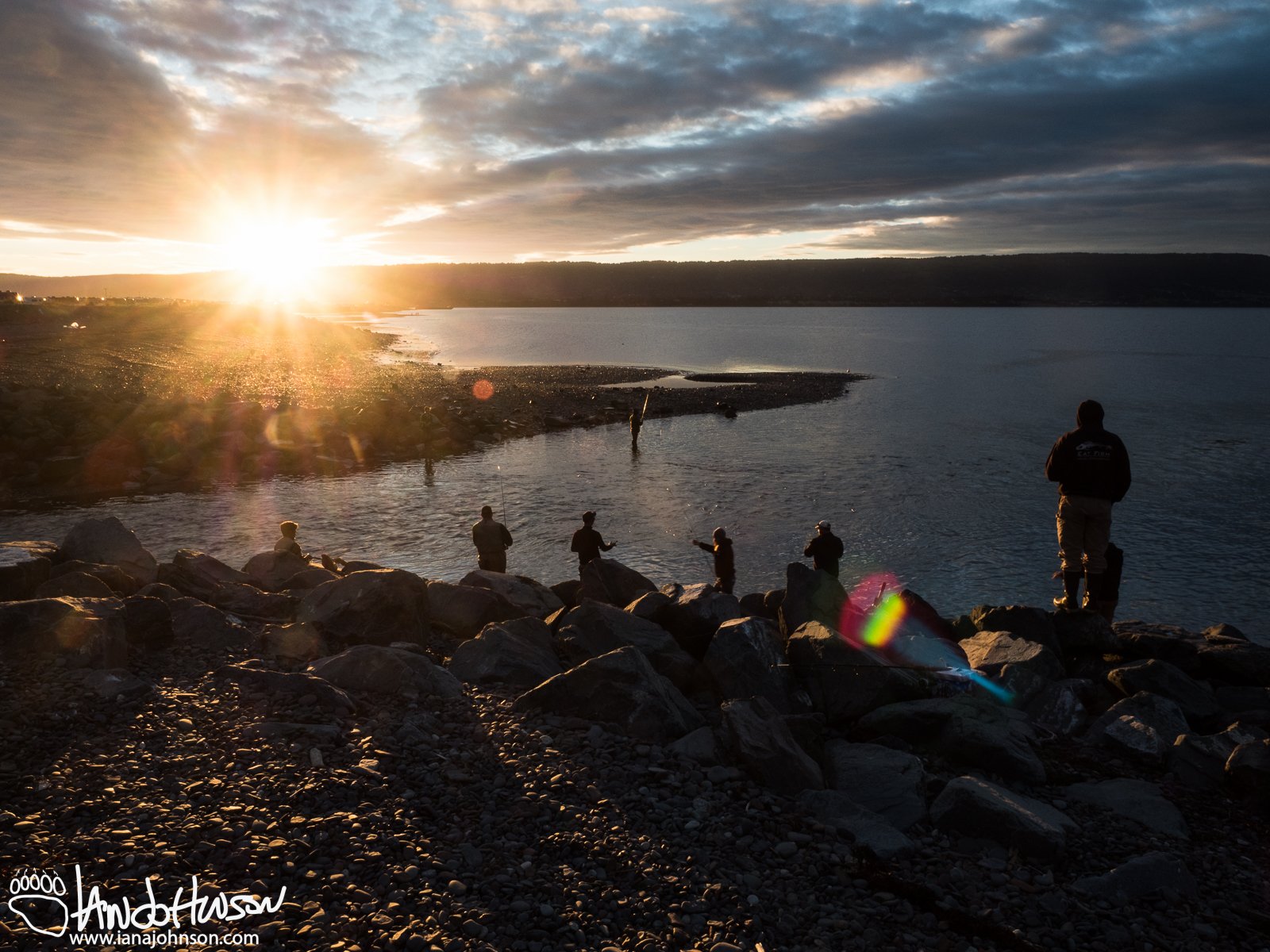
Lupines and yellow paintbrush jut out from the hillside along the beach.As we walked up the Diamond Creek trail, we passed under a large canopy of cow parsnip flowers. I was struck by their contrast against the sky.Shipping traffic is a common sight throughout Kachemak Bay. As I fished, Kassie capture this great image that puts the grandeur of the mountains in perspective.A subtle shift in that same scene, and the sailboat now dominates the foreground.I fished for salmon at the fishing hole in the lingering sunset. With a fly rod as my weapon of choice I only wrangled one “dollie”, a dolly varden.A large trunk blots out a beautiful sunset near the fishing hole.As the tide becomes more ideal, the fishermen stack into the Fishing Hole lagoon in Homer. At this place it is possible, if not likely, to catch silvers, sockeye, and king salmon.
You never know what you will see when you leave Seward Harbor, but with blue skies and calm seas our hopes were high for a remarkable trip. Our trip last year on this same boat, and captained by the same crew had been truly memorable!
We reached the open ocean at the edge of Resurrection Bay about 20 miles outside of Seward harbor, and immediately recognized based on an enormous flock of gulls and sea-birds that something special was happening in front of us. Of course, the many tails of humpback whales emerging from the water was a good tip too! As we carefully approached the scene the captain explained that we were observing “bubble-net feeding” of a large group (~18) humpback whales. This behavior has only been recorded consistently around Seward for about five years, as apparently many of the whales had taught it to each other. Observing from the water surface, it is hard to imagine the underwater pandemonium of bubble-net feeding. In the deep waters under a large school of bait fish all 18 whales were blowing bubbles in synchrony to herd the bait ball into one group. Once corralled, all of the whales ascended to the surface with their huge mouths agape to scoop up as many fish as possible. From the surface we were able to predict the timing and location of each emergence, because the flock of hundreds of seabirds would lift up high into the sky, before diving on the susceptible fish just before the whales broke the surface!
Our boat drifted silently with the engines turned off, and as the whales came up for the fifth time under the baitfish the flock of tell-tale gulls began to fly straight towards our boat! It was going to be a close encounter!! Sure enough, enormous mouths attached to up to 80,000 pounds and 80 feet of whale broke through the surface near the boat in a show that left me shaking. Not from fear, but rather sheer awe-struck wonder. I simultaneously snapped imagery of the incredible scene and watched each wonder unfold. I was too busy taking imagery to record video of the whales breaking the surface, but have chained together a series of images in the video below that demonstrate the behavior of bubble-net feeding. Be sure to listen to the incredible sounds they make while on the surface!
I was fortunate enough to have my camera point in the same spot, and set up for a quick burst of shots. It allow me to catch the graceful ark of this full breach! It is likely that this humpback whale was celebrating a successful day of feeding and hunting.
Mammals
The humpback whales were just the start of a remarkable series of wildlife sightings. A first of my life was the killer whales. A large pod of them traveled along and breached frequently for air exposing their fin and distinct white eyepatch. The dominant male of the group was evident thanks to an especially large dorsal fin. Baby orcas surfaced directly behind their mothers as they were still dependent them for protection, and to learn from. We spotted many sea otters throughout Ressurection Bay and along the coast. The story of their recovery is remarkable. Sea otters were extirpated from much of their traditional range by exploiting Russian and American hunters. Their loss led to the collapse of kelp beds as urchins populations, a diet item of the sea otter, expanded and ate of the kelp hold fasts (their roots). Once protected by federal law, the recolonization of sea otters helped reestablish the kelp communities and repair a crucial underwater ecosystem for small fish, and many invertebrates.
This sea otter was found cracking a clam in the Seward Harbor before we departed.
Sea otters are iconic creatures of the Resurrection Bay.
The enormous mouth of a mature humpback whale opens as it breaches the surface.
A humpback whale finishes it ascent through the baitfish school by breaking the surface, mouth agape. The gulls all around were waiting for the scrambled fish.
This humpback whale showed off a spurt of energy in a triumphant jump into the air. A full breach!
We were not the only boat watching the feeding frenzy. This image puts into perspective the size of the fluke!
As we moved further out of Resurrection Bay we encountered a pod of Killer Whales! The dominant male was demarcated by a large fin and led the pod.
The progress of the killer whales was quick, and water splashed from their fins as they breached for air.
Near northwestern glacier harbor seals use icebergs as resting haul-outs and to raise pups.
A large group of harbor seals shares a flow of ice.
A large flow of ice holds several harbor seals and is set against the foggy islands of the distant Chiswell Islands.
During the day we found several groups of stellar sealions – the groups of composed of one dominant male and the much smaller females. These two females rested on a rock ledge shrouded in fog.
Birds
The Chiswell Islands provide important breeding habitat and refugia for many sea birds. Puffins, murres, kittiwakes, and dozens of other species are found throughout their rocky crags where they escape predation risk. Many of the species that nest in the rocky crags of the cliffs are classified as “pelagic birds”. These birds only come to shore to breed, and spend the rest of their life at sea. It is remarkable to me that little of their ocean life is understood, although it is clearly an important part of their life history and hence conservation. One incredible fact from the trip’s crew : common murres may dive up 600 feet in search of food! The images below are just a small cross-section of the birds were observed along the way.
Tufted Puffins are a distinct and charismatic bird. Their large eyebrows stretch over their head in a very peculiar way!
Although a bit slow with the shutter speed, I like the image of this flying tufted puffin because it highlights their beautiful beak and face.
This image of a tufted puffin was taken the day before at the aviary of the Alaska Sea Life Center- A remarkable bird!
This group of parakeet auklets was a treat. They are aptly name – their chatter sounds very much like parakeets!
On the sheer rock faces we were lucky to be shown these thick-billed murres. A lifer for the trip!
In contrast to the thick-billed murres, these common murres do not have a white line behind their bill.
Named for the distinct feather that reached above their eye, a horned puffin takes flight near the Chiswell Islands.
This image of a horned puffin taken the previous day at the Alaska Sealife Center demonstrates its namesake beautifully! The horned extension above the eye is striking!
Scenery
The bluebird skies of the day blessed us for the nearly the entire trip. However, as we moved away from Northwestern Glacier, a thick bank of fog moved in from the ocean. The damp air made the day cooler, and provided a mystical backdrop to the Chiswell Islands which poked in and out of the fog like chandeliers in a smokey bar. The islands created a partial barrier to the fog which flowed through the lowest points of the islands like a sinewy serpent. Subsequently, the fog established the base of some of my favorite scenery images throughout the day, and featured below.
As we pulled out of Seward harbor the bluebird skies were stunning!
This panoramic shot really captures the setting of the Chiswell Islands. Characteristic of the islands, bright green tops and trees were seperated from the water by a gray band of rock.
Our boat the “Viewfinder” moved past the mainland with the Northwestern Glacier Behind us.
We threw a big wake as the Viewpoint moved to a new location.
As we rounded Granite Island and moved towards to the Northwestern Glacier I captured this panorama across our bow. Brilliant blue skies!
Cataract falls spilled down this large headwater and was fed by a snow/glacial field above.
As we moved back onto the open ocean, heavy fog rolled in from the ocean. Although this island blocked much of the fog, it still spilled through the lowest point of the island like a living creature.
The vertical cliff faces of the Chiswell Islands are often near to each other creating small pasages. I was struck by the lone tree to the upper right of this one, and the fog that lit the scene. I was fortunate to click the shutter as a gull took off far above.
Many of the Chiswell Islands have broad rock arches like the one displayed here.
Several groups of harbor seals float in front of the face of this tidewater glacier near the Northwestern Glacier.
The Northewestern Glacier spill from the Harding Ice Field into the ocean. The “calving” of this glacier, and others in the bay provide the icebergs for the harbor seals.
As whales-of-a-tales go, I’ve stuck to the facts of the day, although so much of was above average that even I feel that it’s a tale of whoppers. It was the type of trip that every subsequent trip to the ocean will be relative to. Perhaps I will tie it someday, but it would take a Moby Dick sized whale of a day to beat it!
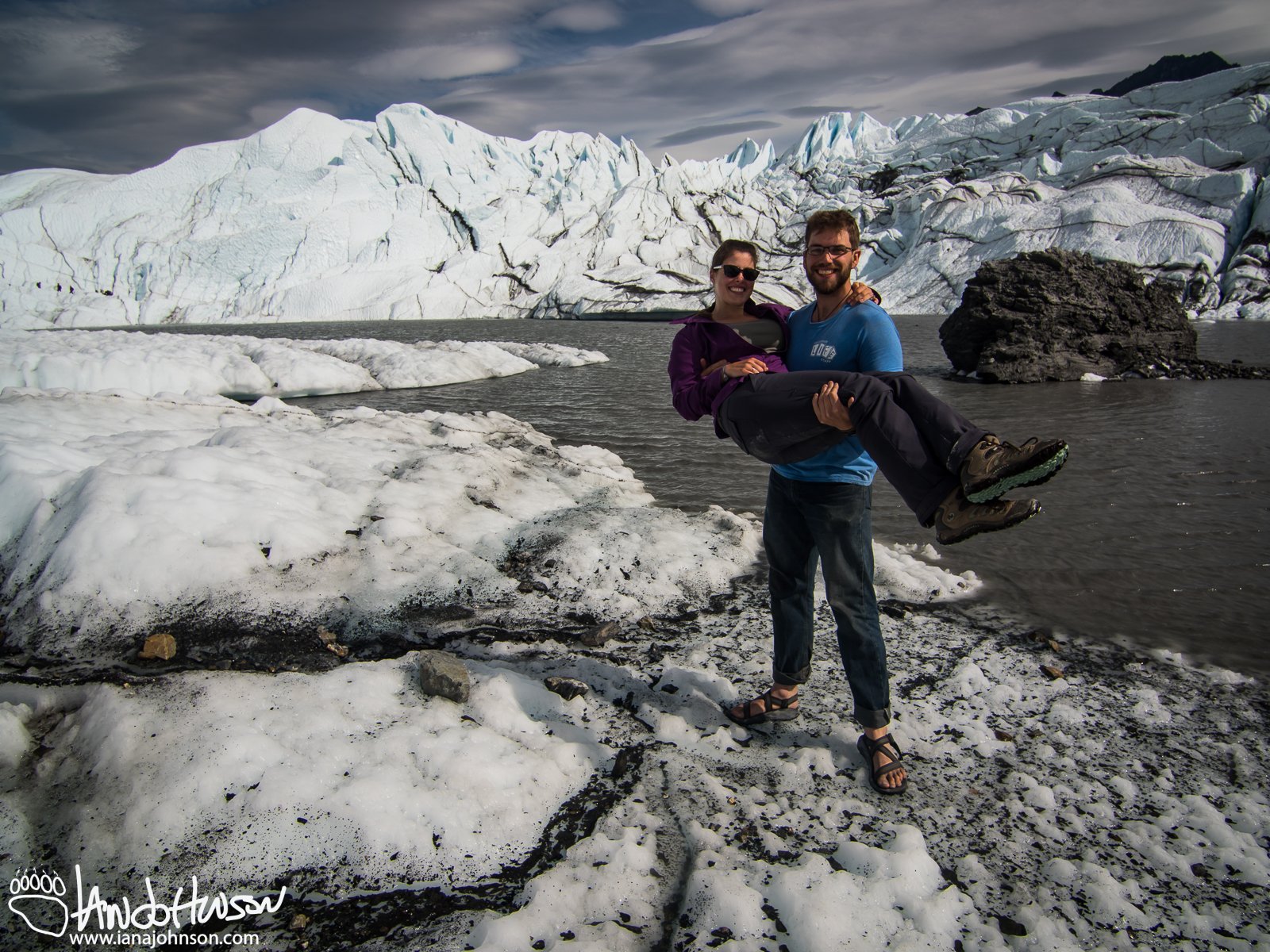
I arrived back at the car from after a couple of hours hiking around on Matanuska Glacier, and my clothes were still wet. Although the day on the glacier had been beauty-filled and grand, I had learned a steep lesson on glacier safety.
We reached Matanuska Glacier just as the sun was starting to come out again. During the drive up the Matanuska Valley the sun illuminated the mountains that rose high on each side, and the Matanuska river lay below us along the curvy, Glenn Highway. As we stood in the parking lot we could see a 4 mile-wide swath of ice at the front of the glacier called the terminal moraine. From there the glacier stretched back over 26 miles into the mountains! We walked down the safest path of firm glacial silt and ice, which was marked by orange cones. In a few more minutes we stepped onto the full glacier.
Hindsight is always 20/20, which is why I now realize that stepping away from the orange cones which marked the “safe trail” was more risky than I previously thought. In a quest for images I moved through the ice hills of the glacier looking for pools of water to shoot reflection shots from. I walked through ankle deep, sticky mud towards higher ground where the glacier had deposited a gravel pile. From there I stepped to the edge of some flowing water, stuck out my toe to test the depth of the water, and immediately slipped off the ice edge and into the water. I never hit bottom!! The flowing water had cut a deep, deep pool which I now found myself in up to my shoulders. During the fall I was fortunate to have turned myself around quickly, so I put my elbows up on the edge of the glacier and pulled myself back out. In the fall my camera and tripod fell into a pile of glacial silt, and fortunately not into water with me. The incident lasted only a few seconds before I was back on solid ground and moving quickly away from that deep pool. I stripped off my wet shirt for warmth, used it to begin cleaning my camera, and shook a bit as the adrenaline set in.
What is particularly annoying (to me) and perturbing about the situation, is that I was not doing any unnecessarily risky. In fact, when I slipped in I was testing the water before stepping in. So, I’m now asking you to learn from me – test unknown and murky pools with a long stick, rather than a short toe!
Aside from a scrape with death, our day at Matanuska Glacier was remarkable. The gallery and images below details the gigantic ice face as well as the tiny details of the glacier.
Striations in this piece of ice caught Kassie’s eye, and the lighting sealed the deal. I love this image of a glacial ice cube.The face of the glacier was carved in interesting ways. This up-close shot looks at the melting ice on its surface.These large rocks melted rapidly, providing a brilliant blue window into the glacier.This panoramic image looks back at the glacier, and down the headwaters of the Matanuska River.
A small rivulet of water pours into a crevasse.
The glacier till in this picture is created by the glacier as it grinds the river valley down.
The blue ice of the peaks of the Matanuska Glacier lit up as the sun came out.
A valley of ice holds a small pond of water on the Matanuska Glacier.
A semipalmated plover feeds in the glacial till and among the ice cubes of the Matanuska Glacier.The end of a happy day at Matanuska Glacier!
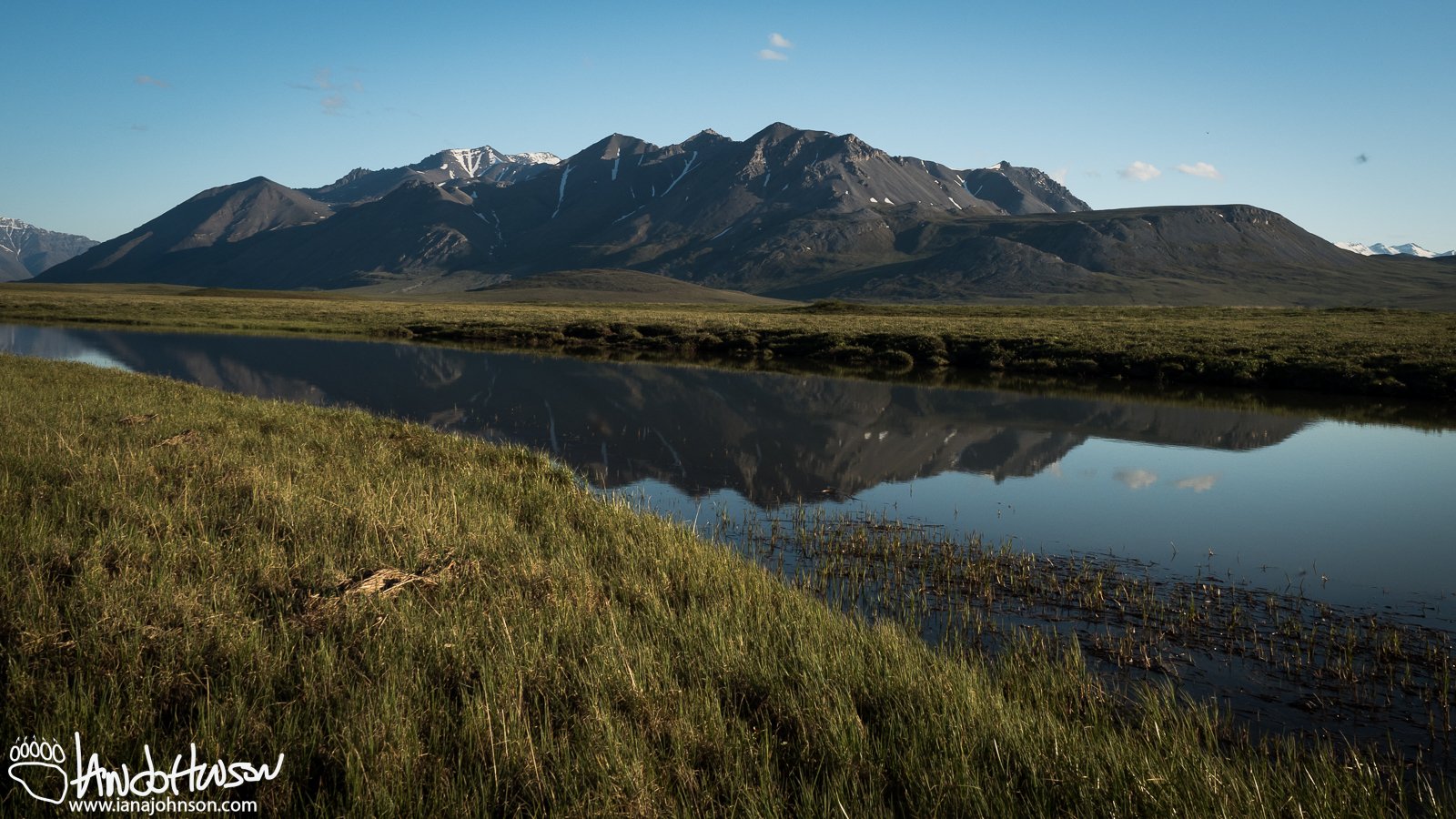
By the time we reached Galbraith Lake, North Slope, Alaska, the low light of the solstice sun to the north was casting shadows on the peaks of the Brooks Range, which finally lay to the south of us after hours of driving. Although rain showers had passed through earlier in the day, the lingering clouds were just cotton in the sky, lit to the orange color of hot coils of a stove. Our trip was planned for three days, and our mantra was to have “nowhere to be, and all day to get there”! We observed, absorbed, and enjoyed the birds, flowers, and beauty of the Tundra during solstice. Due to the many photos from the trip, the results will be broken into two chapters, “Solstice, Solitude, Soliloquy”, and “Birds and Blossoms of the Tundra”. I hope you enjoy this first installment!
During the day we drove the Haul Road to various hiking destinations. A creek bed, a bird sighting, or a nice pull-off were all excuses to hike around and check out a new region. Although the road was busy with traveling semi-trucks and tourists, as soon as you walked away from the road the solitude was immediate. Few others hike around on the tundra at this time of the year, and its vast expanse ensures that even if they do, you do not have to see them unless you choose to. Since creek beds offer a natural hiking corridor through and around ankle twisting tundra humps, tussocks, we used them often. The small, bubbling rivers bottoms flowed through rockfields created by spring melts, and were just a fraction of their size during the melt a few weeks prior. However, flow was higher than normal for the time of year, as a snow storm just 10 days earlier fed them from the mountains. I was drawn to the colors and sizes of rocks on the stream beds, and the mountains behind them which birthed the running waters.
A small mountain stream runs out of the mountains south of Atigun Pass.The Haul Road runs over this stream, and is visible in this shot. Multple stream braids flowed into each other in small rapids.West of Atigun Gorge, this small pond is joined to Galbraith lake and reflected the still snow-covered peaks of the northern Brooks Range.The north edge of the Brooks Range was lit up each night in the low light of the midnight sun. What a scene!
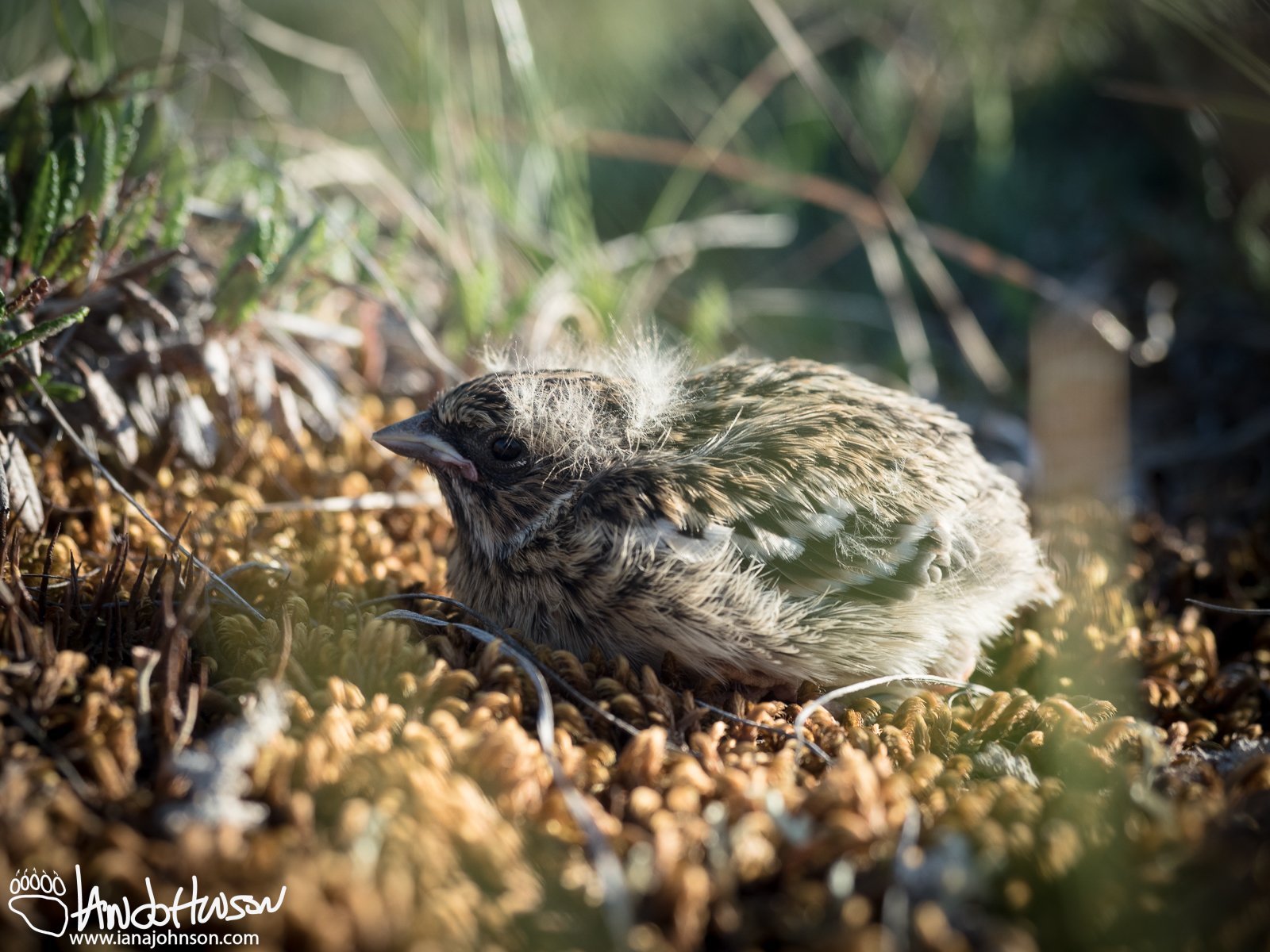
At the end of each day we set up camp on the tundra, targeting soft patches of sphagnum moss for our sleeping pads. The mattress companies of the world should take note of the comfort of the tundra – it is unparalleled in soft-yet-supportive sleep. From our camp we took small hikes to check out the local flora and birds. The hikes always brought something new to see and experience. Near one of our camps we discovered this baby longspur (either a Smith’s or Lapland) on the tundra. It perched on the moss in the warm sun, and was likely waiting for food from its parent. Unable to escape, this baby bird’s instinct was to sit as still as possible. I snapped a few shots, and then stepped away so its parents could rejoin and feed it.
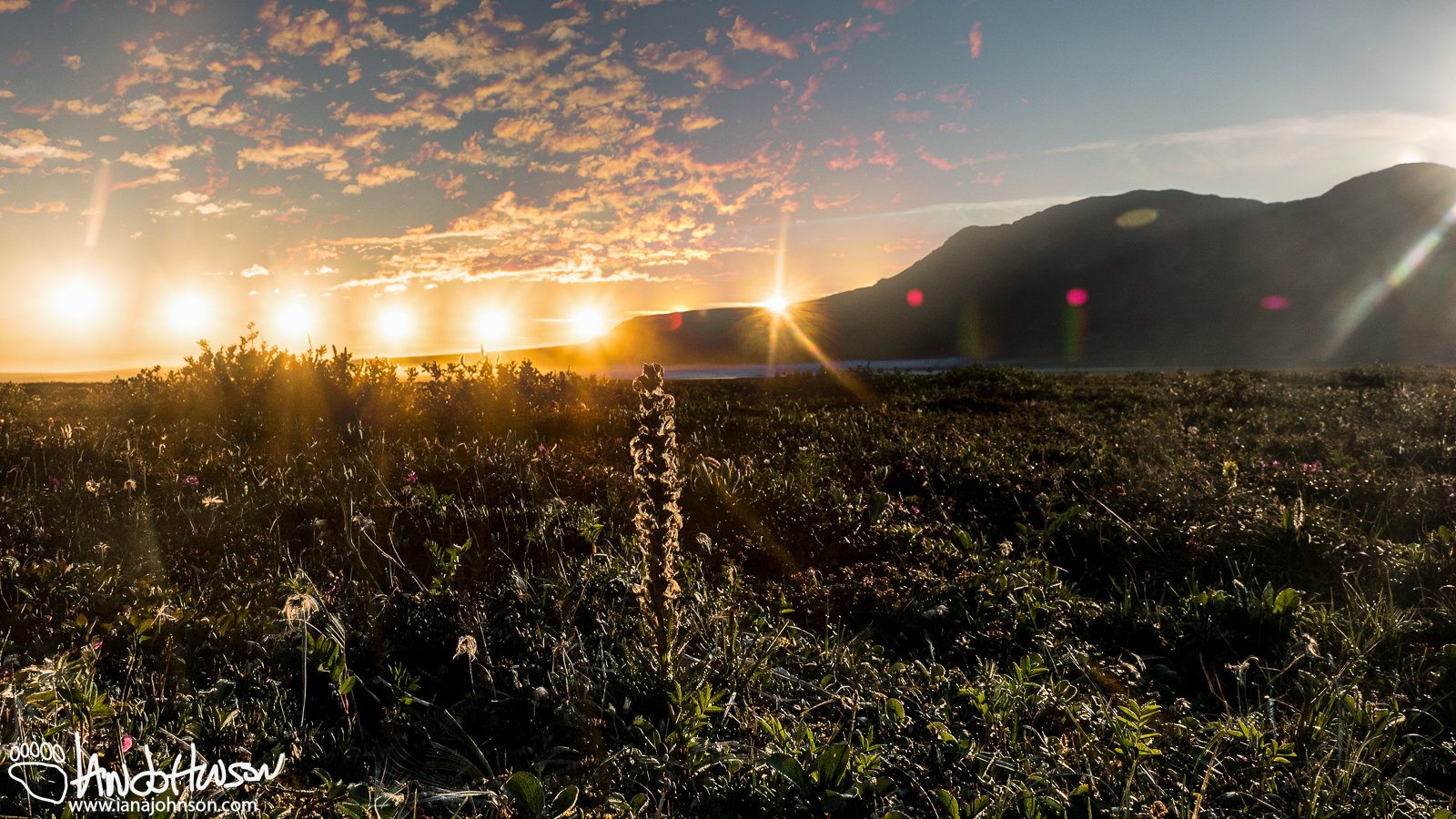
As we walked around each night I looked for settings to put up a solstice timelapse. The advantage of a timelapse over a single shot is to show the traveling path of the sun as it reaches the horizon and then curves back into the sky. Over the Brooks Range, being so far north, the sun stayed far above the horizon – it hadn’t dropped below the horizon there for over a month. This was in stark contrast to shooting at Finger Mountain about 15 miles south of the Arctic Circle where the sun just dipped below the curve of the earth. The resulting shots from each location have been fused together, and shown individually below. The lighting of the composite shots, in particular, I believe is very striking. Since each image is made of 8-10 shots over time, each plant has been lit from many angles. Because of this, extreme detail can be seen in each flower in the tundra foreground.
This solstice shot was shot June 21 – 22nd from Finger Mountain, about 7 miles south of the Arctic Circle. Smoke from the over 200 active wild fires in the state (at the time) came in from the south, staining the sky red.This composite timelapse shot was taken over 4.5 hours. Since this was shot just south of the Arctic Circle, the sun disappears behind the horizon at ~2AM.This solstice shot was taken from Galbraith Lake Campground. In the foreground, an Oeder’s Lousewort stands as a sundial.This composite makes the foreground of the tundra particularly epic. The small mountain avens that would be hid in a single shot really pop out when lit from many angles!
This solstice shot was taken June 20 – 21st, just west of Atigun gorge over camp for the night.
Our trip to the tundra was spectacular, but was not without its setbacks! Clouds of mosquitoes emerged about 10 PM each night, and were thick in the face, eyes, and back of the neck until we went to bed. However, during the night they receeded, and the mornings were quite pleasant again.Kassie, Jess and I at camp with the Brooks Range in the Background.
A trip to the Tundra will bring as much to experience as the eye can behold and the brain can perceive. I’m looking forward to the next chapter of birds and blossoms!
It seemed like a good omen that the clouded skies cleared to bluebird conditions as we pulled into the parking lot of Wickersham Dome. The unexpected blue skies cheered us on as we went about threading our ganglines, clipping on snowhooks, and packing our sleds. Eager and expectant dogs watched our progress, and when we began to hook them up their tug lines, they fed upon each others energy. Leaping, pulling, and baying they waited for me to pull my snowhook and quickrelease. When I did, the sled lurched over the hardpack of the parking lot, banked left onto the main trail, and we were on our way to Crowberry Cabin, 30 miles into White Mountains.
Sled dogs have a plethora of personalities. Jeff (friend and owner of Black Spruce Dog Sledding) let me know that Sooner, one of my dogs in lead only pulled well for “people he liked”, and I was conscious of that trait as we made our first stop. I walked up to the front of the team and gave Sooner a good pat on the head. “Keep it up, bud”, I stated. I’m not sure if my initial approaches made a difference or not, but Sooner and Stoic, the lead along with him, pulled great the entire trip with their heads down, and always with some tension on the tuglines. Behind the leads, Simon, an old veteran pulled well too. As a veteran dog he knew his roll in the team and worked hard. Sniffing the tip of Simon’s tail was Beaver and Scorch. Finally, taking “wheel”, Grizz and George were responsible for pulling hard. George can be a great worker, and out of my entire team he is my favorite. He loves to check out what’s going on, and since his position was closest to the sled, every time I opened the sled bag he craned his neck to get a look inside. Together they were my team of 7, and I was happy to be pulled by them!
Simon : a veteran knows to get some sleep at camp!
Sooner : Taking a quick break on the trail
Stoic and Sooner : Nose to the wind
Beaver : lots of character
Scorch : Those floppy ears!
Grizz : my youngest pup, and a great puller
George : a goofy and fun loving dog
Crowberry cabin sat on a facing to the west, and the peaks of the White Mountains surrounded us. The wooden cabin looked iconic for the Alaskan Wilderness. Throughout the Whites, these public use cabins serve as refuge for those who venture far. Trappers, hunters, mushers, or snow machiners make use of them. The full log construction of this cabin was wonderful, and when once we built a fire and warmed the inside, it was a truly incredible getaway. The four bunkbeds, dinner table, and camps stove, and lantern made it into a 5 star Alaskan Suite. However, admiration of the cabin was actually secondary to the task at hand. I walked along the gangline of the staked out dogs and tossed out beef snacks. We layed down straw for each of the pairs to keep them off the snow, and started heating up water for their main course – kibbles and meat. Building a fire, we enjoyed the sunset and fed the dogs their final meal.
This was Jeff’s dog, and a notorious chewer. To prevent any damage to the gangline or necklines, this dog got his own bed of straw and post at a tree.Our lookout.A moody landscape over the White Mountains.Curved black spruces in the white mountainsCrowberry CabinThe sunset over the white mountains illuminating the edge of the snow-carrying front.
The next morning an inch of powdery snow had fallen over the night. My team was wide awake as I stepped outside for the first time, and George gave me a happy tail wag. I dusted the snow off my sled, packed my gear, harnessed my team and hit the trail. The dogs were just as eager to set out on the trail as the day before. The intermittent, light snow shaded the hills and made our ride home far different. The sprawling vistas of the White Mountains were gone, replaced by a moody gray. The next 4 hours breezed by, and before I knew it the Wickersham Dome parking lot was back under foot, ending an incredible experience and trip!
The opportunity to experience dog sledding for an overnight trip is the fulfillment of a life-long dream. I have literally wanted to drive my own team since reading about fictional characters “Lew and Charlie” in Fur Fish Game, stories by Jack London, or books like Jim Kjelgaard’s “Snow Dog”. Those stories have fueled my imagination and desire to visit open spaces since I was twelve. I have always been drawn to the mystery, adventure, and vastness of remote areas. The White Mountains are just one of the broad wilderness areas of Alaska, and the opportunity to experience it using the low-impact “Alaskan” method was truly a gift!
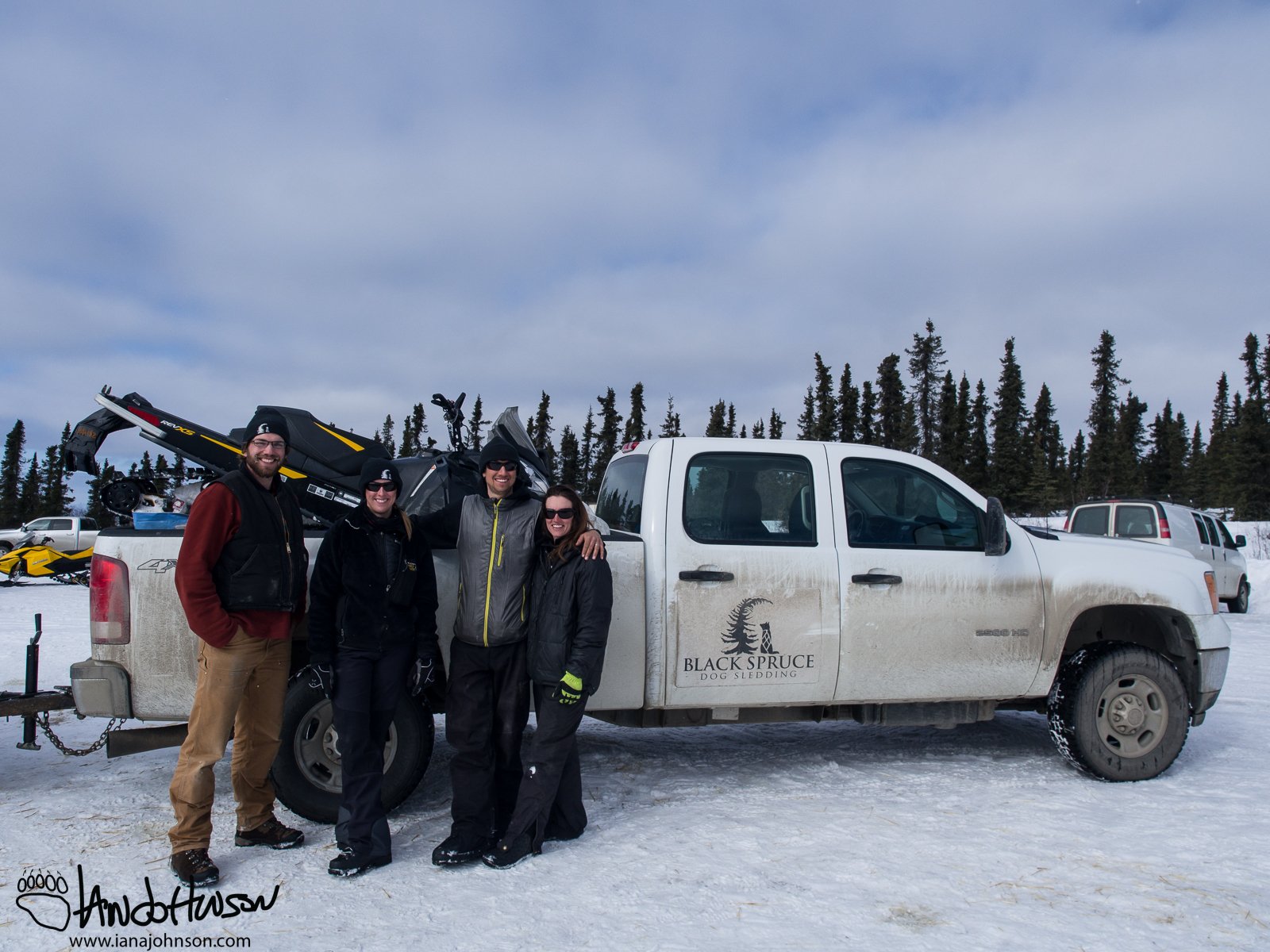
Lindsey’s team was a bit faster than mine, and I captured them here as we headed back home.The crew. Jeff, KattiJo, and Lindsey. A great trip!
Just a few days ago I was writing to that it would be six months until I went chasing the lights again. Little did I know that one of the best nights of the season was still in store! Last nights aurora swelled overhead in vibrant shades of purple and blue. I was there to capture the action as the sunlight filtered out of the horizon at 10:30 and didn’t leave until nearly 2:30AM! The clouds rolled in and out through the night, and are evident in these shots.
Since I thought the Lights were all wrapped up for the summer – I guess they got the last laugh!
180 degree panorama looking to the north.
A huge pillar of aurora shoots into the sky.
The “Aurora Borealis Lane” sign is an infamous Fairbanks sign in the Goldstream Valley. Many aurora pictures have been taken over it – now I guess I have mine!
One of my best aurora shots to date! I love the colors and banding in this shot.